Medical Reform Special Committee Approves First Reform Implementation Plan
Strengthening Compensation in Six Key Areas Including Severe, Emergency, and Maternity Care
Establishment of Four Major Public Policy Fees to Reinforce Essential Medical Services
The health insurance fees for over 3,000 items such as severe and emergency surgeries and anesthesia, which were priced below cost and resulted in losses the more they were performed, will be increased. Compensation for medical services such as emergency care, pediatrics, and childbirth will be strengthened, and health insurance coverage for 24-hour services including emergency treatment and waiting times will also be newly established.
The Presidential Commission on Medical Reform held its 6th meeting on the 30th and deliberated and approved the "First Implementation Plan for Medical Reform," which includes these measures.
 Noh Yeon-hong, Chairman of the Special Committee on Medical Reform, is speaking at the meeting of the Special Committee on Medical Reform held on the 30th at the Government Seoul Office in Jongno-gu, Seoul. Photo by Jo Yong-jun jun21@
Improvement of Fee Structure Imbalance
The commission plans to analyze approximately 9,800 health insurance fees in total and improve the long-standing imbalance in the fee structure. Currently, among claims from general hospitals and above, about 3,000 fees are estimated to be compensated below cost.
The commission decided to raise fees for about 800 severe surgeries mainly performed at tertiary general hospitals and anesthesia fees required for surgeries starting from the second half of this year. More than 500 billion KRW will be invested annually to increase fees for about 1,000 severe surgeries and anesthesia procedures up to the level of general hospitals by the first half of next year.
Raising these fees to cost level means that the overall average fee for surgeries and treatments will increase to about 95% of cost, according to the commission. Additionally, tertiary general hospitals participating in structural transition projects such as reducing general beds will receive further increases in fees for severe surgeries and anesthesia. The commission plans to prepare adjustment measures for fees in undercompensated and overcompensated areas and implement them by 2027.
The commission will also activate the Medical Cost Analysis Committee of the Health Insurance Review and Assessment Service to establish a periodic fee adjustment system. Based on this, a system for frequent fee adjustments will be created to prevent under- and overcompensation, and the cycle for revising relative value scales will be shortened from the current 4-7 years to within 2 years.
The fee determination structure will also be reformed. Currently, the conversion factor is contracted by institution type such as clinics and hospitals, while relative values are adjusted uniformly by procedure type. This has caused imbalances such as the "reversal phenomenon," where clinics have higher conversion factors than hospitals. The commission plans to prepare reform measures by next year and, once the imbalance is resolved, will pursue a plan to fully link the conversion factor and relative values in the future.
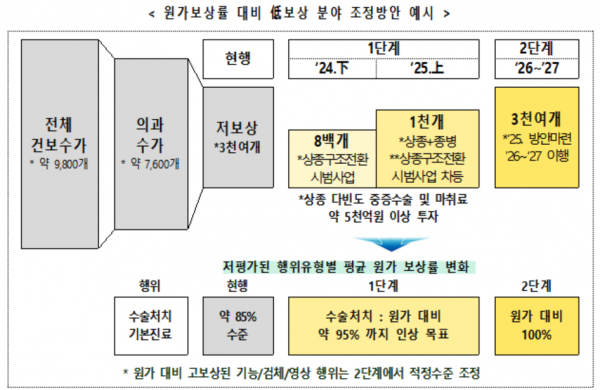
Strengthening Compensation in Six Priority Areas Including Emergency and Childbirth
In addition, the commission has designated six priority investment areas?severe cases, high-difficulty essential medical care, emergency, nighttime/holiday, pediatrics/childbirth, and vulnerable areas?to strengthen compensation. Furthermore, it will create public policy fees reflecting four factors that are currently insufficiently reflected in fee-for-service payments: difficulty/risk level, skill level, emergency treatment waiting, and region.
In particular, health insurance compensation for 24-hour care will be newly established within this year and will be applied first to the structural transition projects of tertiary general hospitals.
To systematically operate public policy fees, a Public Policy Fee Operation Committee will be established within the Health Insurance Policy Deliberation Committee. The uniform classification-based additional fee system, which applies the highest additional rate unconditionally to tertiary general hospitals, will be changed to a performance-based compensation system. Approximately 2 trillion KRW in performance compensation funds will be secured to support compensation payments to each medical institution.
Redefining the Role of Actual Expense Insurance That Encouraged 'Overtreatment'
Management of actual expense insurance, which causes excessive non-covered treatments, will be strengthened. This aims to resolve side effects such as frequent use of tertiary general hospitals and emergency rooms by mild and non-emergency patients.
The commission will consider measures to strengthen patient co-payments for new actual expense insurance products or rationalize the coverage scope and level of non-covered services to prevent overtreatment. It will also institutionalize prior consultations between the Ministry of Health and Welfare and the Financial Services Commission when deciding important matters related to insurance systems to enhance collaboration. Additionally, the commission plans to explore ways to involve medical institutions in setting standards and prices for non-covered services under actual expense insurance and establish review systems to manage treatment volume and levels.
Furthermore, the commission will establish classification criteria for cosmetic procedures to clearly distinguish between cosmetic medical treatments performed by doctors and other cosmetic services, and create a management system for the cosmetic market based on these criteria.
A Ministry of Health and Welfare official stated, "We plan to consider allowing minor cosmetic procedures that can ensure safety if certain qualification requirements are met, to improve public access to cosmetic services. However, since classification of cosmetic procedures and qualification standards may involve various issues, we will gather opinions from various sectors including the medical community and discuss them in the commission in the future."
© The Asia Business Daily(www.asiae.co.kr). All rights reserved.


















