Kamala Harris, the U.S. Democratic presidential candidate and Vice President, stated in her first television interview as a presidential contender on the 29th (local time) that she would appoint Republican members to her cabinet if elected. She also emphasized that her values on key policy issues such as climate change and immigration have not changed. This is interpreted as her intention to achieve true 'unity,' as declared in her acceptance speech last week, by upholding progressive values while listening to the opinions of conservatives, including Republicans. She also previewed that she would begin building an 'opportunity economy' on her first day in office.
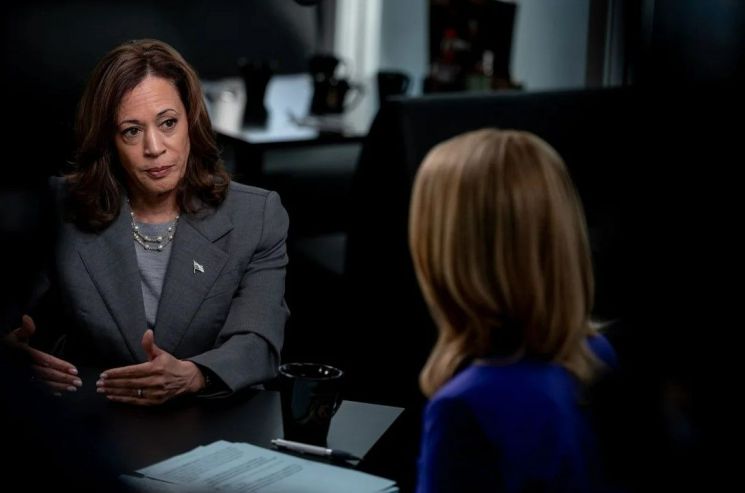 U.S. Vice President and Democratic presidential candidate Kamala Harris is being interviewed by CNN in Savannah, Georgia, on the 29th (local time).
 [Image source=CNN, Will Lanzoni]
In an in-depth CNN interview aired that night, Vice President Harris said, "It is important to have people with different perspectives and experiences involved in important decision-making positions." Having declared last week at the party convention that she would be "a president for all Americans," she added, "There are 68 days left until the election, so I will not get ahead of myself," but also said, "Including Republicans in the cabinet would be beneficial for Americans." Previously, former President Barack Obama also appointed Republicans, such as retaining Robert Gates, who served as Secretary of Defense under the George W. Bush administration. However, Vice President Harris added that she has not yet considered any specific individuals.
This interview was Vice President Harris's first media interview as a presidential candidate following President Joe Biden's withdrawal from the race last month. Tim Walz, Governor of Minnesota and her running mate (Democratic vice-presidential candidate), also participated. When asked what she would do on her first day if she wins the November election, Harris said, "One of the most important priorities is to do everything possible to support the middle class," and previewed, "I will implement plans to build an opportunity economy." She added, "I have already proposed several measures, including lowering the prices of daily goods, investing in small and medium-sized businesses, and investing in families."
This refers to the 'first 100 days economic plan' that Vice President Harris unveiled ahead of the party convention, which includes tax cuts for ordinary citizens, support for new homebuyers, expansion of housing supply, and regulation of large corporations' food price increases. When asked why she had not pursued these policies during her three and a half years as Vice President, she mentioned that the circumstances at the time of her inauguration were unfavorable. She recalled, "When the Biden administration took office, the U.S. economy was collapsing due to former President Donald Trump's mismanagement," and said, "Our top priority was to do what we could to save America."
Regarding criticisms that her progressive stance on immigration and the ban on hydraulic fracturing (fracking) has changed since the primary elections, she responded, "The most important and meaningful aspect from my policy perspective is that my values have not changed." She also spoke about the 'Green New Deal' (an eco-friendly economic growth policy), saying, "I have always believed that the climate crisis is real and that it is an urgent issue requiring deadlines and measurable indicators." She mentioned the Biden administration's Inflation Reduction Act (IRA) as part of these efforts and reiterated, "That value has not changed." On border policy, she added, "We will enforce the law at the border," and "Our work to protect the border has not changed."
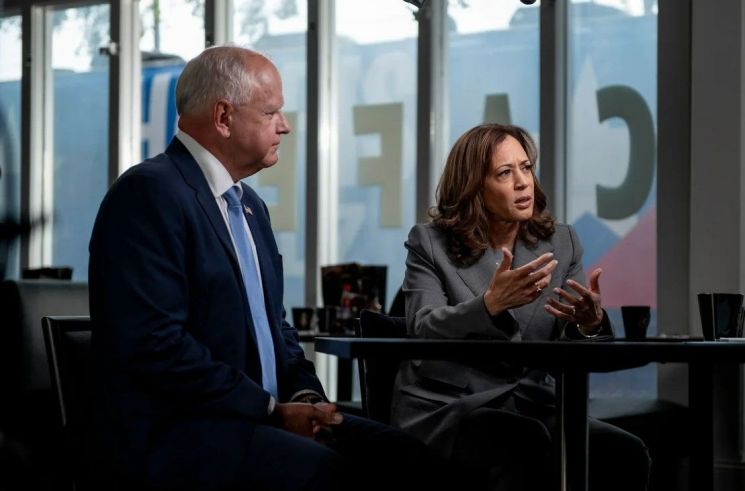 U.S. Vice President and Democratic presidential candidate Kamala Harris (right) and Minnesota Governor Tim Walz are attending and responding to an interview with CNN broadcast in Savannah, Georgia, on the 29th (local time). [Image source=CNN, Photo by Will Lanzoni]
When asked about former Republican presidential candidate Donald Trump's racial identity attacks on her, such as saying "I didn't know she was Black" and "Suddenly she became Black," Vice President Harris dismissed the questions with a simple answer. She called it "the same old, tired strategy" and said, "Let's move on to the next question."
Regarding the U.S. stance on Israel's Gaza Strip, and whether she would take a different tone from President Biden, she said, "My commitment to Israel's defense will not change," but added, "Too many innocent Palestinians have died. This war must end, and we must negotiate to rescue hostages."
This interview attracted early attention as an opportunity to scrutinize Vice President Harris's policies amid her rising approval ratings. The Republican Party has long criticized Harris for deliberately avoiding policy scrutiny through media interviews. Former President Trump disparaged Harris's CNN interview, saying it was "pre-recorded, not live," and remarked, "To me, she does not look like a leader."
© The Asia Business Daily(www.asiae.co.kr). All rights reserved.