Son Young-sun, Chairman of the Elevator Association, "Certification TF Completed, Now Need to Form Inspection TF"
Elevator Industry Promotion Act Expected to Revive Domestic Elevator Industry
120m Speed Limit for Competitive Products Among SMEs by 2026, "Will Expand SME Market"
"We will complete the improvement of the elevator safety inspection system by the first half of next year."
Son Young-sun, Chairman of the Korea Elevator Industry Cooperative, stated in an interview with Asia Economy on the 29th, "To fix the unreasonable safety inspection system, we will start discussions with the Ministry of the Interior and Safety from early next year," expressing this intention.
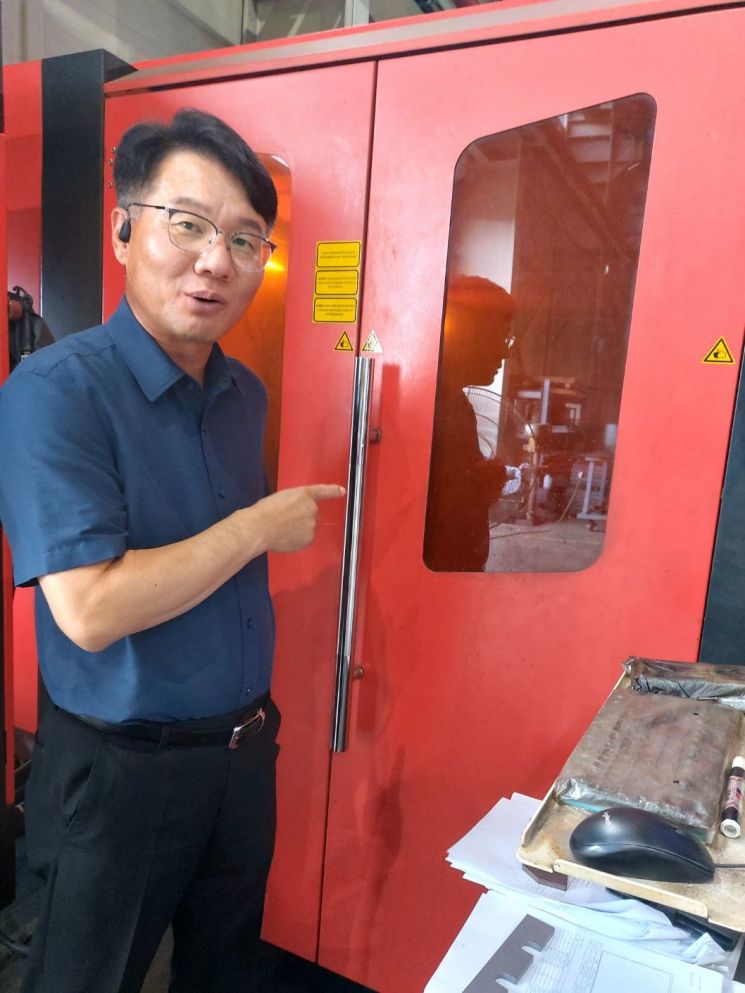 Son Young-sun, Chairman of the Korea Elevator Industry Cooperative, is explaining the process of cutting steel plates with a laser in the laser workroom at Saehan Elevator Co., Ltd., located in Suwon-si, Gyeonggi-do, which he manages.
 [Photo by Kim Jong-hwa]
In August 2022, to simplify the elevator safety certification system, the 'Elevator Safety Certification Reform Task Force (Certification TF)' was launched, consisting of the Ministry of the Interior and Safety, Korea Elevator Safety Agency (Safety Agency), Korea Elevator Association, Korea Elevator Industry Cooperative, and Korea Elevator Management Industry Cooperative. As this task force neared completion, the plan is to take the opportunity to improve the remaining challenge in the elevator industry?the safety inspection system.
Domestic manufactured elevators have been required since March 2018, under the revised and strengthened 'Elevator Safety Management Act,' to obtain mandatory certification for 20 types of parts, including 14 elevator parts and 6 escalator parts. In addition, safety certification (model certification) must be obtained for the finished products assembled from these parts, and after installation at the facility, a safety inspection (installation inspection) must be conducted again.
Regarding this, the elevator industry has requested the Ministry of the Interior and Safety and others to ease the mandatory certification for 7 of the 20 parts from certification to a lower level called 'confirmation,' as Korea is the only country adopting mandatory certification for all 20 parts. The Certification TF was formed to discuss this and held 15 meetings until March.
However, after escalator reverse operation accidents occurred at Suinae Station on the Suin-Bundang Line in June last year and at Gyeongbokgung Station on Seoul Subway Line 3 in December, the Ministry of the Interior and Safety expressed reluctance to accept the issues discussed in the TF, stating, "Why should safety be relaxed?"
Regarding this, Chairman Son explained, "The Certification TF has effectively ended, and it is expected that the Ministry of the Interior and Safety will finalize and announce the decision around the end of the year." He added, "Now is the time to form an Inspection TF," and emphasized, "The improvement of the inspection system cannot be delayed any longer."
Certification is the procedure to confirm safety with samples before producing parts, while inspection is the procedure to verify whether the parts were properly manufactured after production. The elevator industry appeals to exempt either model certification or installation inspection since they overlap. Even products that have received model certification must undergo installation inspection after being installed in buildings, doubling the costs.
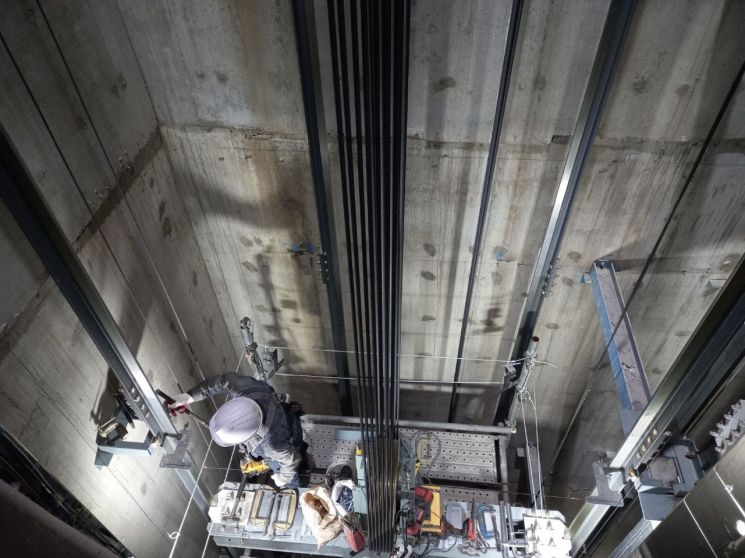 Elevator company employees are performing installation work in the elevator shaft of a high-rise building.
 [Photo by Korea Elevator Industry Cooperative]
According to the industry, for small and medium-sized enterprises (SMEs), certification and inspection costs account for 5% of total sales. For company S, which produces about 50 elevators annually on average, certification and inspection costs were 50 million KRW annually before 2018 but increased sevenfold to 350 million KRW in 2020. Although costs decreased to 300 million KRW in 2022, this was due to production volume halving because of low-priced Chinese products during the COVID-19 pandemic. Ultimately, company S, unable to bear the increased costs, closed last year.
As the Safety Agency's inspection workload piled up, the processing time for certification and inspection has taken more than twice the legally mandated period, causing many companies to miss delivery deadlines and pay delay penalties, revealing further problems.
Chairman Son pointed out, "While the reason for closure was not solely due to certification and inspection costs, it certainly played a role," adding, "Excessive costs and manpower投入 in certification and inspection have led to increased production costs and indirect expenses, and the Safety Agency's monopoly has extended inspection periods, significantly reducing export competitiveness." He further noted, "Since the transfer of the elevator industry from the Ministry of Trade, Industry and Energy to the Ministry of the Interior and Safety following the revision of the Elevator Safety Management Act in March 2018, export volumes of small and medium elevator companies have decreased by more than 70%."
The global elevator market size is about 100 trillion KRW, but the domestic elevator market ranks third in the world in terms of annual new installations and seventh in terms of the number of units owned and operating, with a market size of only about 5 trillion KRW. Five major companies?Hyundai Elevator, TK Elevator, Otis Elevator, Mitsubishi, and GS Elevator?compete for 4 trillion KRW, while SMEs compete for the remaining 1 trillion KRW. According to the National Elevator Information Center, the number of newly installed elevators (including escalators) was 46,945 units last year, and as of the 31st of last month, the number of elevators (including escalators) currently in operation reached 855,510 units. However, with new installations declining, growth has slowed.
The elevator industry is pinning hopes on the 'Elevator Industry Promotion Act,' which came into effect on the 31st of last month. Chairman Son said, "Until now, the Ministry of the Interior and Safety could not directly support elevator companies' R&D projects, which had to be supported through the Ministry of Trade, Industry and Energy or the Ministry of SMEs and Startups, but now the Ministry of the Interior and Safety can directly implement these projects," adding, "We expect the Elevator Industry Promotion Act to be a milestone in revitalizing the domestic elevator industry."
Additionally, the Elevator Cooperative plans to work on registering the rated speed of passenger elevators at 120 meters per minute in the Ministry of SMEs and Startups' 'Competitive Products among SMEs' list. Currently, SMEs can only manufacture and install elevators with speeds up to 105 meters per minute. Recently, Chairman Son's company, Saehan Elevator Co., Ltd., along with Korea Elevator University and others, formed a consortium and participated in the Ministry of SMEs and Startups' 'Performance-sharing Common Technology Development Project,' successfully developing an elevator with a speed of 150 meters per minute.
Chairman Son said, "We will not immediately introduce the 150 meters per minute elevator to the market, but we believe the 120 meters per minute elevator can enter the market," adding, "We will complete the group standardization work next year and aim for the Ministry of SMEs and Startups to announce it by 2026, thereby expanding the market where SMEs can operate."
© The Asia Business Daily(www.asiae.co.kr). All rights reserved.
![Clutching a Stolen Dior Bag, Saying "I Hate Being Poor but Real"... The Grotesque Con of a "Human Knockoff" [Slate]](https://cwcontent.asiae.co.kr/asiaresize/183/2026021902243444107_1771435474.jpg)
















