US Emergency Room Doctor Shares Patient's CT Scan
'Nangmichung Disease' Caused by Eating Undercooked Pork
An emergency room doctor at a university hospital in the United States shared a computed tomography (CT) scan of a patient infected with parasites after eating undercooked pork, urging caution.
According to the Daily Mail on the 28th (local time), Dr. Sam Galli, an emergency room physician at the University of Florida College of Medicine hospital, posted a CT scan of the patient's leg infected with parasites on the social networking service X (formerly Twitter) on the 25th. Dr. Galli described the image as "the most horrifying CT scan I have ever seen." The photo shows numerous white, rice grain-shaped nodules densely embedded from the patient's femur down to below the knee joint.
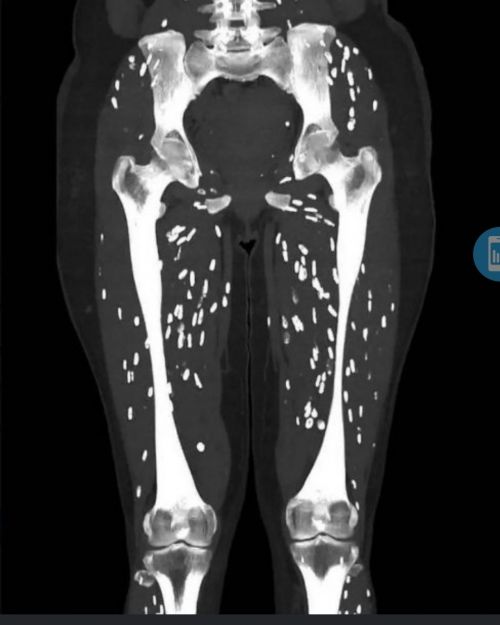 CT of the leg of a patient infected with parasites after eating undercooked pork [Image source=Social Networking Service (SNS) capture]
The diagnosis for this patient is cysticercosis. This disease is caused by infection with the larvae of the tapeworm commonly known as the "pork tapeworm." Cysticercosis occurs when the larvae of the tapeworm enter tissues such as muscles or the brain, usually through consumption of undercooked pork or other food containing larvae.
These larvae can develop into adult tapeworms in the human intestines. Typically, the larvae mature into adults within 5 to 12 weeks. The eggs laid by these adult tapeworms are excreted in feces, but some larvae exit the intestines and form hard cysts inside the body. These cysts contain the larvae and, when located under the skin, can feel like hard lumps similar to tumors. Dr. Galli described this as "rice grain calcification."
Despite the somewhat repulsive appearance in the video, the cysts themselves are generally not dangerous because the larvae cannot survive outside the intestines. However, if cysts develop in the brain, they can cause headaches, seizures, and in severe cases, mental confusion. If they occur in the eyes, they may cause blurred vision or decreased eyesight.
Dr. Galli explained, "The larvae leave the intestines and spread throughout the body via the bloodstream," adding, "The brain, eyes, subcutaneous tissue, and skeletal muscles are the most common destinations." He also noted, "Cysticercosis can be transmitted through feces," explaining that "infection occurs when an infected person does not wash their hands properly after using the bathroom and then shares food with others or through water contaminated with feces." He added, "The prognosis for cysticercosis is generally good," and that it can be treated with antiparasitic drugs, steroids, antiepileptic drugs, and surgical removal. However, since some cases can be fatal, Dr. Galli advised, "Always wash your hands thoroughly to maintain cleanliness and never eat raw or undercooked pork."
It is estimated that about 50 million people worldwide are infected with pork tapeworm parasites annually, with approximately 50,000 deaths among them. Pork tapeworm infections mainly occur in pigs raised in unsanitary farming environments. Domestically produced pork in Korea is known to have a relatively low risk of parasite infection.
© The Asia Business Daily(www.asiae.co.kr). All rights reserved.
![Clutching a Stolen Dior Bag, Saying "I Hate Being Poor but Real"... The Grotesque Con of a "Human Knockoff" [Slate]](https://cwcontent.asiae.co.kr/asiaresize/183/2026021902243444107_1771435474.jpg)















