The 3rd Policy Symposium of the Korean Securities Association
Future of Blockchain Technology - Exploring the Development Direction of the Digital Asset Market
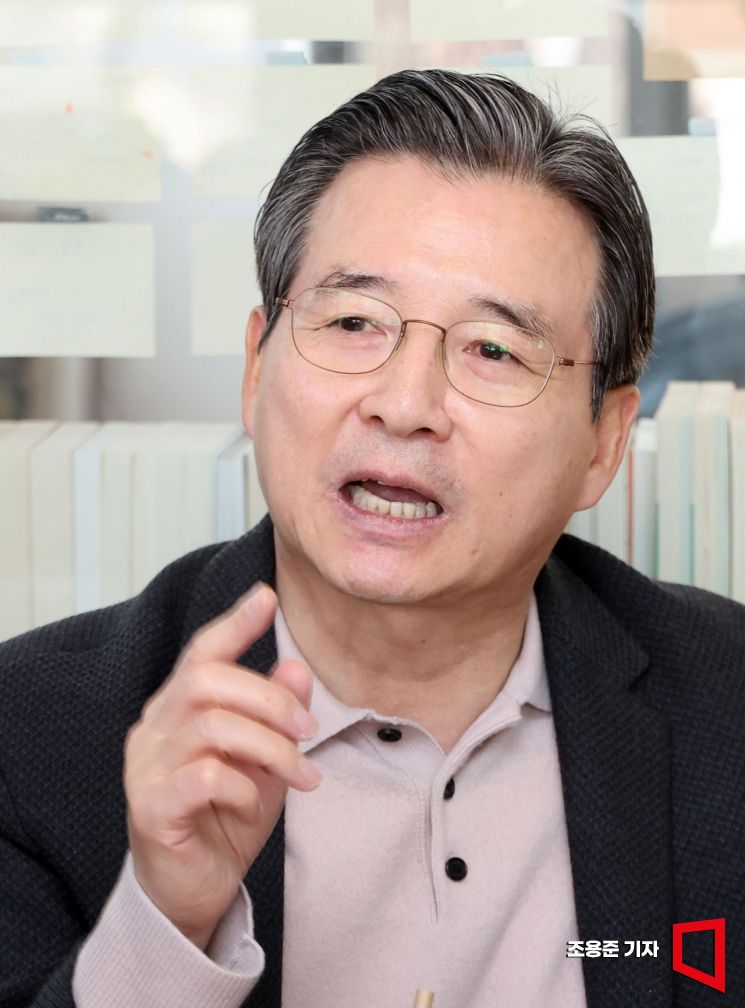 Manbo Jeongdam - Kim Yongbeom, Former Vice Minister of Strategy and Finance. Photo by Jo Yongjun jun21@
Kim Yong-beom, CEO of Hashed Open Research, emphasized on the 27th that "Bitcoin spot exchange-traded funds (ETFs) can be approved through administrative measures" and stressed the need to narrow the blockchain policy gap with advanced countries such as the United States and Japan.
On the same day, Kim attended the 3rd Policy Symposium of the Korean Securities Association held at the Korea Financial Investment Association in Seoul, themed "The Future of Blockchain Technology - Exploring the Development Direction of the Digital Asset Market," and said, "Japan is moving forward with fierce momentum regarding blockchain policies."
At the event, Kim delivered a keynote speech titled "Digital Asset Market and the New Future." He explained how to view the relationship between blockchain technology and finance from four perspectives: △ blockchain as an asset △ blockchain as a means of payment △ blockchain as decentralized finance (DeFi) △ blockchain as ownership.
Kim first evaluated that finance utilizing blockchain technology has already established itself as an asset. He stated, "Bitcoin spot ETFs and Ethereum spot ETFs have emerged," and diagnosed that "they have firmly established themselves as a very meaningful asset class."
Regarding blockchain as a means of payment, he also believes the debate is essentially over. Kim said, "The reason the Bank for International Settlements (BIS) and the International Monetary Fund (IMF) have recently been actively conducting related research is that they recognize the potential disruptive power of blockchain as a means of payment," adding, "In developing countries, it is being widely used as a means of payment."
On DeFi finance, he maintains a neutral stance but emphasized the need to note that the leverage ratio is lower than expected. BIS conducted a comprehensive survey of DeFi finance in March. Kim explained, "The leverage in DeFi finance is lower than expected," noting, "Before the subprime (global financial crisis), hedge funds had leverage levels of 40 to 50 times, but DeFi shows levels of 3 to 4 times."
This means that despite the absence of regulatory authorities, the leverage levels in DeFi finance are being strictly managed. Although central banks and financial supervisory authorities still view it with concern, it is difficult to regard it as a disorderly market.
Kim emphasized 'blockchain as ownership' as the most important reason to pay attention to blockchain technology. He pointed out that it can be used as a regulatory tool against big tech companies, which are becoming difficult to regulate beyond just global corporations.
Kim stated, "There is currently no answer on how to regulate and manage big tech companies that transcend national borders," and pointed out, "In the digital economy, where rights to assets existing in digital form rather than real estate, securities, or paintings are becoming increasingly important, there is currently no method to confirm, manage, and transfer ownership."
He diagnosed, "Assets existing in digital form in the digital economy inevitably have to be decentralized," and added, "Blockchain technology can be a solution related to the regulation of big tech companies."
Meanwhile, Kim previously served as the 1st Vice Minister of the Ministry of Economy and Finance and as Vice Chairman of the Financial Services Commission, leading macroeconomic and financial policies. Notably, during his tenure as Vice Chairman of the Financial Services Commission in 2018, he was responsible for establishing virtual asset policies. At that time, while the Minister of Justice and others leaned toward closing virtual asset exchanges, Kim contributed to the sustainability of the domestic virtual asset market by creating systems such as the real-name system.
© The Asia Business Daily(www.asiae.co.kr). All rights reserved.
![Clutching a Stolen Dior Bag, Saying "I Hate Being Poor but Real"... The Grotesque Con of a "Human Knockoff" [Slate]](https://cwcontent.asiae.co.kr/asiaresize/183/2026021902243444107_1771435474.jpg)
















