Quarantine to Prevent Entry of Foreign Livestock Infectious Diseases and Plant Pests
Steady Increase in Overseas Travel Leads to Rise in Seizures... 1,169 Cases in First Half of This Year
Quarantine Guidance and Promotion, Blocking Illegal Import Sites
After finishing a trip to Thailand and returning to Incheon Airport, Mr. A was surprised to find an electronic tag attached to his suitcase while retrieving his luggage. He had stored leftover mangoes from fruits he bought and ate in Thailand in his suitcase and entered the country with them, making them subject to quarantine inspection.
There have also been cases where travelers were caught smuggling fruits or sausages, thinking "one piece should be okay." Some try to avoid X-ray screening by wrapping fruits or sausages or hiding them in pockets or shoes. In such cases, fines of up to 10 million KRW may be imposed.
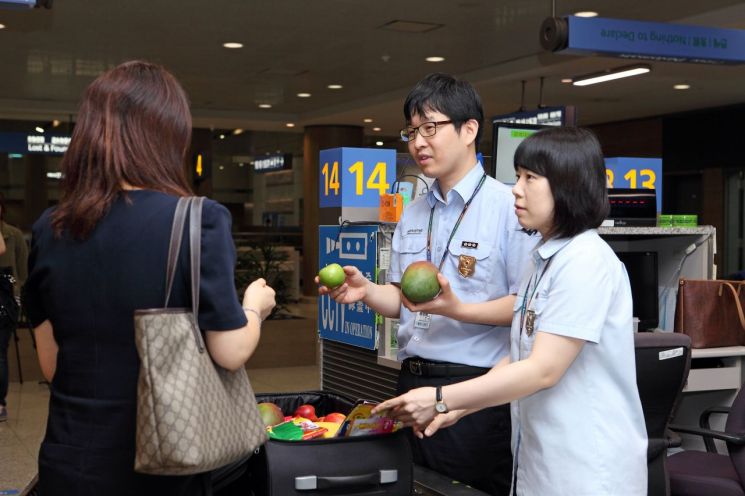 At the arrival hall of Incheon International Airport, employees of the Animal and Plant Quarantine Agency are inspecting personal belongings. Photo by Animal and Plant Quarantine Agency
Since the global COVID-19 pandemic, as air travel routes have reopened, the number of travelers going abroad has steadily increased. According to the Tourism Knowledge Information System on the 28th, the number of outbound overseas travelers increased 3.5 times from about 6.55 million in 2022 to 22.72 million last year. In the first half of this year (January to June), 14.02 million people traveled abroad, far surpassing the 9.93 million during the same period last year.
Along with the surge in overseas travelers, the number of cases caught bringing agricultural and livestock products into the country has also increased. According to the Animal and Plant Quarantine Agency, the number of cases fined for carrying plants such as mangoes, limes, peppers, and fruit trees increased from 1,131 in 2022 to 2,167 last year. In just the first half of this year, there were 1,169 cases, and if this trend continues, it is expected to exceed last year's figures.
An official from the Quarantine Agency explained, "Most travelers caught bringing fruits or sausages forget that they are in their bags and enter the country as is," adding, "The Quarantine Agency intensively provides guidance and publicity on animal and plant quarantine during holidays and summer vacation seasons when overseas travelers increase to prevent such cases in advance."
Border quarantine refers to quarantine (of animals, livestock products, and plants) conducted before importation into the country regardless of transportation method or means, including cargo, carry-on, mail, courier, and moving goods. It is carried out at airports or ports to prevent the introduction of overseas livestock infectious diseases and plant pests. Animal and plant quarantine officers perform animal, livestock product, and plant quarantine duties at airports and ports.
The Quarantine Agency strengthens border quarantine before and after the Chuseok holiday period, when overseas travelers and returning visitors are expected to increase, to prevent the introduction of livestock infectious diseases such as highly pathogenic avian influenza (AI) and African swine fever (ASF), as well as plant pests. They conduct border quarantine publicity campaigns targeting travelers at 12 major airports and ports, including Incheon Airport, and make every effort to prevent quarantine breaches through dedicated X-ray inspections, joint inspections with customs, and quarantine detection dogs.
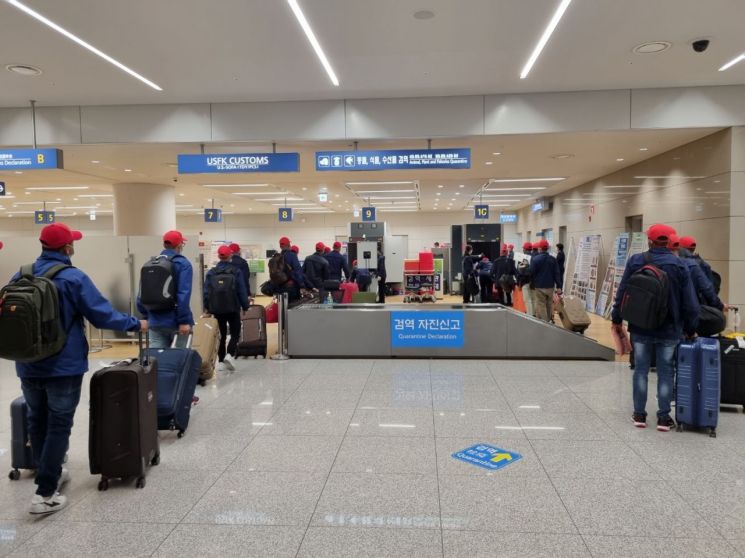 Domestic arrivals are waiting for their belongings to be inspected at the quarantine checkpoint in the arrival hall of Incheon International Airport. Photo by Animal and Plant Quarantine Agency
Animal quarantine during border inspection is conducted to prevent the introduction of livestock infectious diseases such as ASF into the country, while plant quarantine aims to protect Korea's natural ecosystem by blocking the entry of foreign pests and diseases at the border. Over the past five years, more than 515.6 billion KRW in national funds have been spent on compensation due to outbreaks of livestock infectious diseases, and since the introduction of pine wilt disease in 1988, over 1.5 trillion KRW has been spent on control costs. Such livestock infectious diseases and foreign pests cause enormous damage to agriculture and livestock industries, requiring huge costs and efforts for prevention and control.
Kim Jeong-hee, head of the Quarantine Agency, emphasized, "Border quarantine is as important as a second line of national defense," adding, "Although animal, livestock product, and plant quarantine may be somewhat unfamiliar to the public, cooperation from citizens is essential to completely block the introduction of overseas livestock infectious diseases and plant pests."
The Quarantine Agency has been building quarantine infrastructure to respond to the diversification of international trade countries and items, continuously conducting joint inspections with the Korea Customs Service on high-risk routes. They quarterly search and block internet sites selling illegally imported livestock products and conduct joint inspections with the Ministry of Food and Drug Safety and others on distribution and sales outlets regarding illegal livestock imports. Last year, they blocked 121 illegal livestock product sales sites, including Chinese pork processed products, and conducted three joint inspections on 263 distribution and sales outlets, detecting four violations.
Additionally, the Quarantine Agency differentiates quarantine methods such as document inspection, on-site inspection, laboratory precision inspection, and quarantine cultivation inspection according to the risk level of imported cargo, aiming to prevent the introduction of pests through rapid plant quarantine.
Director Kim stated, "Through continuous public quarantine promotion, awareness of the importance of border quarantine has increased, and the number of disqualified detections per entry is decreasing," emphasizing, "Through constant pest surveillance at international airports and ports, foreign pests are detected early before establishing domestically, preventing their spread. Korea's plant quarantine technology has been internationally recognized, growing into a country on par with advanced quarantine nations such as the United States and Australia."
The Quarantine Agency plans to diversify joint inspection routes in close cooperation with related agencies such as the Korea Customs Service to respond to outbreaks of overseas livestock infectious diseases like ASF and foot-and-mouth disease. They will conduct joint inspections of express shipments with customs and strengthen quarantine at international postal logistics centers, thoroughly managing border quarantine. For plant quarantine, they have announced the 'Plant Quarantine Mid- to Long-Term Development Plan (2024?2028),' which includes four major strategies: establishing a proactive response system to changes, advancing the border quarantine system, building a national-level comprehensive pest management system, and establishing an advanced quarantine foundation to expand new export markets.
Director Kim said, "We will strengthen border quarantine by advancing a more precise and scientific quarantine system to cope with changes in the global trade environment such as mega free trade agreements (FTAs)," adding, "We will thoroughly implement scientific import risk assessments of agricultural and livestock products based on international standards to ensure the safety of imported agricultural and livestock products produced overseas."
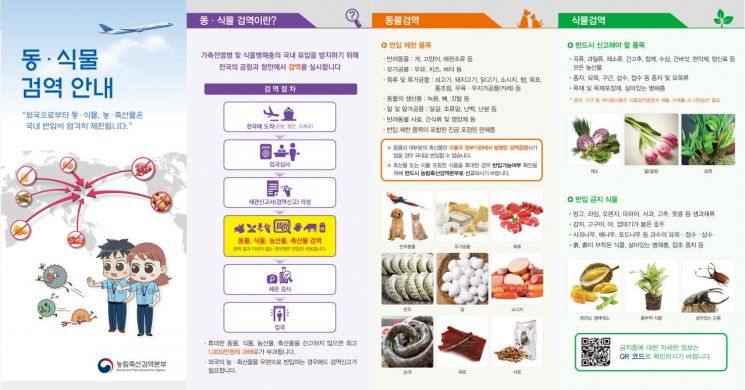
© The Asia Business Daily(www.asiae.co.kr). All rights reserved.
![Clutching a Stolen Dior Bag, Saying "I Hate Being Poor but Real"... The Grotesque Con of a "Human Knockoff" [Slate]](https://cwcontent.asiae.co.kr/asiaresize/183/2026021902243444107_1771435474.jpg)


















