Approval of SK Inno-SK E&S Merger at Temporary General Meeting on the 27th
Park Sang-gyu, President of SK Innovation, said on the 27th, "The company's cash holdings exceed 1.4 trillion won, so it is not at a level where it cannot handle the stock purchase rights."
On the same day, at the SK Innovation extraordinary general meeting held at the SK Seorin Building in Jongno-gu, Seoul, Park responded to a shareholder's question asking, "If you multiply the number of votes against the merger by the planned purchase price per share, it amounts to about 920 billion won. What is the company's response and funding plan if this exceeds the set amount (800 billion won)?"
Park said, "We set the limit sufficiently by referring to past cases," and added, "We expect that the stock purchase rights will not exceed the range anticipated by the company." He also said, "If it does exceed, we will decide whether to proceed after consulting with the board of directors."
SK Innovation passed the merger agreement agenda with SK E&S at the general meeting that day. The National Pension Service (NPS), the second-largest shareholder of SK Innovation, exercised its voting rights against the merger as expected, but the merger was approved as originally planned with 85.76% of attending shareholders voting in favor.
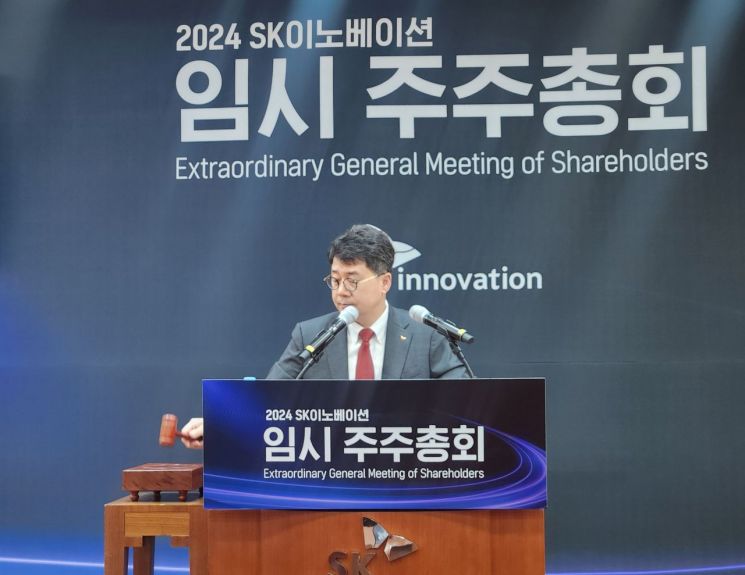 Park Sang-gyu, President of SK Innovation, is striking the gavel at the SK Innovation Extraordinary General Meeting of Shareholders held on the 27th at the SK Seorin Building in Jongno-gu, Seoul. Photo by Choi Seoyoon
Although the NPS did not raise any particular objections at the general meeting, there is a possibility that it may exercise the stock purchase rights later. If the NPS exercises all stock purchase rights, SK will have to buy shares worth 681.7 billion won. This amount approaches the 800 billion won prepared by SK Innovation. Shareholders who opposed the merger, including the NPS, can exercise their stock purchase rights from that day until the 19th of next month.
The planned purchase price per share is 111,943 won. SK Innovation's stock price was 106,500 won based on the previous day's closing price, which is about 5,000 won lower than the exercise price of the stock purchase rights, potentially leading to a flood of shares for profit realization. SK Innovation announced that if the amount exceeds 800 billion won, the contract may be canceled or the merger conditions may be changed.
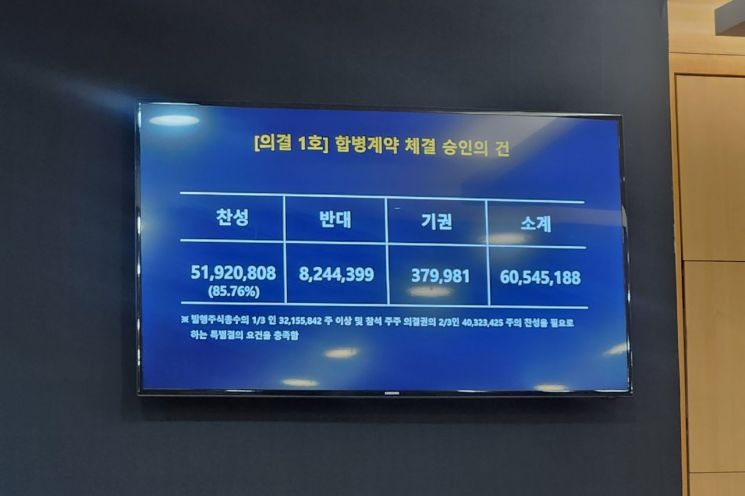 On the 27th, at the SK Seorin Building in Jongno-gu, Seoul, the voting results for the approval of the merger agreement between SK Innovation and SK E&S were announced at the SK Innovation extraordinary general meeting of shareholders. With 62.76% of all shareholders attending the meeting, 85.76% of the attending shareholders approved the agenda, thereby approving the merger. Photo by Choi Seoyoon
In response to a shareholder's comment that "the most favorable condition for SK Innovation minority shareholders would be to evaluate SK Innovation common stock based on per-share value rather than stock price, and even if set by stock price, if SK E&S was evaluated on the premise of cash redemption of redeemable convertible preferred shares (RCPS), it would have been more favorable to minority shareholders," Park said, "Both companies involved independent professional institutions to appropriately reflect the valuation, including the RCPS issue of SK E&S." He added, "Listed companies are required to base merger ratios on market price, and although there are exceptions, these are quite special cases."
Earlier, the Korea Governance Forum commented on the 22nd that the 3.1 trillion won scale RCPS issued by SK E&S against Kohlberg Kravis Roberts (KKR) is effectively debt rather than capital. "Ultimately, it is debt that must be repaid, and if cash repayment is not possible, KKR must be repaid in kind with stakes in seven city gas companies." SK E&S's city gas business accounts for 46% of total sales (power generation business accounts for 42%).
The National Pension Service's Stewardship Responsibility Committee decided on the same day to oppose the merger ratio of 1 to 1.1917417 between listed SK Innovation and unlisted SK E&S, citing concerns that it is inappropriate and could significantly harm the value of SK Innovation's common shareholders. Even if this merger ratio calculation does not violate the Capital Markets Act, they viewed that SK Innovation's stock price is undervalued at about half of its asset value and does not properly reflect the company's stock value.
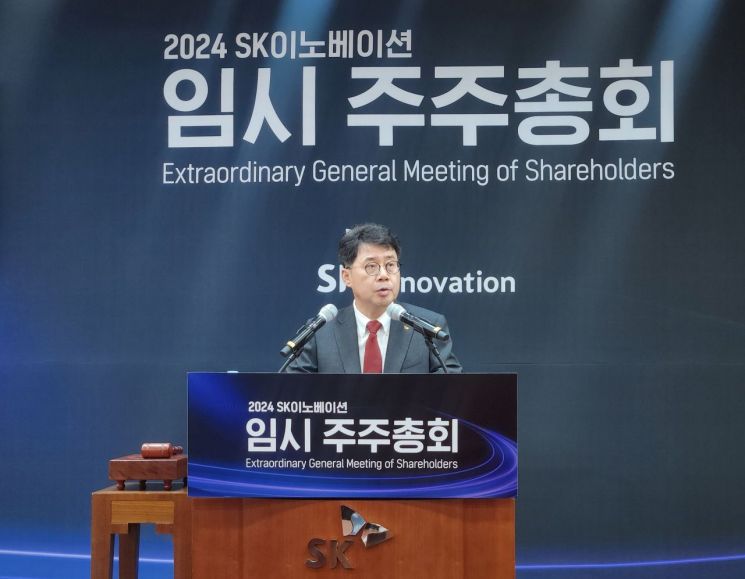 Park Sang-gyu, President of SK Innovation, is speaking at the SK Innovation Extraordinary General Meeting of Shareholders held on the 27th at the SK Seorin Building in Jongno-gu, Seoul. Photo by Choi Seoyoon
Regarding shareholder questions about plans to enhance shareholder value, including share buybacks, Park said, "First of all, I apologize that the stock price has not reached the increased amount from last year," and added, "After the merger is completed, we will consider various factors such as the company's finances and implement shareholder-friendly policies." He also said, "The government is also discussing value-up plans, and we will create mid- to long-term plans in line with that to repay our shareholders."
On the question about the expected timing of SK On's profitability, he said, "External factors are quite significant. Internally, SK On needs to make two efforts simultaneously." Park stated, "We must consistently strive to create an environment where profits can be made even if growth is slow through internal cost reduction," and added, "If we build a balanced business portfolio including LNG, power, and batteries in addition to the existing petrochemical business, I believe we can operate a stable business in the mid- to long-term."
© The Asia Business Daily(www.asiae.co.kr). All rights reserved.



















