Bloomberg "Intensified Price Competition Amid Slowing Consumer Spending in China"
The world-renowned dim sum (點心) chain from Taiwan, Din Tai Fung (鼎泰豊), will cease operations at 14 of its stores in Beijing and other regions this October.
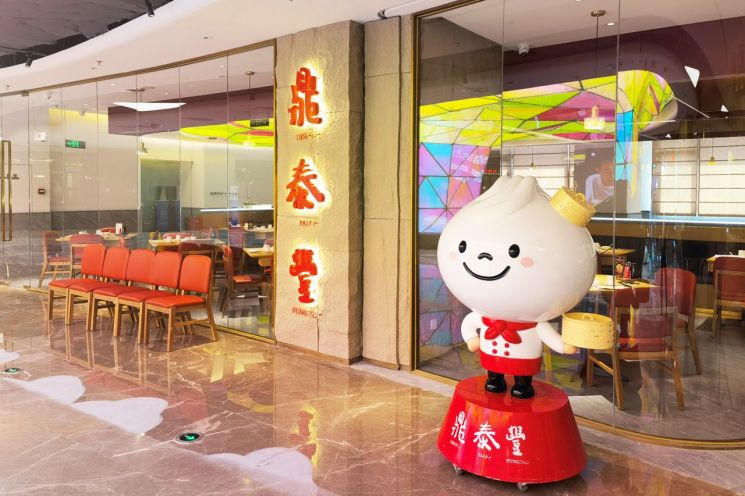
On the 26th, Din Tai Fung announced on its official website, "Today, Beijing Hengtai Fung Catering Co., Ltd. (hereafter Beijing Hengtai Fung) decided not to renew its business license, so Din Tai Fung will end the brand franchise earlier than planned," adding, "The stores operated by Beijing Hengtai Fung will close before October 31."
Beijing Hengtai Fung operates 14 Din Tai Fung branches, including eight in Beijing, as well as locations in Tianjin, Qingdao in eastern Shandong Province, Xiamen in southeastern Fujian Province, and Xi'an in central Shaanxi Province. On the same day, Beijing Hengtai Fung announced on its official social media, "Due to the expiration of our 20-year business license and failure to reach a renewal agreement with the board, we have decided to gradually close 14 branches."
However, Din Tai Fung explained that other branches in Shanghai, eastern Jiangsu Province cities Suzhou, Wuxi, and Nanjing, eastern Zhejiang Province cities Jiaxing, Hangzhou, and Ningbo, as well as southern Guangdong Province cities Guangzhou and Shenzhen, are operated by separate joint ventures within China and will continue normal operations.
Bloomberg reported, "As Chinese consumer spending slows and consumers become increasingly frugal, restaurants are fiercely competing on price, and Din Tai Fung is closing 14 of its approximately 30 stores in China," noting, "Unlike upscale restaurants offering buffets or fast-food chains selling items for just 1 dollar (about 1,300 won), Din Tai Fung, where the average spend per person is about 150 yuan (approximately 28,000 won), is becoming increasingly out of sync."
Din Tai Fung was founded in 1958 in Taipei by Yang Bingyi (1927?2023), who left mainland China during the Chinese Civil War in 1948 and moved to Taiwan.
Yang initially sold cooking oil, but after canned cooking oil became widely available in 1972, he began selling xiaolongbao, a type of steamed dumpling, alongside it. As the xiaolongbao gained popularity and the business gradually expanded, he officially transitioned to a restaurant business, adding meal items such as egg fried rice and noodles sold at Din Tai Fung locations worldwide, gradually shaping the brand's identity.
Din Tai Fung gained fame in 1993 when it was the only Chinese restaurant selected by the New York Times (NYT) as one of the world's top 10 restaurants. Starting with Shinjuku, Japan in 1996, it expanded to Singapore, Thailand, Hong Kong, Indonesia, South Korea, Malaysia, Australia, the United Arab Emirates, the Philippines, and the United Kingdom. Currently, it operates over 170 stores in 13 countries, generating annual sales of $150 million (approximately 199 billion won as of 2021).
Din Tai Fung's first branch in China opened in Shanghai in 2001, and the first Beijing store opened in 2004.
© The Asia Business Daily(www.asiae.co.kr). All rights reserved.
![Clutching a Stolen Dior Bag, Saying "I Hate Being Poor but Real"... The Grotesque Con of a "Human Knockoff" [Slate]](https://cwcontent.asiae.co.kr/asiaresize/183/2026021902243444107_1771435474.jpg)















