Purpose of Avenge Defeat in Information Warfare Revealed in Shukre Pisaso
On the 26th (local time), claims were made that the target of Hezbollah's retaliatory attacks, a pro-Iranian armed faction in Lebanon, following Israel's preemptive airstrikes, was Israel's intelligence capabilities.
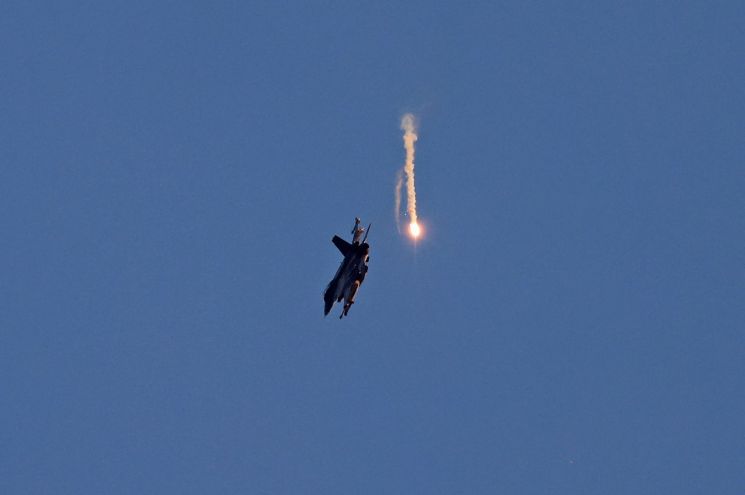 Israeli Military Fighter Jet
 (AFP=Yonhap News) On the 25th (local time) at dawn, an Israeli military fighter jet that took off fired flares to intercept Hezbollah rockets flying into its airspace.
Hezbollah leader Hassan Nasrallah stated in a broadcast speech the day before, "The Gililot base and Ein Shemer base near Tel Aviv, Israel, were the primary and secondary targets," and released related footage of the bases.
Israeli media outlet Ynet interpreted this as "Nasrallah targeting Israel's core intelligence facilities based on his understanding of Israel's cyber capabilities."
Israeli think tank Alma Research and Education Center also analyzed in a report that "Hezbollah's targets were the military intelligence facilities in Gililot, where the Mossad headquarters and the Israeli military's Unit 8200 intelligence base are located."
The Gililot base, targeted by Hezbollah, houses major intelligence facilities including Mossad, Israel's overseas intelligence agency, Unit 8200 responsible for cryptanalysis, signals intelligence (SIGINT), and cyber operations, as well as military communications units.
Additionally, the Ein Shemer base, mentioned as the secondary target, is home to the Arrow missile battery and a drone airfield, and has been identified as the origin of so-called 'spoofing' operations that disrupt GPS information of aircraft in the Middle East, Ynet reported.
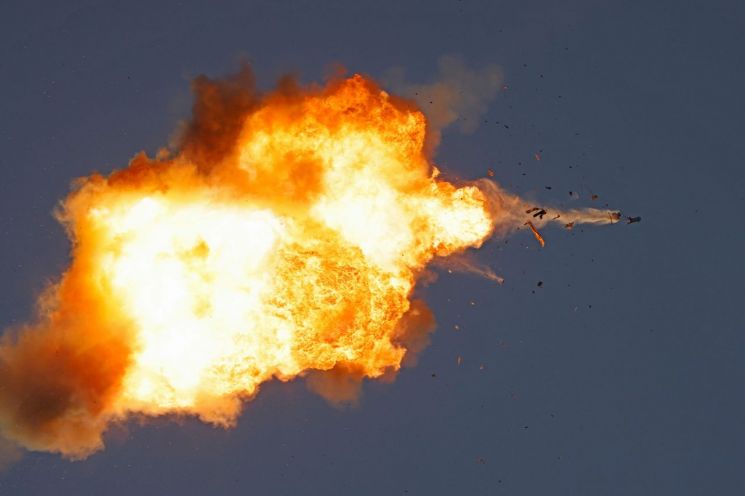 A Hezbollah UAV intercepted by the Israeli Air Force over northern Israel on the 25th. The Israeli military announced that after detecting preparations for a large-scale attack by Hezbollah, an armed group supported by Iran, it conducted a preemptive strike in southern Lebanon early on the 25th. Despite the Israeli military's announcement of the preemptive strike, Hezbollah declared that it launched more than 320 rockets targeting military areas in Israel overnight on the 25th. [Image source=AFP Yonhap News]
Ynet previously cited a report from the US daily The Wall Street Journal (WSJ) on the 18th, linking the death of Hezbollah senior commander Fouad Shukr on the 30th of last month with Hezbollah's recent retaliatory attacks.
WSJ reported that on the evening of the 30th of last month, Shukr, who was hiding in Beirut, received a phone call and was instructed to quickly move from his office on the 2nd floor of a building to a residential area on the 7th floor.
Shortly after Shukr went up to the 7th floor, he was killed on the spot by an Israeli airstrike. Hezbollah later hacked internal communication networks and concluded that the Israeli military had lured Shukr into a vulnerable position for the strike.
Ynet added, "This report can explain why Nasrallah chose intelligence bases as targets."
Hezbollah, considering Shukr's death a defeat in the information war, made Israel's intelligence units and agencies the top priority targets in this airstrike to make up for it.
Israel dismissed Hezbollah's claim the previous day that all drone attacks were successful, stating, "Military bases were not attacked."
© The Asia Business Daily(www.asiae.co.kr). All rights reserved.
![Clutching a Stolen Dior Bag, Saying "I Hate Being Poor but Real"... The Grotesque Con of a "Human Knockoff" [Slate]](https://cwcontent.asiae.co.kr/asiaresize/183/2026021902243444107_1771435474.jpg)

















