7.7 Medical Radiation Examinations Per Person Last Year
3 Out of 4 Are X-Ray Shots... 67% of Exposure Dose from CT
"Appropriate Use Needed"
Last year, it was found that each Korean citizen underwent an average of 7.7 medical radiation examinations such as X-rays or computed tomography (CT) scans. This level is seven times higher than that of advanced countries, raising concerns about the need for appropriate levels of testing.
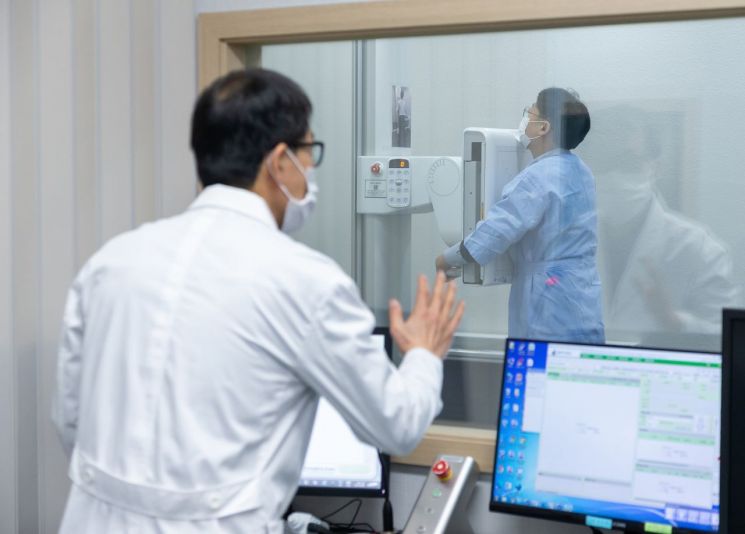
According to the "2023 National Medical Radiation Usage Status" announced by the Korea Disease Control and Prevention Agency on the 26th, the total number of medical radiation examinations nationwide last year was approximately 398 million, with a total radiation exposure dose of 162,106 man·sieverts (man·Sv).
On average, each citizen underwent 7.7 medical radiation examinations, resulting in exposure to 3.13 millisieverts (mSv) of radiation. Man·sievert is a unit used to represent the total radiation dose exposure of a group of individuals, while millisievert is a unit used to evaluate the effective radiation dose exposure.
The number of examinations per person increased by 13.2% (0.9 examinations) from 6.8 in the previous year. The figures have rapidly increased from 5.9 in 2020 to 6.4 in 2021, 6.8 in 2022, and 7.7 last year.
The number of examinations was much higher than the global average. In the past, the number of medical radiation examinations per person was 1.1 in Switzerland (2018) and the United States (2016), and 0.5 in the 36 countries of the European Union (EU) (2014).
Korea’s per capita radiation exposure dose also showed an increasing trend: 2.46 mSv in 2020, 2.64 mSv in 2021, 2.75 mSv in 2022, and 3.13 mSv in 2023.
The Disease Control and Prevention Agency collected data on the number of examinations from the Health Insurance Review and Assessment Service, National Health Insurance Service, Ministry of National Defense, Korean Tuberculosis Association, Ministry of Education, and others to compile the usage status.
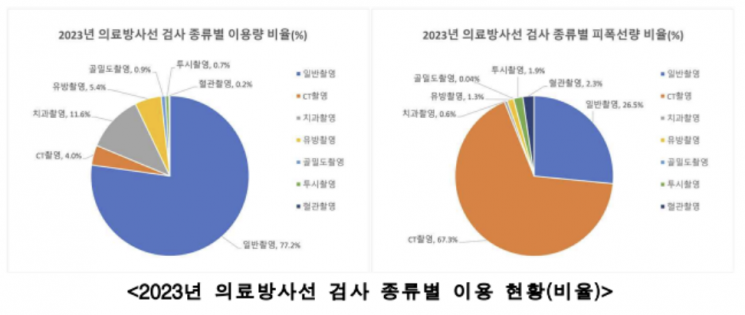
Looking at the total medical radiation examinations by type, general radiography (X-ray) accounted for the largest share at 77.2% (6.0 examinations per person), followed by dental imaging (4.0%), mammography (5.4%), and CT scans (4.0%).
Regarding radiation exposure dose, CT scans accounted for the largest proportion at 67.3% (2.11 mSv per person), followed by general radiography (26.5%), angiography (2.3%), fluoroscopy (1.9%), and mammography (1.3%).
The Disease Control and Prevention Agency explained that considering CT scans have the highest radiation dose per examination among radiological tests, the need for appropriate use is the greatest.
By type of medical institution, 40.7% of all examinations were conducted at clinics, 28.4% at general hospitals, and 17.8% at hospitals. Based on radiation exposure dose, general hospitals accounted for 68.7%, which was higher than clinics (17.3%) and hospitals (12.6%).
The Disease Control and Prevention Agency previously conducted surveys on medical radiation usage every 3 to 5 years, but starting this year, it will conduct annual surveys to provide the latest medical radiation usage status more quickly each year.
Ji Young-mi, director of the Disease Control and Prevention Agency, said, "With population aging and increased interest in health, the use of medical radiation examinations is expected to continue to rise. We will strive to ensure that medical radiation is used safely and appropriately by providing guidelines and diagnostic reference levels to medical institutions."
© The Asia Business Daily(www.asiae.co.kr). All rights reserved.
![Clutching a Stolen Dior Bag, Saying "I Hate Being Poor but Real"... The Grotesque Con of a "Human Knockoff" [Slate]](https://cwcontent.asiae.co.kr/asiaresize/183/2026021902243444107_1771435474.jpg)
















