Pan Gongsheng, Governor of the People's Bank of China, stated that China is gradually resolving a series of financial risks and that the authorities will continue to maintain supportive monetary policies.
In an interview with China Central Television (CCTV) on the 24th, Governor Pan said, "The number of Local Government Financing Vehicles (LGFVs) and the scale of unpaid local government debt are continuously decreasing." LGFVs are institutions that indirectly lend funds primarily to support infrastructure projects such as roads and ports.
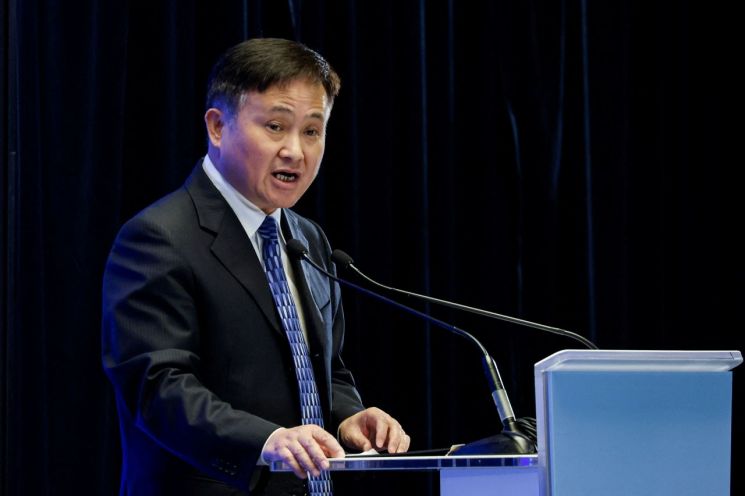
He explained, "Most of the debt maturities of financing vehicles have been extended or restructured, and the financing costs of local government debt have also significantly decreased," adding, "The number of high-risk small and medium-sized banks has been reduced to nearly half compared to the peak." According to the 'China Financial Stability Report' released by the People's Bank of China at the end of last year, out of 4,364 banks evaluated, 337 were classified as high-risk institutions.
Governor Pan emphasized, "The central bank aims to reasonably grow credit for enterprises and households and steadily lower financing costs while maintaining the stability of the yuan exchange rate." He also added, "Financial institutions have been encouraged to increase support for vulnerable groups and key sectors, meet reasonable consumer finance demand in a more focused manner, and study measures to strengthen macro policy adjustments."
Pressure from local government debt is considered one of the major risks facing the Chinese economy. The prolonged real estate market downturn and weak credit demand are delaying China's economic recovery. According to official statistics, new bank loans in China in July amounted to 260 billion yuan (approximately 48.3522 trillion KRW), marking the lowest level in 15 years and a decrease of 85.9 billion yuan compared to the previous year. In the same month, China's M1 money supply decreased by 6.6% year-on-year, reaching a historic low. China's Gross Domestic Product (GDP) growth rate was stronger than expected at 5.3% in the first quarter but slowed to 4.7% in the second quarter.
Lin Song, ING's Chief Economist for Greater China, stated, "The sluggish growth is likely to lead to additional monetary easing policies by the People's Bank of China, and considering the low interest rates and still limited risk appetite for domestic assets, there remains a certain level of capital outflow pressure."
© The Asia Business Daily(www.asiae.co.kr). All rights reserved.
![Clutching a Stolen Dior Bag, Saying "I Hate Being Poor but Real"... The Grotesque Con of a "Human Knockoff" [Slate]](https://cwcontent.asiae.co.kr/asiaresize/183/2026021902243444107_1771435474.jpg)















