'4+1 Reform' Plan Including National Pension Unveiled
Pension to Ensure Intergenerational Equity and Sustainability
Also Includes Measures for Healthcare, Education, Labor, and Low Birthrate
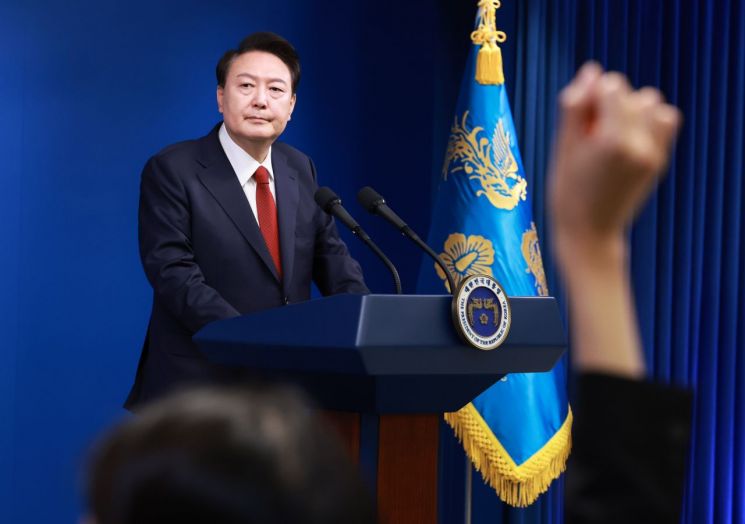 President Yoon Suk-yeol is answering questions from the press at the 'Two-Year Public Report and Press Conference of the Yoon Suk-yeol Administration' held on the morning of May 9 at the briefing room of the Yongsan Presidential Office building in Seoul. [Image source=Yonhap News]
President Yoon Suk-yeol will hold a national briefing this week to directly explain the achievements of major national tasks and future plans. The core of the plan is the ‘4+1 Reform’ concept, which includes responses to low birth rates alongside four major reforms in pensions, healthcare, education, and labor. In particular, President Yoon is expected to mention pension reform measures focused on intergenerational equity and sustainability.
Jung Jin-seok, Chief of Staff to the President, said in his opening remarks at a high-level ruling party-government meeting held on the 25th at the Prime Minister’s official residence in Samcheong-dong, Jongno-gu, Seoul, "The President will hold a national briefing this week," adding, "He plans to clearly present his vision and aspirations regarding key national tasks directly linked to the long-term future of the Republic of Korea to the public."
The exact date has not yet been confirmed, but it is expected to take place after the National Assembly’s Steering Committee meeting scheduled for the 27th. President Yoon is also expected to respond directly to questions from the media during this briefing.
At the briefing, President Yoon plans to announce pension reform measures. Currently, the National Assembly is focusing on parametric reforms that adjust the contribution rate and income replacement rate to delay the depletion of the National Pension Fund, but the government plan to be disclosed by President Yoon is said to place greater emphasis on fundamentally reforming the framework of the National Pension itself.
Basically, the plan aims to strengthen intergenerational equity by having the younger generation pay less in contributions while the generation soon to receive pensions pays more. For example, if the contribution rate for the middle-aged group is increased by 1 percentage point annually and the rate for the younger generation is increased by 0.5 percentage points annually, the burden on the younger generation can be somewhat reduced during the period it takes to reach the targeted increased contribution rate.
The plan may also include pension benefits for military service members and women giving birth. Currently, the ‘childbirth credit’ is recognized from the birth of the second child onward, but it is likely to be applied from the birth of the first child. Additionally, the period of military service recognized as pension contribution currently covers only up to six months, but it is expected to be extended to cover the entire military service period.
Furthermore, if the fund is at risk of depletion, mechanisms to automatically adjust contribution amounts and benefit payments will be established to ensure sustainability.
However, at this national briefing, President Yoon is expected to present only the broad direction of pension reform, with detailed government proposals to be announced by the Ministry of Health and Welfare early next month.
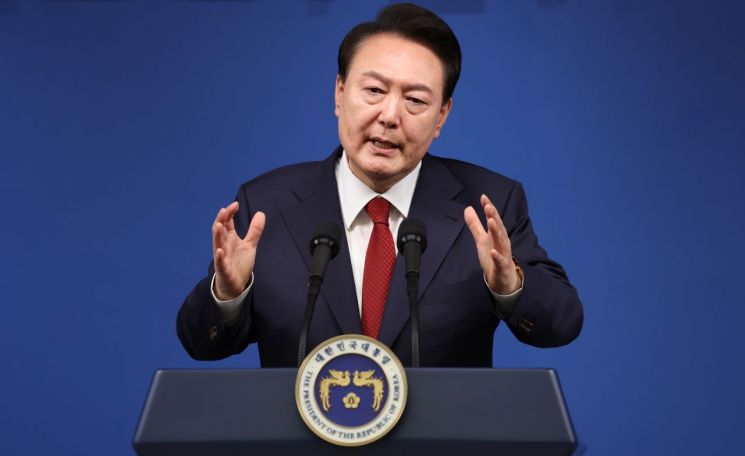 President Yoon Suk-yeol is answering questions from the press at the 'Yoon Suk-yeol Government 2-Year National Report and Press Conference' held on the morning of May 9 at the briefing room of the Yongsan Presidential Office building in Seoul.
 [Image source=Yonhap News]
President Yoon is also expected to address healthcare, education, labor, and low birth rate issues. Regarding education, the government’s focus on initiatives such as ‘Neulbom School’ and ‘Yubotonghap’ (integration of early childhood education and care) is expected to be emphasized. Key topics will also include AI textbooks and dismantling private education cartels.
In the labor sector, the focus is likely to be on protecting vulnerable workers such as unorganized laborers and non-regular workers, which President Yoon has consistently emphasized. At a public discussion on livelihood issues in May, President Yoon instructed the enactment of a law to protect vulnerable workers and also urged preparations to introduce legislation for establishing a labor court within his term.
In healthcare, the core plan is to shift tertiary general hospitals, which have relied on the sacrifices of resident doctors, to a specialist-centered system. The structure will be changed to allow focus on treating severe patients, and measures to strengthen support for essential medical personnel and address shortages of emergency medical institutions are also expected to be mentioned.
Attention will also be drawn to President Yoon’s remarks on responses to the low birth rate, an issue of great interest to him. He has previously announced plans to create a Population Strategy Planning Department to serve as a control tower for low birth rate issues, and recently established a Low Birth Rate Senior Secretary’s Office to handle this matter. Since launching the Population Strategy Planning Department requires amendments to the Government Organization Act by the National Assembly, cooperation from opposition parties will be sought.
© The Asia Business Daily(www.asiae.co.kr). All rights reserved.
![Clutching a Stolen Dior Bag, Saying "I Hate Being Poor but Real"... The Grotesque Con of a "Human Knockoff" [Slate]](https://cwcontent.asiae.co.kr/asiaresize/183/2026021902243444107_1771435474.jpg)

















