Sales Limited to 'One Bag per Person' at Marts and Supermarkets
Production Decreases Due to Heatwave... Demand Surges as Tourist Numbers Rise
There is a rice shortage occurring in Japan. While bread and noodles are available in supermarkets, polished white rice is sold out, and even the limited stock that arrives is restricted to a certain number of purchases per person. The term "Reiwa Era (since 2019) Rice Crisis" has even emerged.
Nihon TV (Nittere) has been focusing daily reports on the rice shortage, stating, "Rice is disappearing from supermarkets and grocery stores nationwide." Recently, Nittere showed empty rice shelves in supermarkets, explaining, "Rice is being sold with purchase limits, but the shelves are still empty." During their coverage, when six 5kg bags of white rice were stocked, a scramble among customers to buy them ensued. A customer who managed to buy one bag due to the one-bag-per-person limit told Nittere, "I finally found it at the seventh supermarket after going around several stores."
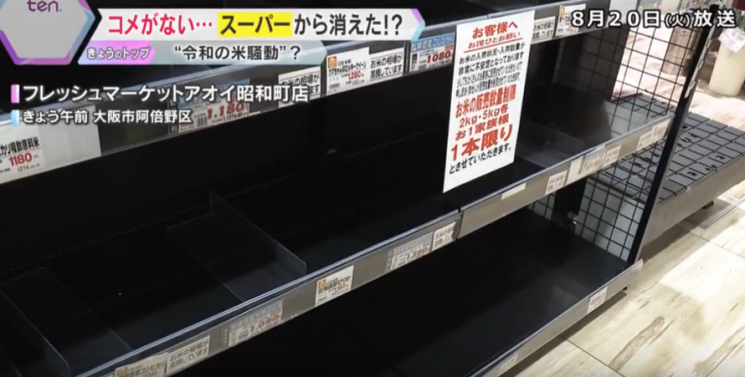 A supermarket in Osaka City. The rice display is completely empty. In front, there is a notice stating, "Purchase of rice is limited to 1 bag per customer, ranging from 2 to 5 kg." (Photo by NNN)
Moreover, as more people in the metropolitan area visit direct sales outlets at rice production sites to buy rice, these outlets have also experienced sellouts. NHK introduced the case of a rice direct sales outlet in Fukui Prefecture in the Hokuriku region, reporting, "Since the 10th of this month, there has been no white rice stock available for sale, and this situation continues."
On social networking services (SNS), posts such as "I checked supermarkets near my workplace, but they really don't sell rice. Even brown rice is gone," "There is no rice in stores, and if there is, it is really expensive," and "There is no rice, so I am only eating noodles" can be frequently seen. NHK added, "When investigating the popularity trend of the word 'rice' on Google over the past month, related search terms such as 'rice shortage' and 'no rice' appear, and the number has been steadily increasing since August."
This shortage is attributed to a decrease in rice production due to last year's heatwave combined with a surge in demand. Amid ongoing inflation, the price increase rate of rice has been relatively moderate compared to wheat-based processed products like bread and noodles, leading to increased demand as a substitute. Furthermore, the number of tourists visiting Japan has sharply increased, significantly boosting rice demand in restaurants and other establishments. According to the Ministry of Agriculture, Forestry and Fisheries, as of June, the annual demand for staple rice was 7.02 million tons, an increase of 110,000 tons compared to last year, marking a rise for the first time in ten years. On the other hand, rice stockpiles stood at 1.56 million tons at the end of June, down 20% (410,000 tons) from the same month last year, reaching the lowest level since 1999.
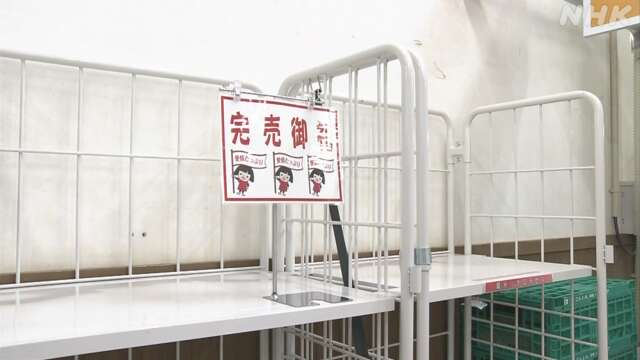 The sales counter at the Fukui City rice direct sales center is also completely empty with no stock. (Photo by NHK)
Additionally, after a magnitude 7.1 earthquake occurred off the coast of Miyazaki Prefecture on the 8th and a Nankai Trough Earthquake Advisory (major earthquake warning) was issued, panic buying spread nationwide, further impacting the situation. Nittere reported, "Since the Nankai Trough Earthquake Advisory was issued, inquiries at supermarkets in Osaka City surged to about ten times the usual volume for a week," adding, "Due to the combination of supply shortages and panic buying, current stock levels are estimated to be about 10% of normal."
The Ministry of Agriculture, Forestry and Fisheries stated, "August is normally the time when new rice shipments begin in earnest, and rice stockpiles are at their lowest point of the year," and reassured consumers by saying, "The situation is not yet urgent." However, consumer anxiety is growing. Japan experienced a similar rice crisis in 1993. Due to cold damage and prolonged rainy seasons, a rice shortage occurred, prompting the government to urgently import rice from countries like Thailand. However, the imported Thai rice did not suit Japanese tastes, leading consumers to seek domestic rice again, causing panic buying in supermarkets and other stores, and this confusion continued into the following year.
Currently, there is no solution other than waiting for the new rice harvest. In Shiga Prefecture, which produces rice in the Kansai region, harvesting has begun from mid-month. The Ministry of Agriculture, Forestry and Fisheries expects the shortage to ease next month when new rice shipments start. However, experts point out that this is an optimistic view. Ryoji Ito, an assistant professor at the Faculty of Agriculture, Niigata University, told ANN, "New rice from all over the country will start circulating only by November, so supply and demand issues will begin to be resolved then," adding, "The atmosphere is that prices will remain higher than usual until December."
© The Asia Business Daily(www.asiae.co.kr). All rights reserved.
![Clutching a Stolen Dior Bag, Saying "I Hate Being Poor but Real"... The Grotesque Con of a "Human Knockoff" [Slate]](https://cwcontent.asiae.co.kr/asiaresize/183/2026021902243444107_1771435474.jpg)
















