'Role of Real Estate PF for Stable Housing Supply' Discussion
"REITs as Starting Pitchers... Should Act as Equity Investors"
Financial Sector-Developers Demand Resolution of 'Information Asymmetry'
"Risk Management through Feasibility Assessment... 'Objectivity' is Key"
#. In October last year, the 'Ulsan Deokha Station Shinil Happy Tree The Roots' project site in Cheongnyang-eup, Ulju-gun, Ulsan, was classified as a sales guarantee accident site. This was because Shinil, a mid-sized construction company responsible for construction, entered court receivership (corporate rehabilitation procedure) on May 31. The project's equity capital accounted for only 3.0% of the total project cost, but the project financing (PF) loan amounted to 80 billion KRW, representing 28.7% of the total project cost. Sales performance was poor. In the six months following the start of sales in 2022, the actual sales rate was 3.0%, far below the planned sales rate of 60%. Four months later, Shinil applied for court receivership.
According to the Housing and Urban Guarantee Corporation (HUG), a total of 14 sales guarantee accidents occurred last year. After 8 cases in 2020, there was a quiet period for two years, but due to the downturn in the construction market, last year recorded the highest number in 11 years.
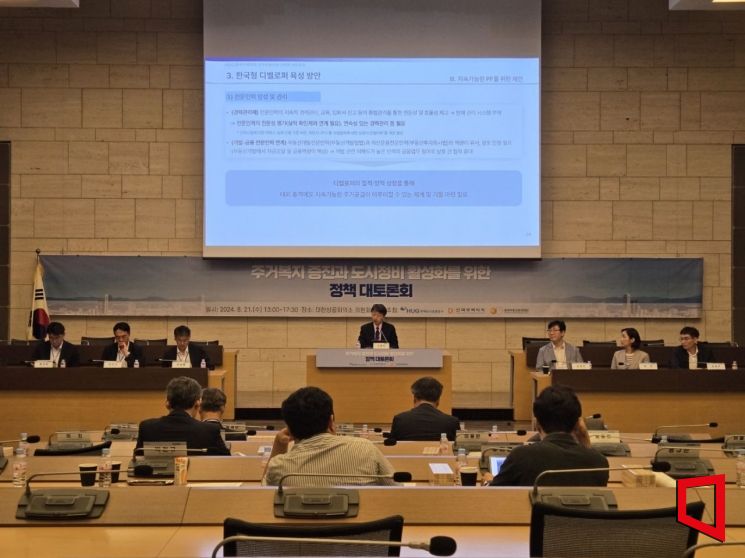 On the afternoon of the 21st, a discussion on the theme of 'The Role of Real Estate PF for Stable Housing Supply' is taking place at the Korea Chamber of Commerce and Industry in Jung-gu, Seoul. / Photo by Noh Kyung-jo
On the 21st, industry experts gathered at the Korea Chamber of Commerce and Industry in Jung-gu, Seoul, to discuss the 'Role of Real Estate PF for Stable Housing Supply' based on such cases. They pointed to the low equity ratio of developers as a cause of PF insolvency and proposed solutions such as activating investment through project REITs, establishing a real estate finance statistics system by the Ministry of Land, Infrastructure and Transport, and strengthening project feasibility evaluations.
Lee Jin, Director of Policy Research at the Korea Real Estate Development Association, said, "For sustainable PF, developers themselves must assign major shareholders and activate equity investments from external investors." He also urged efforts to activate investment through project REITs and blind funds and to secure major financial investors (FIs). In particular, he emphasized the need to prioritize attracting key players such as the National Pension Service to create an atmosphere for FI participation.
Park Cheon-gyu, Director of the Real Estate Research Division at the Korea Research Institute for Human Settlements, strongly agreed with the use of REITs. Director Park said, "REITs should act as starting pitchers, not relief pitchers," adding, "Although it may take time as it requires legal approval, project REITs should become the cornerstone so that REITs can play a role as equity investors." The Ministry of Land announced in June its 'REITs Activation Plan,' introducing 'project REITs' that allow REITs to directly develop, lease, and operate real estate.
Experts also agreed on the Ministry of Land's establishment of a PF statistics system. The Financial Supervisory Service has been strengthening continuous monitoring through the 'Integrated Real Estate Finance Exposure Management System' targeting financial institutions such as securities firms and asset management companies. However, the Ministry of Land pointed out that the lack of statistics on real estate finance such as PF causes information asymmetry, making it difficult to provide effective support measures to real estate developers compared to financial institutions.
Professor Yoo Seung-dong of the Department of Economics and Finance at Sangmyung University said, "There is much talk about financial market stability and protecting financial institutions regarding housing development finance, but little discussion on how to stabilize housing for ordinary people through development finance," adding, "We must build a statistics system to turn crises into opportunities."
As part of this, there was also a suggestion to strengthen project feasibility evaluations using HUG's housing sector data. Kim Seong-woo, Research Fellow at HUG's Housing and Urban Finance Research Institute, said, "Real estate PF insolvency is a matter of who bears the risk of unsold units," and added, "We need to develop products linking unsold unit loan guarantees through project feasibility evaluations and expand public guarantees such as completion guarantees to manage risks by project site." Jeong Gyu-chan, Team Leader of HUG's Financial Review Department, also said, "Institutional support is required to increase the predictability of project feasibility by utilizing data such as appropriate sales price assessment reviews."
Some raised doubts about whether objectivity is guaranteed in project feasibility evaluations. Kim Jeong-ju, Senior Advisor at the law firm Sejong, said, "I am not sure if it is possible to objectively analyze the Korean development market," pointing out, "Project feasibility may change due to unpredictable policy factors rather than economic fluctuations."
© The Asia Business Daily(www.asiae.co.kr). All rights reserved.
![Clutching a Stolen Dior Bag, Saying "I Hate Being Poor but Real"... The Grotesque Con of a "Human Knockoff" [Slate]](https://cwcontent.asiae.co.kr/asiaresize/183/2026021902243444107_1771435474.jpg)















