It Seems Handling Contentious Issues Between Ruling and Opposition Parties Will Take Time
Growing Consensus Between Ruling and Opposition Parties on Passing Livelihood Bills
Legislative progress on livelihood-related bills between the ruling and opposition parties is beginning to open up. In the National Assembly, which had been completely stalled for nearly three months since the 22nd session with no bills processed by agreement, there are now movements to handle livelihood bills. However, it appears that more time will be needed for contentious bills between the parties to undergo full review, including coordination of differing opinions.
On the 21st, the National Assembly held plenary meetings of the Land, Infrastructure and Transport Committee and the Industry, Trade, Energy, Small and Medium Enterprises Committee to process bills. Among these was the Special Act on Jeonse Fraud (Special Act on Support for Victims of Jeonse Fraud and Housing Stability). This bill was one that President Yoon Seok-yeol exercised his veto power on during the 21st National Assembly, but through compromise between the ruling and opposition parties in this session, a consensus was reached. This is the first time since the 22nd National Assembly that a compromise has been sought on an issue that had shown sharp disagreements between the parties.
The Special Act on Jeonse Fraud, agreed upon by the parties at the bill review subcommittee the previous day, centers on supporting victims of jeonse fraud through auction profits or allowing them to reside in public rental housing for up to 20 years. It also allows for living in private housing through the jeonse rental method, and provides an option to receive auction profits and vacate immediately. The opposition party had consistently insisted on a plan to directly support victims’ deposits through a "rescue first, recover later" approach. However, they agreed to the government and ruling party’s proposal, judging that support for victims should not be delayed any further. Additionally, the Land Committee processed the Taxi Act (Act on the Development of Taxi Transportation Business), which postpones the introduction of the taxi monthly salary system by two years. The Industry Committee also processed 10 bills, including the Act on Promotion of Mutual Cooperation between Large and Small-Medium Enterprises. This law includes provisions to protect small and medium enterprises by establishing prohibitive claims to prevent technology theft by large corporations.
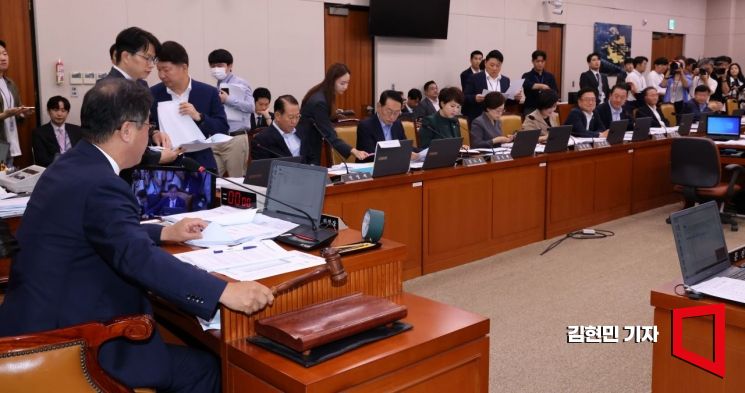 Maeng Seong-gyu, Chairman of the National Assembly Land, Infrastructure and Transport Committee, is striking the gavel at the plenary meeting of the Land, Infrastructure and Transport Committee held at the National Assembly on the 21st. At the meeting, the revised Special Act on Jeonse Fraud, which passed the subcommittee by bipartisan agreement, will be processed. The amendment includes measures such as the Korea Land and Housing Corporation (LH) purchasing houses affected by jeonse fraud at auction and providing them as long-term public rental housing to the victims. Photo by Kim Hyun-min kimhyun81@
Furthermore, the National Assembly is expected to accelerate bill reviews by standing committees, such as the Welfare Committee scheduling bill review sessions on the 22nd and 23rd. The ruling and opposition parties plan to hold a plenary session on the 28th to process the bills agreed upon.
The change in the situation is largely due to growing political fatigue caused by the opposition party’s unilateral processing of bills, which held a majority in the National Assembly, and the president’s exercise of veto power. For this reason, Choo Kyung-ho, floor leader of the People Power Party, proposed declaring a truce in political conflicts during the August extraordinary session. Kim Won-i, the Democratic Party’s secretary of the Industry Committee, said, "We held a subcommittee meeting yesterday, and the atmosphere was good," adding, "There is no distinction between ruling and opposition parties when it comes to livelihood and industrial development. There was even an opinion to hold subcommittee meetings more frequently in the future."
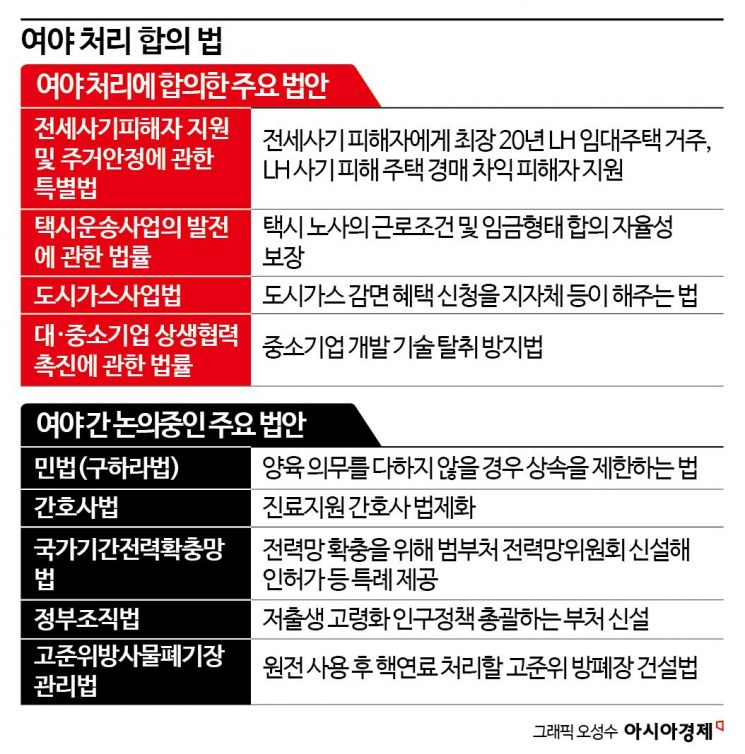
The key question is how much faster bills that both parties agree need to be processed can move forward. In the political sphere, the Civil Act (known as the Gu Hara Act) that prohibits inheritance by parents who fail to fulfill child-rearing obligations, the Nursing Act concerning the legalization of medical support nurses, the Government Organization Act to establish a ministry overseeing population policies such as low birthrate and aging, the High-Level Radioactive Waste Disposal Act, and the National Power Grid Expansion Act supporting power grid expansion are introduced as urgent bills emphasizing the need for processing. On the previous day, Kim Sang-hoon, chairman of the People Power Party’s Policy Committee, and Jin Sung-jun, chairman of the Democratic Party’s Policy Committee, met and agreed to encourage the review of non-contentious bills and committee-level deliberations.
However, among these, only the Nursing Act has been discussed even once in the bill subcommittee, which is the actual channel for bill discussions, while the Gu Hara Act, Government Organization Act, High-Level Radioactive Waste Disposal Act, and Power Grid Expansion Act have not yet begun proper discussions. According to a National Assembly committee official, "There is a kind of tacit understanding between the ruling and opposition parties to prioritize processing livelihood bills," but added, "When handling major issues between the parties, it is necessary to coordinate and reconcile differences, and currently, additional discussions between the parties are still needed."
© The Asia Business Daily(www.asiae.co.kr). All rights reserved.
![Clutching a Stolen Dior Bag, Saying "I Hate Being Poor but Real"... The Grotesque Con of a "Human Knockoff" [Slate]](https://cwcontent.asiae.co.kr/asiaresize/183/2026021902243444107_1771435474.jpg)

















