Gwangju Price Countermeasure Committee Decides to Implement Realistic Pricing from December
City Bus, Subway, and Taxi Fares Frozen... Aiming for Price Stability
Starting this December, water and sewage fees in Gwangju will increase, while local public utility fees such as city buses, city gas, and taxis will be frozen.
On the 20th, Gwangju City held a Price Countermeasure Committee meeting and announced that water fees will increase by 800 KRW and sewage fees by 560 KRW on average per month (based on a household usage of 14㎥).
On the other hand, it added that the committee reviewed and approved a plan to freeze all fees for city buses, city gas, urban rail, taxi fares, and garbage bag fees.
The Price Countermeasure Committee plans to raise water fees by 9.2% annually and sewage fees by 9% annually for four years from the December billing cycle through 2027.
Additionally, the progressive rate system for residential water fees that had been applied will be abolished and replaced with a flat-rate system.
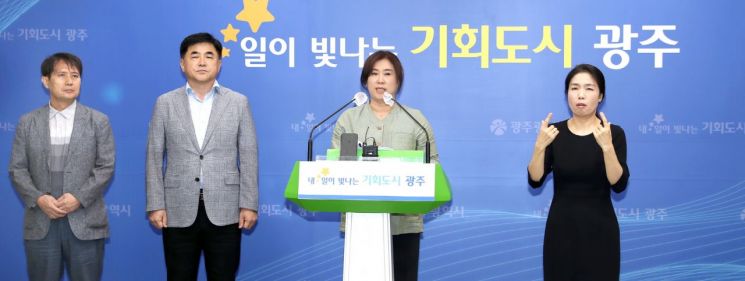 Son Hee-jung, Vice Chairman of the Gwangju City Price Countermeasures Committee, is announcing the results of the Price Countermeasures Committee meeting on the 20th at the city hall briefing room.
 [Photo by Gwangju City]
The Price Countermeasure Committee reported on the operational direction for five types of local public utility fees?city buses, city gas, urban rail, taxi fares, and garbage bag fees?to stabilize prices and reduce the burden on citizens, deciding to freeze these fees. It also decided to postpone the increase in public parking lot fees, which had been decided in 2020, considering the citizens' burden.
Gwangju City explained that the increase in water fees is inevitable as securing funds for essential facility investments such as replacing aging water pipes, constructing and expanding water reservoirs to prepare for water supply interruptions, and modernizing water purification plants is urgently required.
Sewage fees have also been frozen for three years since 2021, resulting in a deficit of 47.2 billion KRW based on the 2023 settlement, and the fee realization rate is 65.7%, the second lowest among metropolitan cities. Meanwhile, essential investment projects such as repairing aging pipes, separating stormwater and sewage systems, and upgrading sewage treatment plants to prepare for urban flooding due to climate crisis and improve river water quality are gradually expanding.
Regarding the approved increase in water and sewage fees by the Price Countermeasure Committee, Gwangju City plans to complete prior administrative procedures such as legislative notice of ordinances and, if the ordinance amendment is reviewed and approved by the Gwangju City Council in October, to promulgate and implement it thereafter.
Son Hee-jung, Vice Chairperson of the Gwangju City Price Countermeasure Committee (representative of the Gwangju Consumer Federation), said, "Most local public utility fees have been frozen to stabilize prices and minimize the burden on citizens. However, the phased increase in water and sewage fees is unavoidable due to the growing deficit and the need to carry out essential projects directly related to citizens' health and safety, such as replacing aging water and sewage pipes."
© The Asia Business Daily(www.asiae.co.kr). All rights reserved.

















