Mercedes-Benz PHEV Owners Unable to Verify Battery Manufacturer
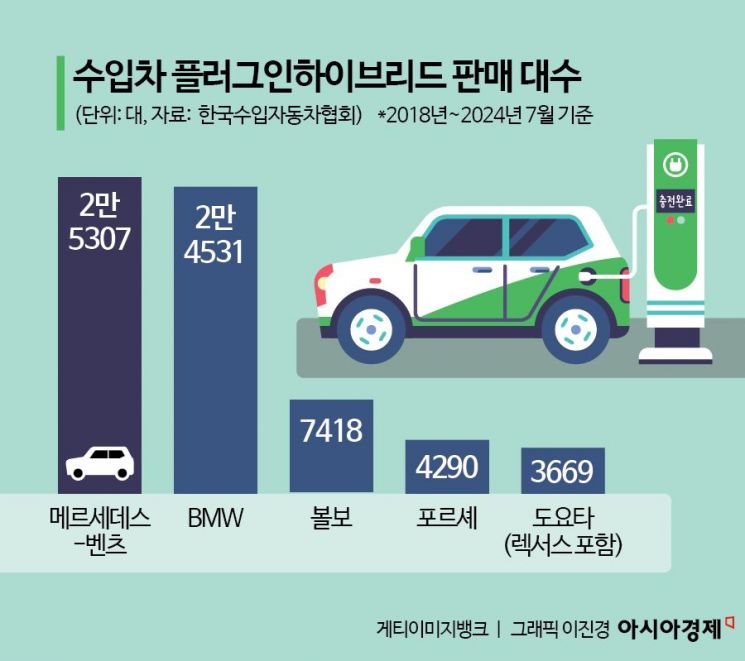
Mercedes-Benz, Largest Domestic PHEV Sales Brand Over Past 7 Years
PHEVs Equipped with Batteries Half the Size of Electric Vehicle Batteries
Exposed to Same Lithium-Ion Battery Fire Risks
The fear surrounding Chinese Parasys batteries is spreading to Mercedes-Benz plug-in hybrid electric vehicles (PHEVs). Parasys batteries recently drew attention after a fire occurred in a Mercedes-Benz electric vehicle equipped with them, raising concerns that they might also be installed in Mercedes-Benz PHEVs. While Mercedes-Benz recently disclosed the battery manufacturers for its electric vehicles, it has not revealed the battery manufacturers for its PHEVs.
According to comprehensive reporting on the 20th, Mercedes-Benz has sold the most PHEV vehicles among imported car brands over the past seven years. Data from the Korea Imported Automobile Association shows that Mercedes-Benz sold 25,307 PHEVs in the domestic market from 2018 through July of this year. Since launching its first PHEV model, the GLC 350 e, in 2018, Mercedes-Benz has established a PHEV lineup including the mainstay E-Class, the flagship S-Class, and the mid-large sports utility vehicle (SUV) GLE.
PHEVs combine the characteristics of electric vehicles and hybrid vehicles. Like conventional hybrids, they use both an internal combustion engine and an electric motor, but they can be charged externally, allowing for a relatively longer electric-only driving range.
However, because the battery capacity is also large, there are concerns that PHEVs are exposed to fire risks comparable to those of electric vehicles. For example, the Mercedes-Benz mid-large SUV GLE PHEV is equipped with a 31.5 kWh lithium-ion battery. This is about half the capacity of the battery used in Mercedes-Benz’s small SUV EQA electric vehicle (65.9 kWh). Compared to the battery capacity of the domestic small electric vehicle Hyundai Casper EV (49 kWh), it amounts to about 60%.
Mercedes-Benz Korea recently disclosed the "status of electric vehicle battery cell manufacturers" on its website but has not separately revealed the manufacturers of PHEV batteries. A company representative stated, "We are currently discussing with headquarters whether to disclose the PHEV battery manufacturers."
As Mercedes-Benz does not disclose the battery manufacturers for PHEVs, anxiety among vehicle owners is growing. This is because it is highly likely that Mercedes-Benz, which installed batteries different from those previously known in its electric vehicles, has also applied Chinese Parasys batteries to its PHEVs. A Mercedes-Benz PHEV owner posted on an online community, "I inquired about the battery manufacturer due to concerns, but the only response was that it is under discussion with authorities," adding, "I worry that there is a high possibility of Parasys battery installation."
There have also been PHEV fire incidents and recalls domestically. Last month, a fire broke out in a Jeep Wrangler PHEV parked in the underground parking lot of an apartment in Geoje City, Gyeongsangnam-do. This model was subject to a recall due to the possibility of high-voltage battery fires.
BMW conducted a recall of six PHEV models domestically and internationally in 2020 due to defects in high-voltage battery manufacturing. In the same year, Ford decided to recall the Kuga PHEV, which had been involved in repeated fire incidents, and replaced all battery packs in approximately 27,000 vehicles. Stellantis Korea disclosed the manufacturers of electric vehicle batteries and also revealed the manufacturers of PHEV batteries.
© The Asia Business Daily(www.asiae.co.kr). All rights reserved.
![Clutching a Stolen Dior Bag, Saying "I Hate Being Poor but Real"... The Grotesque Con of a "Human Knockoff" [Slate]](https://cwcontent.asiae.co.kr/asiaresize/183/2026021902243444107_1771435474.jpg)















