Establishment of Legal Grounds for Administrative and Financial Support
Including Status Surveys and Basic Promotion Plans
A legal basis supporting government support for metaverse (virtual convergence industry) operators has been established.
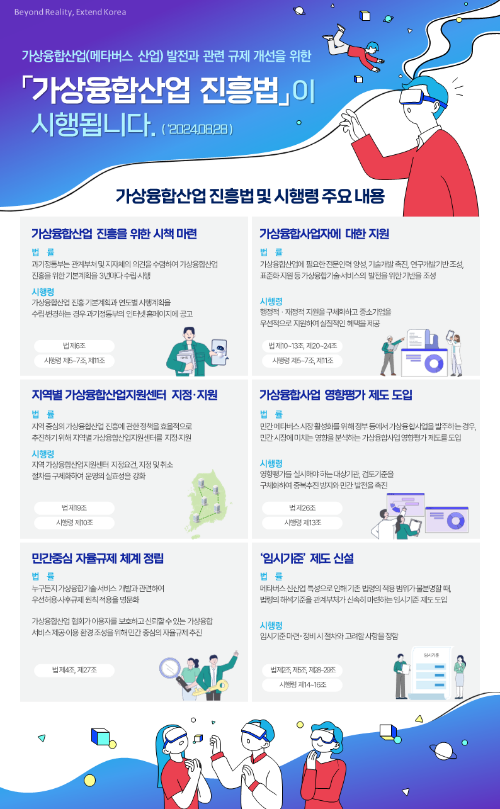
The Ministry of Science and ICT announced that the Enforcement Decree of the Virtual Convergence Industry Promotion Act was approved at the Cabinet meeting on the 19th and will be enforced from the 28th.
The Virtual Convergence Industry Promotion Act was enacted last February to promote the metaverse industry. It was established to create systematic promotion policies, foster a self-regulatory environment, and prepare a temporary standards system for proactive regulatory improvements, considering the characteristics of the virtual convergence industry that integrates various technologies and industries.
The enforcement decree approved at the Cabinet meeting is a follow-up measure to the law, with detailed provisions prepared through corporate meetings and expert consultations.
In the future, various policies will be implemented as stipulated by the law and enforcement decree, including ▲establishing a basic plan for promoting the virtual convergence industry ▲conducting surveys to identify industry status and regulatory improvement tasks ▲training specialized personnel ▲designating regional virtual convergence industry support centers.
Additionally, virtual convergence operators are expected to receive various administrative and financial supports.
The enforcement decree specifies the support that the government and local governments can provide to virtual convergence operators, such as information provision and consultation, provision of business spaces, and support for distribution activation. It also establishes grounds to prioritize support for small and medium-sized virtual convergence operators to foster specialized companies.
Moreover, when central administrative agencies and local governments promote virtual convergence projects, a virtual convergence industry impact assessment system will be introduced to analyze in advance the potential impact on the private market, such as market distortion.
This legislation explicitly applies the principle of prior permission and post-regulation regarding the development of virtual convergence technologies and services. It provides a legal basis for private-led self-regulation to proactively address new user protection issues that may arise in new industry areas while not hindering various innovations.
A temporary standards system to proactively improve regulatory issues will also be introduced. Temporary standards provide interpretative criteria for existing laws when the applicability or scope of current laws is unclear, eliminating regulatory uncertainty. This will increase legal predictability for operators and is expected to further activate the related industrial ecosystem.
The Ministry of Science and ICT plans to pursue follow-up measures such as preparing administrative rules, establish the basic plan for promoting the virtual convergence industry (2025?2027), and discover leading cases of temporary standards through industry consultations on regulatory improvements.
Minister Yoo Sang-im of the Ministry of Science and ICT stated, "The virtual convergence industry holds infinite growth potential and possibilities following innovations in digital technology. Now that a path has opened to systematically support the virtual convergence industry from a more mid- to long-term perspective, we will do our best to create an innovative industrial ecosystem."
© The Asia Business Daily(www.asiae.co.kr). All rights reserved.
![Clutching a Stolen Dior Bag, Saying "I Hate Being Poor but Real"... The Grotesque Con of a "Human Knockoff" [Slate]](https://cwcontent.asiae.co.kr/asiaresize/183/2026021902243444107_1771435474.jpg)
















