"AT&T Strengthens Market Position After Split"
"IBM Without Split, Stagnates by Complacency"
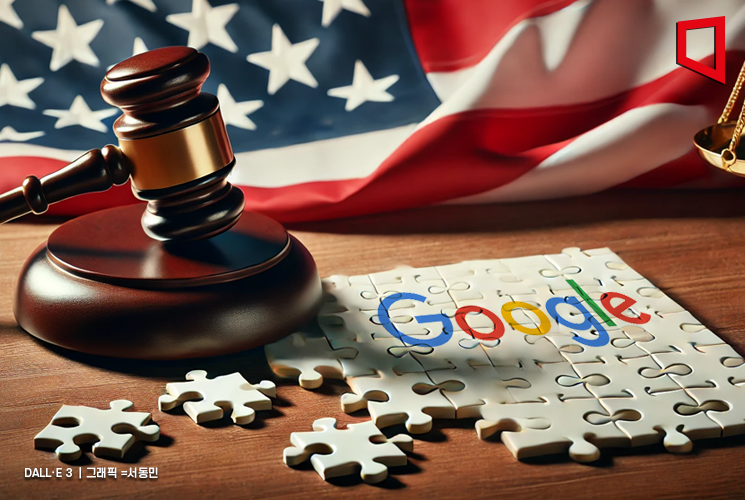
There is a prospect that the business division of Google, the world's largest search engine company, could actually benefit investors.
MarketWatch analyzed this on the 18th (local time) through the case of telecommunications company AT&T, which was split by the U.S. government. After losing a lawsuit that lasted over 10 years with the U.S. Department of Justice, AT&T was divided in 1984 into seven regional telephone companies known as the so-called 'Baby Bells.' Since the Baby Bells performed better than the U.S. market average in terms of stock price increase after going public, it is explained that Google could follow a similar precedent.
Earlier, on the 13th, Bloomberg reported that the U.S. Department of Justice is considering forcibly separating Google's Android operating system (OS) and Chrome web browser or forcing the sale of its advertising service company AdWords. This came after the Washington D.C. federal court ruled in May that Google’s payment of about $26 billion to Apple and others to set its search engine as the default on smartphone web browsers was illegal.
Although the U.S. stock market has been on the rise recently following easing concerns about a recession, Alphabet (Google's parent company) stock has been sluggish, indicating that the market clearly views the possibility of Google's forced breakup as a negative factor. Regarding this, MarketWatch stated, "Dividing Google into several separate companies could be a disguised blessing for Alphabet shareholders."
There is also speculation that a split Google could grow further by learning from its mistakes, similar to AT&T. Despite being split due to antitrust laws, AT&T now proudly maintains a duopoly with Verizon in the telecommunications sector. In this regard, MarketWatch introduced a statement from Robert Allen, who was AT&T's CEO in 1988, saying, "The breakup led to positive changes for us," and "We went through tough times for several years, but the results were good."
On the other hand, MarketWatch added that U.S. tech company IBM, which won its antitrust lawsuit against the Department of Justice, went downhill, citing James Stewart, an emeritus professor at Columbia University's Journalism School. In his 1993 memoir, Professor Stewart wrote, "I agree that after winning the antitrust lawsuit, IBM became complacent in the mainframe world they dominated and retreated." IBM, regarded by the market as an 'IT pioneer,' faced several crises, including selling its PC business in 2005 and semiconductor manufacturing division in 2014.
MarketWatch emphasized that while it is impossible to draw strong statistical conclusions from such cases, they serve as "a strong reminder that initial market reactions can be completely wrong."
© The Asia Business Daily(www.asiae.co.kr). All rights reserved.
![Clutching a Stolen Dior Bag, Saying "I Hate Being Poor but Real"... The Grotesque Con of a "Human Knockoff" [Slate]](https://cwcontent.asiae.co.kr/asiaresize/183/2026021902243444107_1771435474.jpg)
















