Most Poultry... Over 1.27 Million Aquaculture Farm Losses
KMA: "Heatwave to Continue for the Time Being Next Week"
Due to the heatwave, including record-breaking tropical nights, damage to livestock and aquaculture continues. Over the past two months, approximately 900,000 livestock have died from the heat.
According to the Central Disaster and Safety Countermeasures Headquarters (CDSCH) of the Ministry of the Interior and Safety on the 17th, about 900,000 livestock have died over the past two months since mid-June. This is an increase of about 121,000 from the previous day’s count of approximately 779,000.
The majority of the deceased livestock were poultry, accounting for about 848,000, while around 52,000 pigs also died.
Due to high water temperatures, damage to aquaculture fish such as rockfish and flatfish has been reported, totaling approximately 1,278,000 fish. By the 9th, about 500,000 fish had died, which is about 2.5 times more than the number eight days earlier.
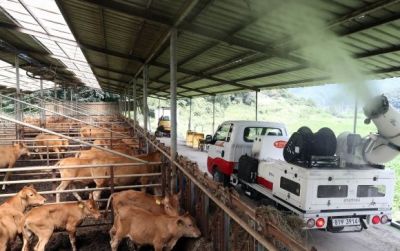 On the 7th, employees from the Animal Policy Team of the Buk-gu Office in Gwangju were spraying water to lower the temperature inside a livestock barn in Chunghyo-dong, Buk-gu, Gwangju.
 [Image source: Provided by Buk-gu Office, Gwangju]
Meanwhile, as of the 15th, a cumulative total of 2,652 heat-related illness cases have been reported.
There were 82 new cases on the 15th alone, which is 306 more than the 2,346 cases reported a year ago. The death toll remained the same as the previous day at 22.
The Ministry of the Interior and Safety activated Level 1 of the CDSCH at 7 p.m. on the 31st of last month and raised the heatwave crisis alert from ‘caution’ to ‘severe’ to respond to the heatwave.
The highest perceived temperature is around 35℃, and the intense heatwave is expected to continue until next week. On the 20th, a low-pressure system located west of the Korean Peninsula is expected to pass over the country, bringing rain nationwide. If the low-pressure system moves slowly, the rain could continue until the 21st.
While the rain will somewhat ease the heat, temperatures are expected to rise again after the rain stops, continuing the hot weather. Tropical nights are expected to occur in many areas, especially in the western regions and coastal areas.
© The Asia Business Daily(www.asiae.co.kr). All rights reserved.
![Clutching a Stolen Dior Bag, Saying "I Hate Being Poor but Real"... The Grotesque Con of a "Human Knockoff" [Slate]](https://cwcontent.asiae.co.kr/asiaresize/183/2026021902243444107_1771435474.jpg)















