Exclusion of Korea Continues in US Big Tech Pre-Elections
Domestic IT Companies Perform Well... Small Market Also a Burden
South Korea continues to be 'passed over' by US big tech companies such as Google and Apple. The strong performance of domestic information technology (IT) companies, regulations, and the small market size are cited as causes.
On the 15th (local time), Google announced that it will launch its 'Artificial Intelligence (AI) Overview' in six countries including the United Kingdom, Japan, Mexico, Brazil, India, and Indonesia.
AI Overview is a feature that, when searched on Google's website, prioritizes displaying a summary generated by the generative AI 'Gemini' at the top instead of the usual search results.
Google first unveiled this service in the United States during its annual developer conference 'I/O 2024' last May. The service supports the national languages in seven countries including the US. However, South Korea was again excluded from the launch countries this time.
The new smartphone 'Pixel 9' released by Google on the 13th was also not launched in South Korea. This marks the eighth consecutive year since the first Pixel phone launch in 2016 that South Korea has been excluded.
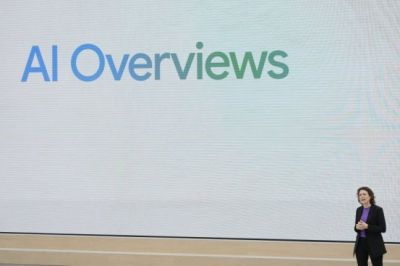 On May 14th (local time), at Google's annual developer conference (I/O) held at Google's Mountain View headquarters, Liz Reid, Vice President of Google Search, explained Google's AI overview.
 [Image source=Yonhap News]
The 'Google Store,' which sells Google's major hardware devices such as Pixel phones and smart home devices 'Nest,' operates in 38 countries worldwide but has no plans to enter the South Korean market. South Korea is also excluded from the family plan that offers discounted prices for YouTube paid memberships for families.
In Apple's case, on the 14th, it announced that from the upcoming fourth-quarter operating system (OS) iOS 18.1, it will allow third-party apps to use near-field communication (NFC) contactless payments, but the target countries are limited to the United States, United Kingdom, Japan, Australia, Canada, and Brazil. The 'Find My' feature used to locate lost devices is also disabled in South Korea.
Apple also did not sell the mixed reality (MR) experience device 'Vision Pro,' which was previously launched in 10 countries, in South Korea. Meta also excluded South Korea from the list of countries for the launch of its smart glasses 'Ray-Ban Meta.'
Industry insiders analyze that the strong performance of domestic IT companies such as Samsung Electronics, Naver, and Kakao in competition with big tech is a cause. There are also criticisms that South Korea's stringent regulations act as a burden for product launches.
Additionally, the small market size, with a population under 100 million and no single block formed with neighboring countries like the European Union (EU), is considered a disadvantage. Especially for AI, which requires language learning, the more native speakers of the language, the better. In other words, even if services are developed in Korean, they can only be used in the Korean market.
© The Asia Business Daily(www.asiae.co.kr). All rights reserved.
![Clutching a Stolen Dior Bag, Saying "I Hate Being Poor but Real"... The Grotesque Con of a "Human Knockoff" [Slate]](https://cwcontent.asiae.co.kr/asiaresize/183/2026021902243444107_1771435474.jpg)















