Reflecting on the Original Intent of National Governance... First Lady Kim Geon-hee Also Attended
Freedom Mentioned 50 Times in Total, "A Value That Runs Through Growth and Prosperity"
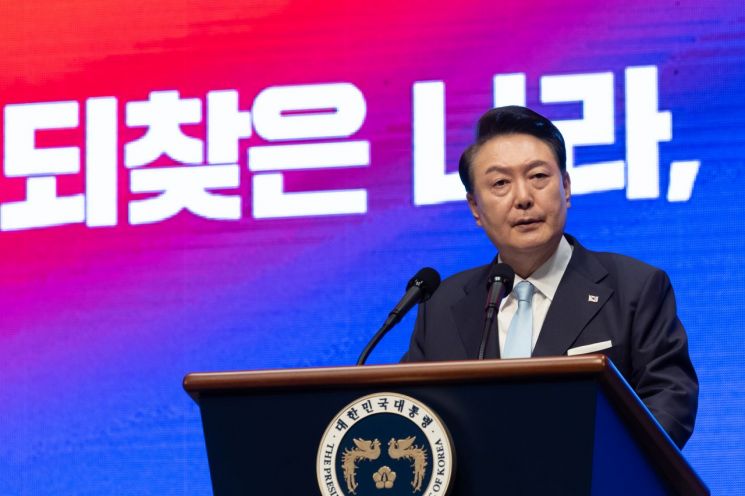 President Yoon Suk-yeol delivers a congratulatory speech at the 79th Liberation Day Celebration held at the Sejong Center for the Performing Arts in Jongno-gu, Seoul on the 15th. [Image source=Yonhap News]
President Yoon Suk-yeol presented a new 'unification discourse based on freedom' in his congratulatory speech at the 79th Liberation Day ceremony on the 15th. President Yoon announced the '8.15 Unification Doctrine,' structured as a 3-3-7 framework consisting of three major visions for unification, three major promotion strategies, and seven unification promotion plans, concretizing a strategy for unification based on liberal democracy.
At the Liberation Day ceremony held at the Sejong Center for the Performing Arts in Jongno-gu, Seoul, under the theme 'Recovered Nation, Great People, Greater Republic of Korea,' President Yoon wore a sky-blue tie, which he had also worn at his inauguration. Last year, he wore the same sky-blue tie at the Liberation Day ceremony to recall the 'original intention' of the national vision. First Lady Kim Geon-hee, dressed in a white suit jacket, also attended the event.
While last year's Liberation Day speech was about 3,700 characters long, this year President Yoon delivered a much longer speech of approximately 5,700 characters over 25 minutes, giving it special significance. Notably, the word 'freedom' was mentioned a total of 50 times, nearly double last year's 27 mentions. This emphasizes that freedom is a value that runs through the March 1st Movement, the establishment of the Shanghai Provisional Government, the 1945 liberation, the 1948 founding of the Republic of Korea government, the 1950 Korean War, and the growth and prosperity of the Republic of Korea.
30th Anniversary of the National Community Unification Plan, Announcement of Unification Promotion Strategy
Last year's Liberation Day speech included messages criticizing the North Korean regime and emphasized trilateral cooperation among Korea, the U.S., and Japan, but this year the focus was on 'unification.' President Yoon maintained the broad framework of the government's official unification plan, the 'National Community Unification Plan,' while emphasizing the future vision of unification and promotion strategies. The National Community Unification Plan is a three-stage unification plan?reconciliation and cooperation, confederation, and establishment of a unified state?developed in the 1990s amid the international context of the collapse of the former Soviet Union.
This year marks the 30th anniversary of the National Community Unification Plan announced by then-President Kim Young-sam in 1994, highlighting the need to reflect changes in the international situation and inter-Korean relations. President Yoon's 8.15 Unification Doctrine, announced on this day, stems from the recognition that the plan is difficult to apply in the current context 30 years later. It is known that President Yoon recognized the need to specify the vision and promotion strategy for unification we seek and actively reflected this in the preparation of the congratulatory speech for this Liberation Day.
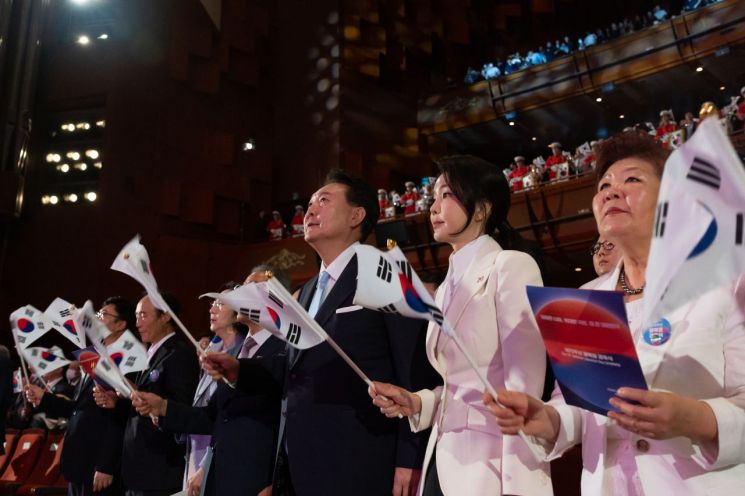 President Yoon Suk-yeol and First Lady Kim Keon-hee wave the Taegeukgi flag at the 79th Liberation Day celebration held at the Sejong Center for the Performing Arts in Jongno-gu, Seoul on the 15th.
 [Image source=Yonhap News]
On this day, President Yoon said, "In 1919, our people began efforts to establish a free democratic nation where the people are the masters on the Korean Peninsula," adding, "Although liberation came with Japan's defeat in 1945, as long as the division system continues, our liberation will inevitably remain incomplete." He continued, "The kingdom of frozen land deprived of freedom, the northern land suffering from poverty and hunger?freedom that we enjoy must be extended there," emphasizing, "Only on the day when a free democratic unified nation where the people are the masters is established throughout the Korean Peninsula will complete liberation be realized."
President Yoon explained the three major visions for unification as "▲ a happy country where the people's freedom and safety are guaranteed ▲ a strong and prosperous country leaping forward through creativity and innovation ▲ a country leading harmony and development in the international community and contributing to world peace and prosperity. This is the future of a unified Korea."
As the three major promotion strategies for moving toward a unified Korea, he cited ▲ firmly establishing the values and capabilities for the people to pursue free unification ▲ creating changes so that North Korean residents earnestly desire free unification ▲ and solidarity with the international community.
The seven unification promotion plans include ▲ revitalizing unification programs ▲ multidimensional efforts to improve North Korean human rights ▲ expanding North Korean residents' 'right to access information' ▲ promoting humanitarian aid to guarantee the survival rights of North Korean residents ▲ reflecting the role of North Korean defectors in unification capabilities ▲ proposing the establishment of a 'dialogue consultative body' between South and North authorities ▲ and creating an 'International Korean Peninsula Forum' to garner international support for free unification.
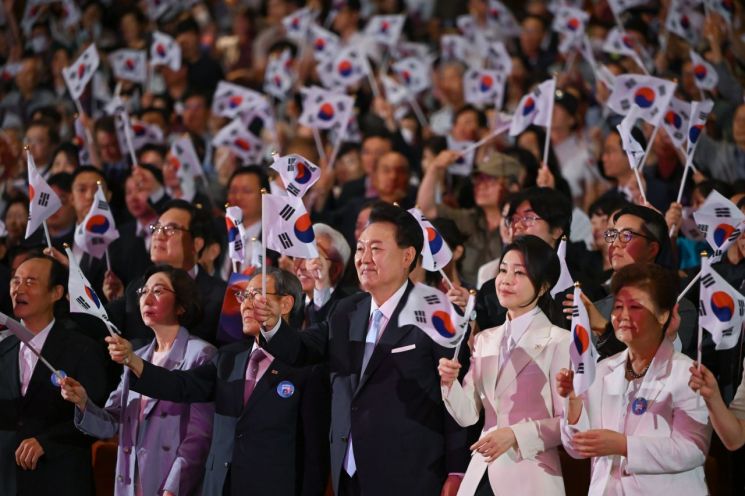 President Yoon Suk-yeol and First Lady Kim Keon-hee wave the Taegeukgi flag at the 79th Liberation Day Celebration held at the Sejong Center for the Performing Arts in Jongno-gu, Seoul on the 15th.
 [Image source=Yonhap News]
This year's speech did not place much emphasis on Korea-Japan relations, unlike last year. A senior official from the Presidential Office explained, "Today's speech implies that the Republic of Korea has grown to the extent that it has steadily achieved economic growth based on the value of freedom and can engage in fair competition with Japan on equal footing," adding, "Although Korea-Japan relations were not explicitly mentioned, confidence in Korea-Japan relations was conveyed."
At the event, Im Si-hyun, who won three gold medals in archery at the 2024 Paris Olympics, read the pledge, and Olympic participants including Heo Mi-mi, a silver medalist in judo at the 2024 Paris Olympics and descendant of independence activist Heo Seok, and Kim Woo-jin, a triple gold medalist in archery, attracted attention. Lieutenant Colonel Jo Eun-ae, who oversees the development of Korea's indigenous fighter jet at the Defense Acquisition Program Administration, also attended.
President Yoon personally awarded honors to five descendants of independence activists, including Moon Hyeong-bae, a descendant of the late Moon Il-seok who devoted himself to restoring national sovereignty in Gyeongbuk and Chungbuk, and 121 independence activists received government awards. The Presidential Office reported that about 2,000 people, including families of independence activists, key national figures, the diplomatic corps in Korea, and representatives from various sectors of society, participated in the ceremony.
Presidential Office: "Expression of 'Half-Event' Was Incorrect... Political Behavior Does Not Help National Interest"
Regarding criticism that the Liberation Day ceremony was a half-hearted event due to the absence of groups such as the Liberation Association, a descendant organization of independence activists, a Presidential Office official said, "About 2,000 people, including families of independence activists, shared the historical significance of liberation," adding, "The official event is the one attended by the President, and it is wrong to call it a half-event just because a specific group did not attend."
The official dismissed the criticism, saying, "The Liberation Association is not the sole subject of the independence movement and liberation," and "The absence of a specific group due to dissatisfaction with personnel does not damage the Liberation Day event." He added, "We plan to respond firmly to the baseless demands to withdraw the government's founding day plan," explaining, "While inheriting the spirit of the Liberation Association, we must not damage the honor of many people who contributed to liberation and independence."
He also pointed out, "On Liberation Day, when all citizens should share the joy of liberation, the political circles' behavior of adding a pro-Japanese frame and attempting to divide the people is not helpful to the national interest at all."
© The Asia Business Daily(www.asiae.co.kr). All rights reserved.
![Clutching a Stolen Dior Bag, Saying "I Hate Being Poor but Real"... The Grotesque Con of a "Human Knockoff" [Slate]](https://cwcontent.asiae.co.kr/asiaresize/183/2026021902243444107_1771435474.jpg)

















