If Prolonged, It Could Shake Global Copper Prices
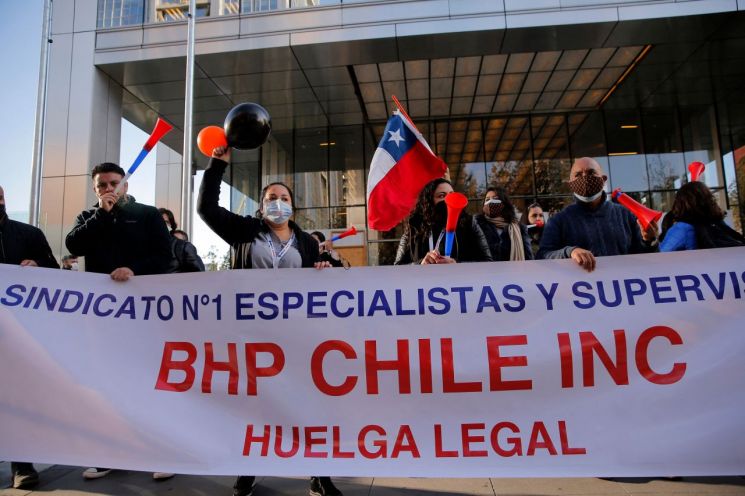 On May 27, 2021, workers at the Escondida mine in Chile are protesting in front of the building of BHP, the major shareholder company of the mine. [Image source=AFP Yonhap News]
Workers at the world's largest copper mine in Chile have gone on strike. There are concerns that disruptions in copper supply could shake global copper prices.
According to major foreign media including AFP on the 14th (local time), workers at the Escondida mine in northern Chile went on strike immediately after wage negotiations with management broke down. This mine is the world's largest copper mine, accounting for about 5% of the world's annual copper production. Australia's largest mining company BHP holds a 57% stake in this mine and operates it.
The mine's union, representing about 2,400 workers, demanded bonuses and shorter working days citing the sharp rise in copper prices earlier this year. However, since no agreement was reached with management, they proceeded with the strike.
Copper is widely used in industries such as electric vehicles, power grids, and wind turbines amid the global decarbonization trend. With the expansion of artificial intelligence (AI), demand is increasing further. Copper prices have risen 400% over the past 25 years. In April, for the first time in two years, the price per ton surpassed $10,000.
Management stated that operations will continue under an emergency system. However, they did not disclose the reduced production volume. Earlier the day before, BHP announced that it was deploying non-union workers to maintain "minimal operations" while dismissing striking workers.
The industry believes that since copper inventories are abundant, the strike will have minimal immediate impact on copper prices. However, if production delays continue for more than one to two weeks, negative effects may appear.
Previously, in 2017, workers at the Escondida mine went on strike for 44 days, halting copper production. As a result, BHP suffered losses of $740 million (about 1.035 trillion KRW), and Chile's economy also contracted.
© The Asia Business Daily(www.asiae.co.kr). All rights reserved.
![Clutching a Stolen Dior Bag, Saying "I Hate Being Poor but Real"... The Grotesque Con of a "Human Knockoff" [Slate]](https://cwcontent.asiae.co.kr/asiaresize/183/2026021902243444107_1771435474.jpg)















