14th AmCham 'US Work Visa Issuance Briefing'
"SMEs Should Avoid ESTA... Aim for L-1 and H-2B"
"If You Have a Travel Visa, Don't Show You're Working"
Communicate with US Border Protection Agency... Build Trust
When companies that have made astronomical investments in the United States, such as the four major groups (Samsung, SK, Hyundai Motor, LG), face production disruptions due to worker visa issuance issues, U.S. officials and experts emphasize that "no matter how urgent it is, documents must be meticulously prepared to secure an intra-company transferee visa (L-1) or a temporary worker visa (H-2B) before departing for the U.S." They stressed the need to break the vicious cycle of using the so-called 'travel visa,' the Electronic System for Travel Authorization (ESTA), to conduct 'work' for 90 days, only to be caught by U.S. authorities. Once a record of entry denial is made, re-entry becomes difficult, and with the strong anti-immigration stance in the U.S., enforcement is becoming stricter. The H-2B visa is a temporary non-agricultural worker visa used to mobilize temporary foreign labor needed in construction and manufacturing sites. It differs from the H-1B visa (professional employment visa) exclusively for foreigners with a U.S. bachelor's degree or higher.
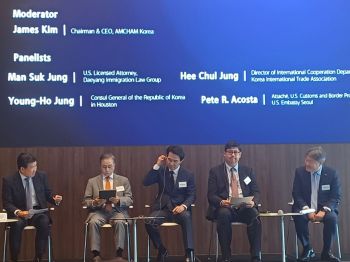 Panelists are discussing at the "U.S. Employment Visa Issuance Procedure Briefing" hosted by the American Chamber of Commerce in Korea (AMCHAM) on the 14th at The Forum, Two IFC, Yeouido, Yeongdeungpo-gu, Seoul.
 From the left: James Kim, AMCHAM Chairman; Jung Young-ho, Consul General of the Republic of Korea in Houston; Jung Man-seok, Senior U.S. Attorney at Immigration Corporation Daeyang; Pete Acosta, U.S. Customs and Border Protection (CBP) Attach? at the U.S. Embassy in Korea; Jung Hee-chul, Director of the Americas Office, International Cooperation Department, Korea International Trade Association.
[Photo by Moon Chae-seok]
On the 14th, Pete Acosta, Customs and Border Protection (CBP) Attach? at the U.S. Embassy in Korea, said at the "U.S. Employment Visa Issuance Procedure Briefing" hosted by the American Chamber of Commerce in Korea (AMCHAM) at Two IFC The Forum in Yeouido, Seoul, "If you are issued an ESTA or visitor visa (B-1, B-2) and are caught working in the U.S. contrary to the purpose of your visit, you will face difficulties with immigration," he said. About 110 HR, labor, and government relations officials from major companies such as Hyundai Motor and SK On, as well as small and medium-sized enterprises, attended the briefing.
Attach? Acosta warned that those issued ESTA (maximum stay of 90 days) or visitor visas (maximum 365 days) are classified as 'temporary visitors' and should not engage in long-term stays or employment activities. He emphasized that when temporarily visiting the U.S. with these visas, one must clearly explain the 'purpose of visit' during the CBP immigration inspection at the airport. CBP considers foreigners who act contrary to their stated purpose of visit as violating visa-related laws. Even a single record can lead to strict entry bans. Acosta said, "For example, technical personnel issued ESTA, B-1, or B-2 should complete equipment replacement or installation 'within a short period' and return quickly, and must not work as paid full-time employees in the U.S."
Jung Man-seok, Senior U.S. Attorney at Immigration Law Firm Daeyang, provided detailed explanations about the types and functions of 'non-immigrant visas' and 'immigrant visas.' Korean companies investing in the U.S. urgently need to obtain 'non-immigrant visas.' Non-immigrant visas include visitor visas (B-1, B-2), student visas (F1), employment visas (H-1B, H-2B), exchange program visas (J-1 internship), small investor visas (E-2), intra-company transferee visas (L-1), religious visas (R-1), and artist/athlete visas (O, P). Large corporations actively issue L-1 visas, but most small and medium-sized enterprises rely on B-1, B-2, and ESTA issuance.
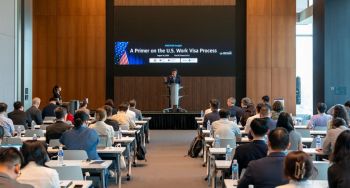 James Kim, Chairman of AmCham, is speaking at the "U.S. Employment Visa Issuance Procedure Briefing" held on the 14th at The Forum, Two IFC, Yeouido, Yeongdeungpo-gu, Seoul.
 [Photo by AmCham]
Attorney Jung advised that not only large corporations but also small and medium-sized enterprises should strive to secure L-1 and H-2B visas rather than relying on ESTA, B-1, or B-2. Recently, the U.S. CBP has been strictly assessing whether E-2 employee visa applicants are 'essential skilled workers.' He said documents must be meticulously prepared to verify essential employee status to CBP. CBP reviews the employer, visa applicant (worker), work dates, job title, initial employment date, position, duties, salary, official title, signature, and contact information. Both the worker and employer must meet the visa qualifications for the visa to be issued. Attorney Jung said, "Obtaining an ESTA instead of a formal visa and staying for 90 days to work in the U.S. is strictly speaking a loophole." He added, "Recently, companies like SK Innovation and LG Energy Solution have been advising their partner companies' employees to obtain visas through proper procedures."
Consul General Jung Young-ho of the Republic of Korea in Houston urged companies to maintain constant communication with CBP. He emphasized the importance of closely monitoring CBP operations at international airports in regions with many manufacturing plants, citing Atlanta and Chicago airports as examples. He advised explaining to CBP officers why the workers need to be there, disclosing lists, and transparently providing basic information to build trust. Consul General Jung said, "If you find answers to CBP's questions and present documents, entry with an ESTA visa may be permitted in some cases." He added, "When the visa stay period ends, you must write a pledge not to attempt permanent residency and return home, taking measures that CBP officials can trust."
The panelists reported that even large corporations face difficulties with visa issues. Consul General Jung said that due to visa problems, technical personnel could not enter the U.S. on time, delaying the completion of Samsung Electronics' Taylor plant. A Tesla parts supplier shared a case where visa issues led to U.S. entry denial, resulting in Vietnamese technicians taking their positions. Hyundai Motor, exposed to the Inflation Reduction Act (IRA) and other factors, is equally sensitive to visa issues. A Hyundai employee on-site asked whether using H-2B visas for employees who provide short-term technical training related to new cars to locally hired personnel (현채인) is reasonable. Attorney Jung responded, "The H-2B visa requires the owner (employer) to be a U.S. citizen, so Korean companies cannot obtain it." He advised, "It might be better to use visitor visas (B-1, B-2) or ESTA instead."
© The Asia Business Daily(www.asiae.co.kr). All rights reserved.


















