Yongin City Launches Service for Establishing 'Aged Planned City Maintenance Plan'
Encouraging Block-by-Block Integrated Development in Suji 1·2 Districts, Gugal 1·2 Districts, etc.
The blueprint for the reconstruction of aging apartments in the Suji 1 and 2 districts of Yongin City, Gyeonggi Province?an area effectively considered part of the Bundang New Town living zone?is set to be actively developed.
Yongin City announced on the 14th that it held a kickoff briefing for the project to establish the "Basic Plan for the Maintenance of Aging Planned Cities" on the 13th at the city hall video conference room.
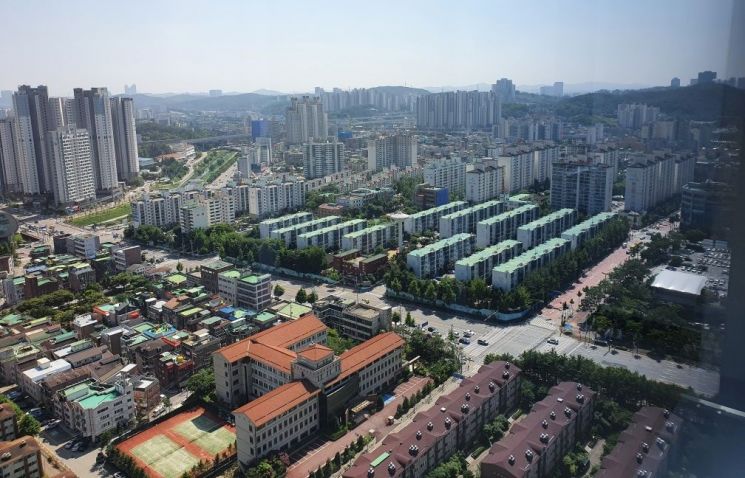 Panoramic view of the Suji district in Yongin. As Yongin City begins to actively establish a basic maintenance plan for aging planned urban areas, expectations for the reconstruction of old apartments in this area are also expected to rise.
 [Photo by Yongin City]
The "Basic Plan for the Maintenance of Aging Planned Cities," to be established through this project, will serve as a guideline presenting the fundamental direction for the reconstruction of aging planned city apartments such as Suji 1 and 2 districts and Gugal 1 and 2 districts, which were developed through land development. This is a measure following the enforcement of the "Special Act on the Maintenance and Support of Aging Planned Cities" at the end of April, aimed at the reconstruction of apartments in large-scale land development districts, including first-generation new towns.
The target for establishing the maintenance basic plan is public land development sites that are over 20 years old and cover an area of more than 1 million square meters. In Yongin, the Suji 1 and 2 districts and surrounding areas, as well as the Gugal 1 and 2 districts and surrounding areas, are included.
The area attracting the most attention is the Suji 1 and 2 districts. Combining Suji 1 district (948,000㎡) and Suji 2 district (947,000㎡) approaches 1.9 million square meters, and when including individually developed complexes nearby, the area reaches the scale of a new town. In Suji 1 district, 9,363 households began moving in from 1995, and in Suji 2 district, 6,581 apartment units were sequentially occupied starting in 1998.
Notably, Suji 1 and 2 districts are located south of Bundang New Town, separated by the Gyeongbu Expressway, effectively making them part of the Bundang living zone. Because of this, if reconstruction is promoted in conjunction with the first-generation new town redevelopment, this land development district is considered the most commercially viable among those outside the new towns.
The Gugal 1 and 2 districts are relatively smaller compared to the Suji districts. Gugal 1 district covers 216,000㎡, and Gugal 2 district covers 645,000㎡, totaling 861,000㎡, which falls short of the 1 million square meter threshold for the maintenance basic plan. However, the city believes that including surrounding aging apartments built around the same time could meet the criteria.
The city plans to encourage integrated block development by combining individual complexes in the maintenance basic plan and include public contribution measures for a portion of development profits resulting from increased floor area ratios. Through this, the plan aims to expand infrastructure such as apartments, aging roads, and parks, and to strengthen the function of central urban areas by reviewing complex developments around station areas and commercial and business districts.
The city will comprehensively review the project regarding ▲the spatial scope of aging planned cities ▲goals and promotion directions ▲designation of spatial scope for special maintenance zones ▲step-by-step promotion plans for maintenance projects ▲density plans for buildings. Based on the project results, the city will prepare the maintenance basic plan, gather public opinions, and proceed through the Aging Planned City Maintenance Committee and Gyeonggi Province review, aiming to finalize the plan by July 2026.
Once the basic plan is finalized, a special maintenance plan will be established for special maintenance zones, enabling maintenance projects such as reconstruction or redevelopment. The special act provides benefits such as exemption or relaxation of safety inspections in these cases.
A city official stated, "We will do our best to seek effective urban space reorganization measures through the establishment of the basic plan."
© The Asia Business Daily(www.asiae.co.kr). All rights reserved.
![Clutching a Stolen Dior Bag, Saying "I Hate Being Poor but Real"... The Grotesque Con of a "Human Knockoff" [Slate]](https://cwcontent.asiae.co.kr/asiaresize/183/2026021902243444107_1771435474.jpg)















