731 Families Applied... Final Selection of 157 Families
Gangnam Ranks 1st with 22 Families... Seocho 16, Songpa 15
Among the 10 households selected for the Seoul City pilot project for foreign domestic helpers, 3 households were located in the 'Gangnam 3 districts.' This is interpreted as a high demand from households that can afford the monthly salary of 1.19 million KRW based on 4 hours of service under the minimum wage.
Seoul City announced on the 14th that, excluding duplicate and applications from other cities and provinces, 731 households applied for the domestic helper pilot project, and 157 households were finally selected and notified. The selection of user households prioritized single-parent, dual-income, multi-child, and pregnant households, and decisions were made through consultations among the Ministry of Employment and Labor, Seoul City, and service providers, considering factors such as having children under 7 years old, longer requested usage periods, and regional distribution.
Interest was so high that the competition rate reached 5 to 1, and the area with the most selected households was Gangnam (22 households). Next were Seocho with 16 households, and Songpa and Seongdong with 15 households each, making 33.8% of the selected households from the Gangnam 3 districts. Previously, there were criticisms that the service fee was expensive due to the application of minimum wage to foreign domestic helpers, but it is analyzed that demand concentrated in the Gangnam area, where income levels are high. Households using the pilot project for 8 hours a day must pay 2.38 million KRW per month.
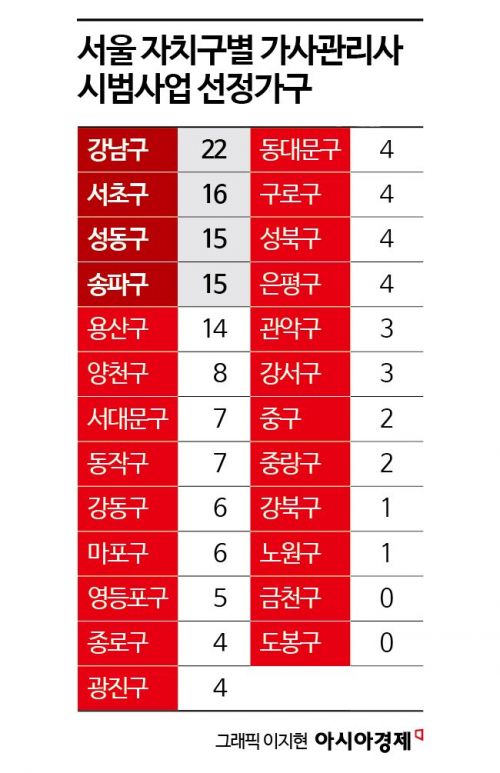
By region, besides the Southeast area including the Gangnam 3 districts accounting for 37.6%, the downtown area (Jongno, Jung-gu, Yongsan, Seongdong, Gwangjin, Seodaemun, Dongdaemun) had 50 households (31.8%), the Northwest area (Eunpyeong, Mapo, Yangcheon, Gangseo) had 21 households (13.4%), the Southwest area (Guro, Yeongdeungpo, Dongjak, Gwanak) had 19 households (12.1%), and the Northeast area (Jungnang, Seongbuk, Nowon, Gangbuk) had 8 households (5.1%).
By household type, dual-income multi-child households were the most common with 97 households (61.8%). Next were single-child households with 39 households (24.8%), pregnant households with 4 households (8.9%), and single-parent households with 7 households (4.5%). Regarding the age of children, 145 households had children aged 7 or younger, accounting for the majority (92.4%).
Regarding usage time, 'half-day' 4 hours was the most popular at 56.7%. Eight hours accounted for 38.2%, and 6 hours for 5.1%. On the other hand, longer usage periods and more frequent weekly usage were preferred. 91.1% (143 households) of the selected households applied for 6 months of usage, and 79.5% (125 households) applied for 5 or more times per week.
The scope of work for domestic helpers, which had been controversial, will be determined in advance through consultation when drafting the usage contract between the domestic helper and the household, based on the desired service tasks of each user household. If additional consultation is needed during use, the household cannot directly instruct the domestic helper but must go through the service center of the provider.
Kim Seon-sun, Director of the Seoul City Women and Family Office, said, "It is regrettable that we could not assist all applicant households as the pilot project operates with about 100 domestic helpers. We will carefully reflect the requirements of the selected households and the characteristics of the domestic helpers comprehensively at the matching stage to increase satisfaction for both user households and domestic helpers."
© The Asia Business Daily(www.asiae.co.kr). All rights reserved.
![Clutching a Stolen Dior Bag, Saying "I Hate Being Poor but Real"... The Grotesque Con of a "Human Knockoff" [Slate]](https://cwcontent.asiae.co.kr/asiaresize/183/2026021902243444107_1771435474.jpg)















