Ministry of Land, Infrastructure and Transport's Basic Policy for Renovation of Aging Planned Cities
Adjust Construction Volume When Relocation Demand Exceeds Supply
'Customized Guarantee Products by Project Stage' to Minimize Burden
The government has prepared various types of relocation measures to meet the relocation demand arising from the redevelopment projects of aging planned cities, including the 1st generation new towns. New housing will be supplied on idle land, and permanent rental housing will be reconstructed into apartment complexes such as mixed-use residential buildings, then supplied to relocated residents before being sold. If the relocation demand is excessively high, the timing of management disposition approval will be adjusted to control the volume of construction. On the 13th, the Ministry of Land, Infrastructure and Transport (MOLIT) held a permanent consultative body meeting with Gyeonggi Province and local governments of the 1st generation new towns to share the 'Basic Policy for Redevelopment of Aging Planned Cities' containing these details.
Supporting Relocation Demand through Idle Land Development and Permanent Rental Reconstruction
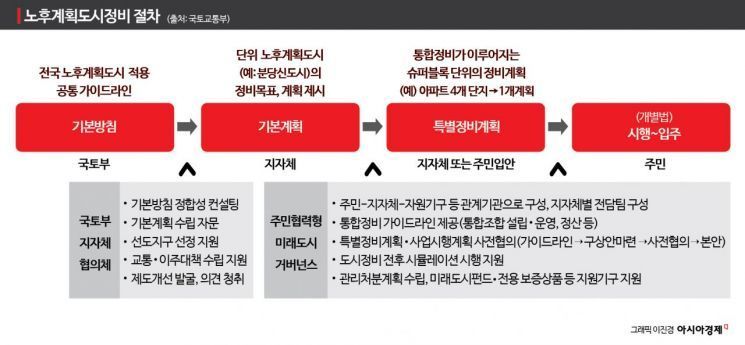
This policy, which serves as a guideline when local governments establish basic redevelopment plans for aging planned cities, includes relocation measures centered on a cyclical redevelopment model such as developing new idle land and reconstructing permanent rental housing.
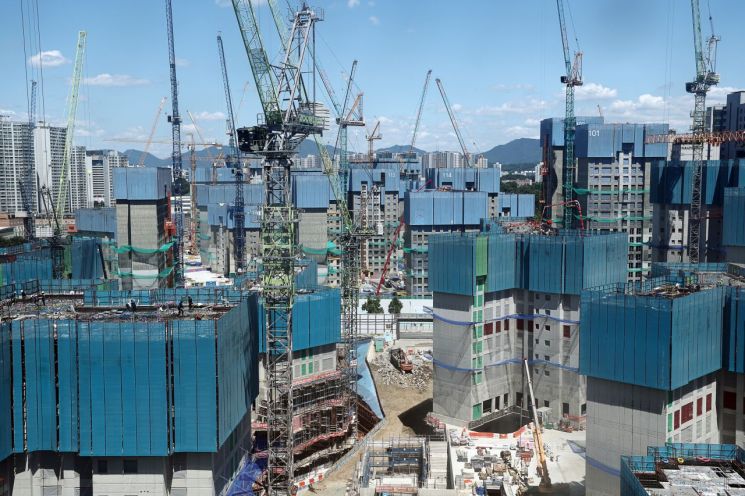
The government will develop new idle land to supply housing in various forms including public and private sales and rental housing. In the case of sale housing, relocated residents will live in these homes and then move into reconstructed houses, after which the previously occupied homes will be remodeled and sold.
Permanent rental housing located in excellent urban locations will also be reconstructed to meet relocation demand. Within the 1st generation new towns, there are a total of 13 permanent rental apartment complexes with about 14,000 units. Due to their low density, reconstruction is advantageous for increasing housing supply. Existing permanent rental residents must relocate during reconstruction, and to minimize this inconvenience, nearby rental housing will be utilized as much as possible.
An MOLIT official stated, "Reconstruction of permanent rental housing takes time to implement, so it is difficult to use it as a relocation measure in the leading districts of the 1st generation new towns," adding, "We will expedite this project so that relocated residents from aging planned city reconstructions can move in by 2030 at the latest."
MOLIT is also preparing financial products for relocated residents. Customized guarantee products tailored to each project phase will be structured to minimize the burden on relocated residents. Additionally, the 'Relocation Support REIT' funded by the Future City Fund will support relocation expenses and rental of relocation spaces. Relocation expenses are mortgage loans secured by the assets of association members.
The allowable redevelopment volume system will be used to manage relocation demand so that it does not exceed capacity. This system, under the Special Act on Aging Cities, adjusts actual construction volumes if housing supply is insufficient compared to relocation demand. Local governments can adjust relocation demand by controlling the timing of management disposition plan approval. Financial cost issues arising from timing adjustments will be resolved through policy financial support. However, special redevelopment zones such as leading districts have annual redevelopment plans in the basic plan and are designated without delay each year.
Plans to Propose Metropolitan Transportation Improvement Measures
In addition to relocation measures, MOLIT will propose metropolitan transportation improvement plans. This will support local governments in incorporating metropolitan transportation implementation plans into their basic plans. Currently, MOLIT is conducting research services on demand forecasting and alternative development to prepare metropolitan transportation improvement measures.
The Basic Policy for Redevelopment of Aging Planned Cities serves as a guideline for establishing basic plans for aging planned cities nationwide under the 'Special Act on Redevelopment and Support of Aging Planned Cities.' This is the first time the basic policy has been established since the special act was enacted. MOLIT will disclose the basic policy to local governments from the 14th until the 12th of next month to collect opinions. The basic policy will be finalized between October and November. It includes goals, basic directions, basic strategies, procedures and systems, national policies, and standards for establishing basic plans for redevelopment of aging planned cities.
Meanwhile, Bucheon City and Gunpo City in Gyeonggi Province will disclose the basic plans for Jungdong New Town and Sanbon New Town, the earliest among the 1st generation new towns, on the 14th. Through this, local council opinion surveys will be conducted in September, followed by reviews by the local redevelopment committee and consultations with MOLIT in December, and then approval by Gyeonggi Province.
Jungdong New Town will increase the floor area ratio to 350% during redevelopment, supplying an additional 24,000 housing units. The average floor area ratio of Jungdong New Town is currently 216%. The number of units will increase from 58,000 to 82,000. Sanbon New Town will apply a floor area ratio of 330%, supplying an additional 16,000 units from the existing 42,000 units. The current average floor area ratio is 207%.
Anyang City plans to disclose the basic plan for Pyeongchon New Town by the end of this month, and Seongnam City (Bundang) and Goyang City (Ilsan) will sequentially disclose their basic plans and begin public inspection thereafter.
© The Asia Business Daily(www.asiae.co.kr). All rights reserved.
![Clutching a Stolen Dior Bag, Saying "I Hate Being Poor but Real"... The Grotesque Con of a "Human Knockoff" [Slate]](https://cwcontent.asiae.co.kr/asiaresize/183/2026021902243444107_1771435474.jpg)

















