C-Commerce Offensive... E-Commerce Market Restructuring
Analysis of Employee Turnover Rates at 6 E-Commerce Companies in the First Half of This Year
Oasis Has the Highest Monthly Average Turnover Rate... Shinsegae Group the Lowest
The so-called 'Al-Te-Sh (AliExpress, Temu, Shein)' Chinese e-commerce (C-commerce) platforms have intensified their offensive, leading to a shrinking presence of domestic e-commerce companies, which are now undergoing large-scale restructuring. In this context, the highest employee turnover rates in the first half of this year were observed at online grocery shopping platforms Oasis and Kurly.
On the 19th, Asia Economy investigated the employee turnover rates for the first half of this year at six major domestic e-commerce companies based on data from the National Pension Service. Oasis recorded the highest average monthly turnover rate at 5.81%, followed by Kurly at 3.91%. The turnover rate was calculated by dividing the number of retirees (job changers), as defined by the Korea Labor Institute, by the number of employees in the previous month.

Oasis and Kurly Have the Highest Turnover Rates... Shinsegae Affiliates Lowest
11st ranked third with an average monthly turnover rate of 3.28%. While 11st had maintained turnover rates in the 1-2% range, it surged to 9.26% in April, significantly raising the average. This is analyzed to be due to the company's voluntary retirement program, conducted as part of comprehensive cost-cutting measures. Previously, in December last year, 11st accepted first-round voluntary retirement applications from employees aged 35 and over with more than five years of service, but the number of applicants was less than 10, falling short of expectations. Consequently, in April, a second voluntary retirement program was operated for all employees.
The largest domestic e-commerce platform, Coupang, had an average monthly turnover rate of 3.09% in the first half of this year.
Among domestic e-commerce companies, the lowest turnover rates were found in Shinsegae Group affiliates. Gmarket recorded the lowest turnover rate at 1.13% monthly, followed by SSG.com at 2.83%. SSG.com accepted its first voluntary retirement applications since its establishment last month, but the number of applicants was reportedly minimal. A Shinsegae Group official stated, "Due to the economic downturn and household financial difficulties, as well as various affiliate discounts offered to Gmarket and SSG.com employees?including Starbucks discounts, and discounts at E-Mart, No Brand, Shinsegae Food, department stores, and hotels"?adding, "The industry-leading welfare benefits appear to contribute to the low turnover rates."
Online Grocery Shopping Platforms Have Average Tenure of Less Than Two Years
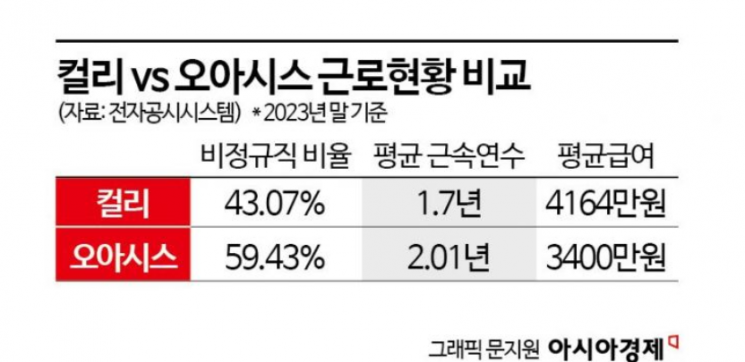
The high turnover rates at Oasis and Kurly are attributed to the large proportion of non-regular workers at their logistics centers. An Oasis representative explained, "The proportion of field workers is as high as 91%," adding, "Since the majority of employees are field workers, the turnover rate appears relatively high." A Kurly representative also clarified, "Employees working at logistics centers tend to have more freedom to join and leave compared to office workers, and their proportion is high at 70%."
According to the two companies' business reports, as of the end of last year, Oasis's non-regular worker ratio approached 60%. Notably, 7 out of 10 male employees at Oasis are non-regular workers. Kurly's non-regular worker ratio was 43.07%. As a result, Kurly's average tenure was only 1 year and 7 months. Oasis's average tenure was 2 years, with male employees averaging 1 year and 3 months.
Oasis and Kurly are competing for the title of 'Korea's first listed e-commerce company.' Both companies had previously pursued initial public offerings (IPOs) but withdrew; however, they have recently shown signs of resuming these efforts. Oasis has expressed intentions to acquire 11st, Korea's third-largest comprehensive online shopping mall, aiming to expand its volume, while Kurly is focusing all efforts on improving profitability. A retail industry insider commented, "As companies try to improve profitability through cost-cutting, work intensity increases, leading to higher turnover."
© The Asia Business Daily(www.asiae.co.kr). All rights reserved.
![Clutching a Stolen Dior Bag, Saying "I Hate Being Poor but Real"... The Grotesque Con of a "Human Knockoff" [Slate]](https://cwcontent.asiae.co.kr/asiaresize/183/2026021902243444107_1771435474.jpg)

















