"Unlike the United States, which can print dollars at will, we have to work hard and sweat to earn one dollar. The economics of the U.S. and ours are inevitably different."
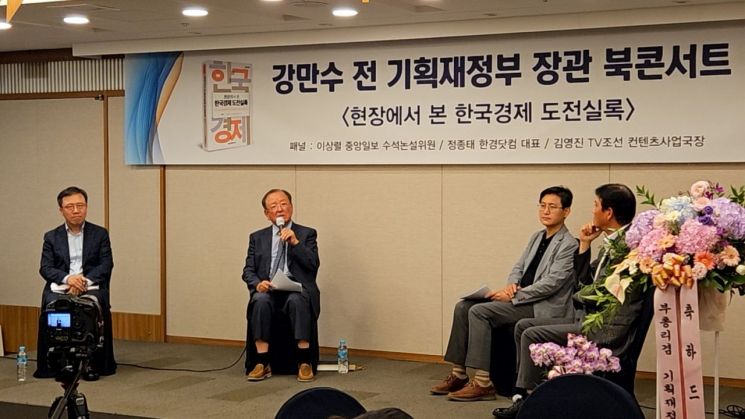 Former Minister of Strategy and Finance Kang Man-soo is speaking at the book concert "Challenges of the Korean Economy Seen from the Field" held on the 13th at the Korea Press Center in Jung-gu, Seoul. (Photo by Park Jae-hyun)
Former Minister of Strategy and Finance Kang Man-soo said this on the afternoon of the 13th at a book concert for his book Challenges of the Korean Economy Seen from the Field held at the Korea Press Center in Jung-gu, Seoul.
Kang, who first entered public service in 1970 and spent over 40 years on the front lines of economic policy, served as Vice Minister of the Ministry of Finance and Economy during the 1997 International Monetary Fund (IMF) foreign exchange crisis and as Minister of Strategy and Finance during the 2008 global financial crisis under the Lee Myung-bak administration, responding to two major economic crises.
He was the key figure who created economic policy pledges when Lee Myung-bak was a presidential candidate, and after the Lee Myung-bak government took office, he was appointed as the inaugural Minister of Strategy and Finance, playing a central role in overcoming the global financial crisis.
At the book concert, Kang emphasized, "The current international financial order is a system dependent on Uncle Sam, the American uncle personified," and added, "It is time to consider what practical Korean economics should become."
He pointed out, "The U.S. can print dollars at will, but we have to work hard and sweat to earn one dollar, so the economics of the U.S. and Korea are inevitably different," and said, "Reserve currency countries can just print money, but if we run out of dollars, it means national bankruptcy."
He continued, "For countries that are not reserve currency nations, fiscal policy and (foreign exchange) reserves are a matter of life or death."
Regarding the high exchange rate policy he promoted during his tenure, he said, "Just as a field army commander cannot wage war when seeing people bleeding in a field hospital, at that time, we had no choice but to ignore the groans of the field army," and apologized, "I am truly sorry to the low-income workers and self-employed who suffered the most from the rising exchange rate," then stood up and bowed deeply.
On the comprehensive real estate tax, he strongly criticized, saying, "The comprehensive real estate tax is political violence disguised as a tax," and added, "It is a tax that has never existed in human history and should never have been born."
Published on the 5th, Challenges of the Korean Economy Seen from the Field is a book that records the intense 40-plus years during which the Korean economy rose from a developing country to an advanced nation from the 1970s to the 2000s. It is a compilation and reorganization of two previously published books, 30 Years of the Korean Economy Seen from the Field and Records of Economic Crisis Response Seen from the Field.
Former President Lee Myung-bak, who attended as a guest of honor, said in his congratulatory remarks, "After the 2008 global financial crisis, while the world economy experienced negative growth, Korea achieved positive growth and overcame the crisis," and added, "Thanks to overcoming the financial crisis well at that time, when I attended international conferences, I noticed European leaders bringing chairs to sit next to me, which made me feel that Korea's status had greatly risen."
He continued, "When the nation is in crisis, there is no ruling or opposition party; everyone must unite their strength," and added, "I hope this book concert becomes an opportunity not to boast about our past but to honestly reflect on it."
© The Asia Business Daily(www.asiae.co.kr). All rights reserved.
![Clutching a Stolen Dior Bag, Saying "I Hate Being Poor but Real"... The Grotesque Con of a "Human Knockoff" [Slate]](https://cwcontent.asiae.co.kr/asiaresize/183/2026021902243444107_1771435474.jpg)















