Buyer Fuel and Aviation Fuel Conference Held for Carbon Neutrality
As demand for biofuels and biojet fuel is expected to increase to reduce carbon emissions, there have been calls to develop technologies from multiple angles to address this.
At the ‘2024 Seoul Biofuel and Biojet Fuel Conference for Carbon Neutrality’ jointly hosted by the Korea Biofuel Forum, the U.S. Embassy in Korea, and the U.S. Grains Council on the 13th, Juan Sacoto, Senior Director at S&P Global, said, "The EU, Canada, Japan, Brazil, and others have introduced mandatory blending policies, and the U.S. has adopted biojet fuel through strong support systems. Asian countries are also urging their governments for related policies and striving to develop Sustainable Aviation Fuel (SAF) for a rapid transition by the biofuel and aviation industries."
He added, "To cope with the rapidly increasing demand for SAF after 2030, rather than focusing solely on technologies using waste cooking oil as raw material, attention should also be paid to technologies that offer abundant raw materials and economic feasibility, such as Alcohol-to-Jet (ATJ) technology that converts plant-extracted ethanol into jet fuel."
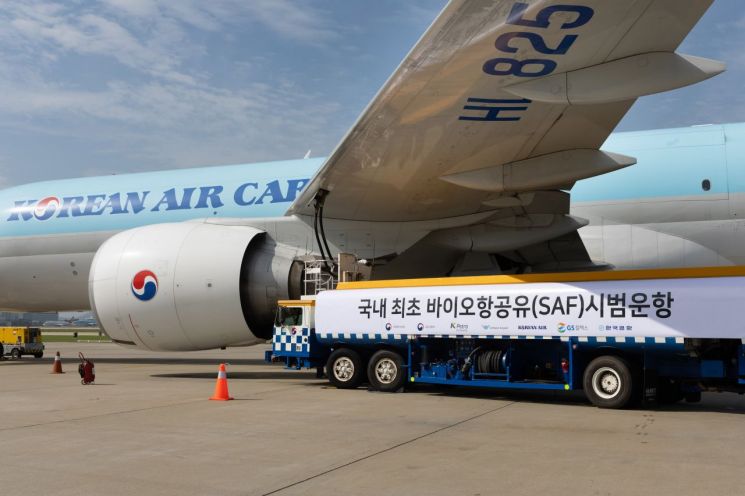 Korean Air and GS Caltex are refueling biojet fuel into a Korean Air Boeing 777F cargo aircraft for demonstration flights.
 [Photo by Korean Air]
This event was organized to inform the Korean government and related industries about international policies and market environments amid global efforts to develop various technologies and support systems to reduce greenhouse gas emissions in the transportation sector. Alexis Taylor, Deputy Secretary of the U.S. Department of Agriculture, proposed active cooperation between Korea and the U.S. in technology development and raw material procurement for carbon reduction in his opening remarks.
In the keynote speech, Youngsook Yoo, Chairperson of the Korea Biofuel Forum, said, "The efforts of the government and industry to participate in the global carbon reduction efforts are crucial not only to achieve the 2030 national greenhouse gas reduction targets promised to the international community but also to realize carbon neutrality by 2050." Kerry Cyphers, Vice President of the U.S. Grains Council, stated, "If we do not limit raw materials and technologies and cooperate internationally based on future competitiveness, we will become a competitive leading country in the biofuel and biojet fuel sectors."
There was also a point raised about the need to consider the amount of carbon emission reduction throughout the entire process of producing biojet fuel. Lee Seong Lee, Ph.D., from Argonne National Laboratory, said regarding Life Cycle Assessment (LCA), "It is possible to quantify the carbon emission reduction of SAF, and LCA analysis should be actively used to further decarbonize production pathways. Since ATJ technology using bioethanol can utilize existing large-scale ethanol infrastructure, it is expected to have significant potential for carbon reduction, and the Korean industry should take active interest."
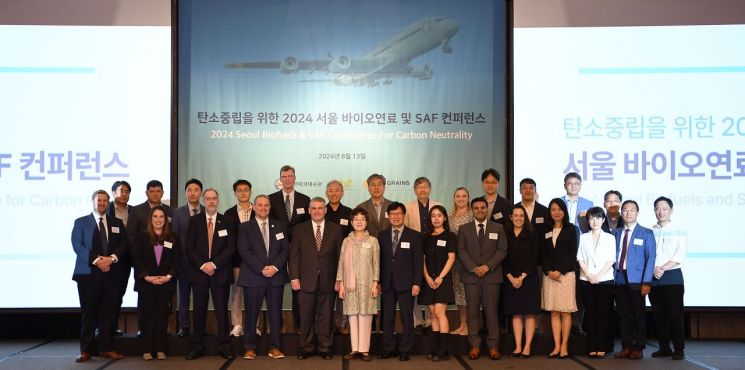 Participants are taking a commemorative photo at the "2024 Seoul Biofuel and SAF Conference for Carbon Neutrality" held on the 13th at the Four Seasons Hotel in Jongno-gu.
 [Photo by U.S. Grains Council]
Paul Bloom, Director at U.S. biojet fuel producer Gevo, said, "By 2050, biojet fuel demand in the U.S. alone will increase by 400 times the current production scale of our company and 1,200 times the current supply capacity. The economical alternatives to meet this surging demand will be not only HEFA, which produces fuel by hydrotreating vegetable oils and animal fats, but also ATJ technology." The company has contracts to supply biojet fuel to leading airlines such as Delta, American Airlines, and British Airways.
Mark Ingebretson, Consultant at the U.S. Grains Council, pointed out, "The HEFA method using waste cooking oil is the most realistic technology, but if SAF demand surges with limited raw materials, securing raw materials and economic feasibility will be difficult." Masahiro Tachibana, Counselor at the Embassy of Japan in Korea, said, "Japan operates a public-private committee composed of the government, refiners, and airlines to achieve the goal of blending 10% biojet fuel into aviation fuel by 2030."
About 250 people from various sectors, including the Korean government, refiners, airlines, government research institutes, and the biofuel industry, attended the event.
© The Asia Business Daily(www.asiae.co.kr). All rights reserved.
![Clutching a Stolen Dior Bag, Saying "I Hate Being Poor but Real"... The Grotesque Con of a "Human Knockoff" [Slate]](https://cwcontent.asiae.co.kr/asiaresize/183/2026021902243444107_1771435474.jpg)
















