"Introduction of 4.5-Day Workweek for Public Institutions and Private Companies under Gyeonggi Province"
"Promotion of Innovative Policies such as Income-Based Caregiver Support and Renewable Energy Profit Sharing"
"If No Referendum Intent by End of Month, Gyeonggi Northern Special Self-Governing Province to Proceed Independently"
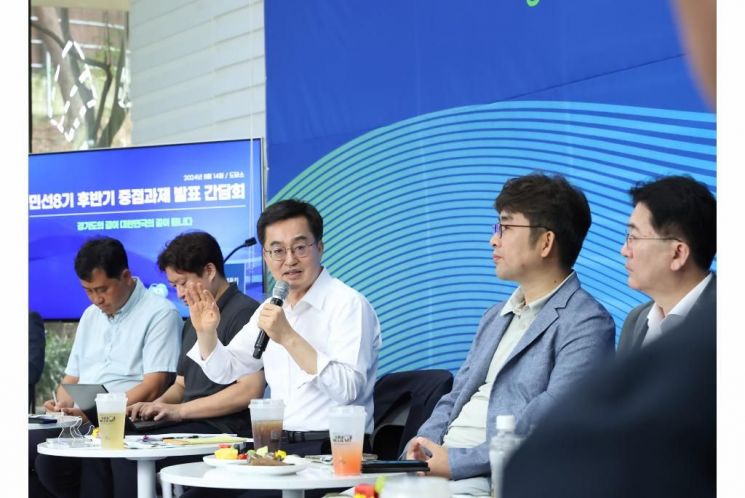 Gyeonggi Province Governor Kim Dong-yeon is speaking about the operational plan for the second half of the provincial administration at a press conference held at Dodamso in Suwon on the 14th.
Gyeonggi Province Governor Kim Dong-yeon is introducing a 4.5-day workweek system for public institutions under Gyeonggi Province and private companies as he enters the second half of his term. He will also implement new innovative policies such as support for low-income caregiving expenses and a renewable energy profit-sharing system. In particular, if the government does not express its intention to hold a resident referendum on the Gyeonggi Northern Special Self-Governing Province by the end of this month, Gyeonggi Province plans to proceed with what it can do independently.
On the 14th, Governor Kim held a press briefing at Dodamso (the former Gyeonggi Governor’s official residence) and announced his plans for future projects by selecting four key economic areas?opportunity, care, climate, and peace?as priority tasks for practicing a “people-centered economy (Humarnomics)” in the second half of his term.
Governor Kim first self-assessed, “In the first half of my term, I worked hard to create more opportunities in various fields such as economy, climate, diplomacy, and people’s livelihood,” and then emphasized, “In the second half, through ‘Humarnomics’ centered on people, I will take on new attempts and challenges as an ‘economic problem solver’ to address the economic, low birthrate, and climate issues currently facing South Korea.”
Humarnomics is a political philosophy proposed as an alternative to overcome the blind spots of traditional economics. It aims to address problems such as social inequality and polarization, which arise from the quantitative growth strategy focused on Gross Domestic Product (GDP), by realizing quality of life, enhancement of individual capabilities, and happiness.
Since presenting ‘Humarnomics’ as the core strategy of Gyeonggi Province’s administration in the February 2024 Gyeonggi Provincial Assembly policy speech, Governor Kim has been concretizing policies based on it. The opportunity income project, a representative project of the first half of the 8th term of the provincial government, can be seen as a typical policy reflecting the philosophy of ‘Humarnomics’ as it promotes activities that create social value through economic investment.
In the opportunity economy sector for the second half of his term, Governor Kim plans to introduce a ‘4.5-day workweek’ without wage cuts and a ‘0.5 & 0.75 job’ project to prevent career breaks.
First, to address low birthrate and reduced working hours, a pilot program for a ‘4.5-day workweek without wage cuts’ will be implemented targeting 50 private companies in the province and some public institutions under the province. The main options include ▲biweekly 4-day workweek ▲35-hour workweek ▲half-day work on Fridays every week. Participating institutions or companies can choose and implement the appropriate option through labor-management agreements.
Additionally, to complement the shortcomings of parental leave and birth support allowance systems, which are measures against low birthrate, and to support those who cannot take parental leave due to concerns about career breaks, the ‘0.5 & 0.75 job’ project will be introduced.
‘0.5 job’ is a modified form of employment where one works 4 hours a day, totaling 20 hours per week (working 2 to 3 days a week), and ‘0.75 job’ involves working 6 hours a day, totaling 30 hours per week (working 3 to 4 days a week).
Gyeonggi Province will conduct a pilot project targeting family-friendly companies among public institutions and private companies. It plans to provide support such as system consulting (education), costs for introducing attendance management systems, subsidies for delegated tasks, and additional employment incentives.
Moreover, the province will continue major projects from the first half of the 8th term aimed at expanding opportunities, including the creation of three future industry innovation clusters in semiconductors, bio, and mobility, attracting investments exceeding ‘100 trillion won+’, and six opportunity incomes such as for artists and persons with disabilities.
In the care economy sector, Governor Kim will newly launch the ‘Gyeonggi Province-style Caregiving SOS Project’ aiming to provide more equitable opportunities.
This pilot project, which urges the establishment of a national caregiving support system, targets low-income elderly residents aged 65 or older registered in Gyeonggi Province who have been hospitalized in hospital-level or higher medical institutions due to injury or illness and have received caregiving services. Caregiving expenses of up to 1.2 million won per person annually will be supported. This amount corresponds to two months of caregiving costs in a six-person shared hospital room.
The ‘360° Care’ project, a representative welfare policy of the 8th term, will also be actively promoted along with the introduction of family care allowances, expansion of 400 public and national daycare centers, and AI+ care, an elderly care policy utilizing artificial intelligence.
In the climate economy sector, Governor Kim will promote new projects such as the public-led renewable energy profit-sharing system ‘Gyeonggi RE100 Fund,’ ‘Gyeonggi Climate Satellite Launch,’ and ‘Climate Insurance Subscription.’
The Gyeonggi RE100 Fund is a policy that installs solar power plants on unused national and public land within the province, supplies the generated electricity to RE100 companies, and returns a portion of the power generation profits to participating residents through the fund.
The project will run from 2025 to 2045, aiming to build renewable energy power plants with a capacity of 15MW on parking lots, idle road areas, bicycle paths, university campuses, and other sites. Gyeonggi Province plans to establish a special purpose corporation (SPC) specializing in renewable energy under Gyeonggi Province Corporation to handle power plant construction and fund management. The province intends to encourage participation from local energy cooperatives, subordinate organizations of cities and counties, and financial institutions when establishing the SPC. To this end, amendments to ordinances and articles of incorporation will be pursued in the second half of this year.
The Gyeonggi Climate Satellite project will also be promoted to establish a differentiated climate change response strategy by securing independent climate data. As a public-private partnership, preparations will begin in 2025, and the satellite launch is planned for 2029 to obtain high-resolution data to enhance Gyeonggi Province’s capacity to respond to climate crises.
Gyeonggi Province will also introduce climate insurance aimed at eliminating climate divides and building a social safety net by mitigating health damages caused by climate change. The climate divide refers to disparities arising between advanced and developing countries, large corporations and small and medium enterprises, and prepared and unprepared groups in adapting to climate change, similar to the ‘digital divide’ in information access. This concept was first proposed by Governor Kim at the ‘Climate Reality Leadership Training’ held at KINTEX in Goyang in August 2023.
Furthermore, a project to provide a fixed amount of support to Gyeonggi residents diagnosed with diseases such as infectious diseases, heat-related illnesses, and cold-related illnesses caused by climate disasters will be introduced next year.
Additionally, projects such as creating an RE100 special zone by converting the Sihwa Lake area into a renewable energy complex aiming to expand renewable energy equivalent to one nuclear power plant, establishing the Gyeonggi RE100 Garden, and implementing a shared electricity rate system for apartments will be pursued simultaneously.
Based on his belief that ‘peace is economy,’ Governor Kim will also work to ease tensions between North and South Korea and establish a peace regime, turning the DMZ’s ecological and tourism resources into growth potential for South Korea. To this end, he plans to swiftly advance the establishment of the Gyeonggi Northern Special Self-Governing Province along with a large-scale development project in northern Gyeonggi.
Meanwhile, Governor Kim cited economic, climate, diplomatic, and livelihood projects as major achievements in the first half of his term.
He first highlighted that during the first half of his term, he attracted investments totaling 69.2 trillion won, achieving about 70% of his 100 trillion won goal during his term, solidifying his status as a ‘money-making governor.’ He also declared the ‘Gyeonggi RE100 Vision’ across four major sectors?public, corporate, residents, and industry?and established the status of a ‘climate governor’ by building Korea’s first ‘climate change platform.’
Governor Kim also showcased his role as a ‘global governor’ by meeting with heads of state, government officials, and business leaders from over 37 countries and more than 160 people over the past two and a half years, leading innovation alliances, economic and talent exchanges.
In particular, he self-assessed that he earned passing marks as a ‘people governor’ through opportunity incomes for artists and persons with disabilities, the 360° Care project, and the youth’s three major opportunity packages.
© The Asia Business Daily(www.asiae.co.kr). All rights reserved.
![Clutching a Stolen Dior Bag, Saying "I Hate Being Poor but Real"... The Grotesque Con of a "Human Knockoff" [Slate]](https://cwcontent.asiae.co.kr/asiaresize/183/2026021902243444107_1771435474.jpg)















