Continued Increase in Foreign Currency Deposits by Domestic Residents
Analysis of Contribution to Financial Market Stability
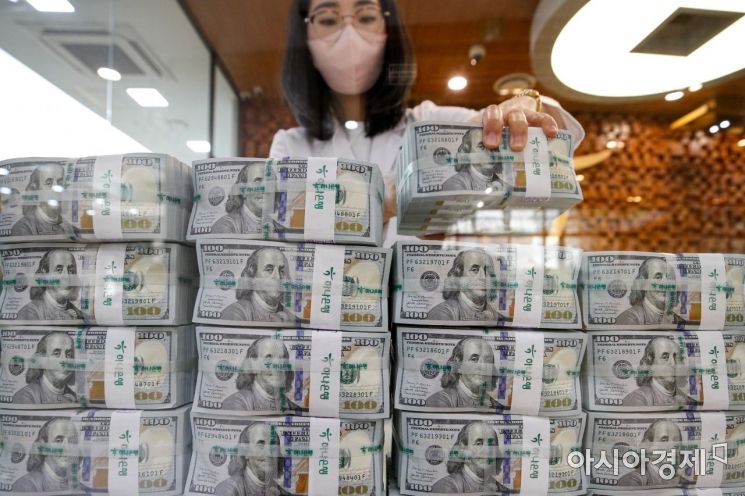 An employee is organizing US dollars at the Hana Bank Counterfeit Response Center in Jung-gu, Seoul. Photo by Jinhyung Kang aymsdream@
An analysis has emerged that the increasing foreign currency deposits held by domestic residents contribute to market stability during financial instability.
According to the Bank of Korea's report titled 'Characteristics and Implications of Resident Foreign Currency Deposits' on the 13th, external borrowings have decreased significantly and resident foreign currency deposits have greatly increased due to the government's efforts to strengthen macroprudential policies following the global financial crisis.
At the end of 2009, the proportion of foreign currency borrowings among major foreign currency funding sources (excluding derivatives) of foreign exchange banks reached 43%, but as of the end of last year, it fell below 20%. Conversely, foreign currency deposits rose sharply from around 18% to approximately 40%.
Most foreign currency deposits are held by corporations. As of the end of last year, by holder, corporations accounted for 85% of resident foreign currency deposits, and by currency, the US dollar accounted for 83%, making up the majority. By maturity, short-term deposits of one month or less accounted for 78%, and by account type, demand deposits such as ordinary deposits and checking accounts made up 65%.
Lee Jong-chan, head of the Capital Movement Analysis Team at the Bank of Korea's International Department, who authored the report, explained, "In Korea's case, the proportion of foreign currency deposits held for savings purposes is low, and it can be inferred that transactional factors, such as export-import companies temporarily depositing foreign currency needed for external transactions, constitute most of the deposits."
Lee added, "The growth rate of resident foreign currency deposits has particularly accelerated since 2013, which is attributed to the government's implementation of various incentive schemes for foreign currency deposits at the end of 2012."
This characteristic of increasing foreign currency deposits is analyzed to have contributed to securing foreign currency liquidity for banks and stabilizing the foreign currency funding market during the spread of global financial market crises.
Lee emphasized, "During the COVID-19 pandemic crisis, the foreign currency funding market showed instability due to a surge in foreign currency fund demand from non-bank financial institutions for managing derivative transaction margins, but the continuous inflow of resident foreign currency deposits contributed to market stabilization."
As resident foreign currency deposits increased mainly in domestic banks, Korea's reliance on foreign bank branches for short-term foreign currency funding decreased, leading to an increase in high-liquidity assets and improving the foreign currency asset and liability structure of domestic banks. The low funding cost is also positive for the profitability of domestic banks.
As of the end of last year, Korea's ratio of foreign currency deposits to total deposits was 5.4%, which is relatively low compared to the average of 20.1% among 21 OECD countries with available data.
Accordingly, the report argued that policies to expand resident foreign currency deposits need to be sustained. However, it added that it is necessary to examine whether there are side effects regarding the impact of expanding resident foreign currency deposits on domestic credit creation and the effect of export-import companies' adjustment of precautionary demand on the spot foreign exchange market.
© The Asia Business Daily(www.asiae.co.kr). All rights reserved.
![Clutching a Stolen Dior Bag, Saying "I Hate Being Poor but Real"... The Grotesque Con of a "Human Knockoff" [Slate]](https://cwcontent.asiae.co.kr/asiaresize/183/2026021902243444107_1771435474.jpg)
















