An Se-young "Release Personal Sponsors"
Federation Likely to Ease Rookie Salary and Signing Bonus Caps
Indian Players Are National Heroes... Badminton Also a Popular Sport
Different Environments and Popularity in Korea and India Make Direct Comparison Difficult
Badminton women's singles world No. 1 and 2024 Paris Olympic gold medalist An Se-young (22, Samsung Life Insurance) earned about 900 million won last year from salary and prize money, while the earnings of a foreign player ranked 13th in the world reached around 10 billion won, drawing comparisons.
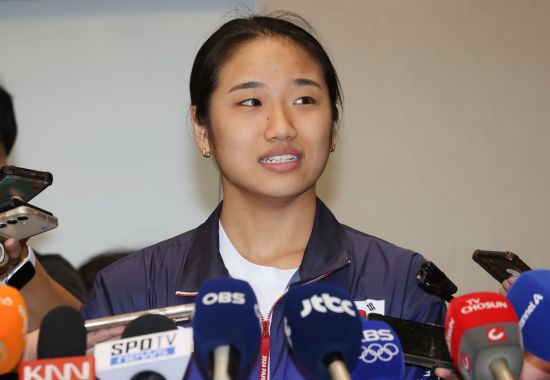 An Se-young, who won the gold medal in women's singles badminton at the 2024 Paris Olympics, is answering questions from the press as she returns home through Incheon International Airport on the afternoon of the 7th.
 [Image source=Yonhap News]
According to the Badminton World Federation (BWF) on the 12th, An Se-young won eight World Tour tournaments last year and reached the semifinals of the Finals, earning prize money of $628,020 (about 860 million won).
An Se-young's exact salary is not disclosed, but it is estimated to be around 61 million won. According to the regulations of the Korea Corporate Badminton Federation, the salary cap for first-year players is 60 million won for college graduates and 50 million won for high school graduates. After that, the annual increase cannot exceed 7% until the third year. Signing bonuses cannot exceed 150 million won and 100 million won, respectively.
An Se-young is currently in her fourth year since joining, so these regulations do not apply to her. However, in her first year in 2021, she received a salary of 50 million won, and the salary increase rate appears to have been 7% annually until the third year. Combining prize money and salary, An Se-young's total income last year is estimated to be about 900 million won. This is much lower compared to other players competing internationally. Foreign players are not subject to restrictions on sponsorships and advertisements, but domestic players are prohibited from receiving any personal sponsorships under the regulations.
Last year, Pusarla V. Sindhu (India), ranked 13th in the world, earned $7.1 million (about 9.7 billion won) solely from advertising fees and sponsorships. Sindhu received total prize money of $54,015 (about 74 million won) last year, ranking around 99th in prize money, but earned about ten times more income than An Se-young. Forbes explained, "Sindhu, an Olympic medalist and 2019 badminton world champion, secured a strong position in the women's income rankings thanks to India's marketing capabilities." Sindhu won the silver medal in women's singles at the 2016 Rio Olympics and the bronze medal at the 2020 Tokyo Olympics.
Directly comparing An Se-young and Sindhu is practically unreasonable. This is because the popularity of badminton as a sport is completely different between Korea and India. In both countries, badminton is a representative recreational sport, but in terms of popularity, it is unpopular in Korea and nationally popular in India. The most popular sport in India is cricket, followed by soccer, and third is badminton. Sindhu is a superstar in India comparable to Son Heung-min and Kim Yuna.
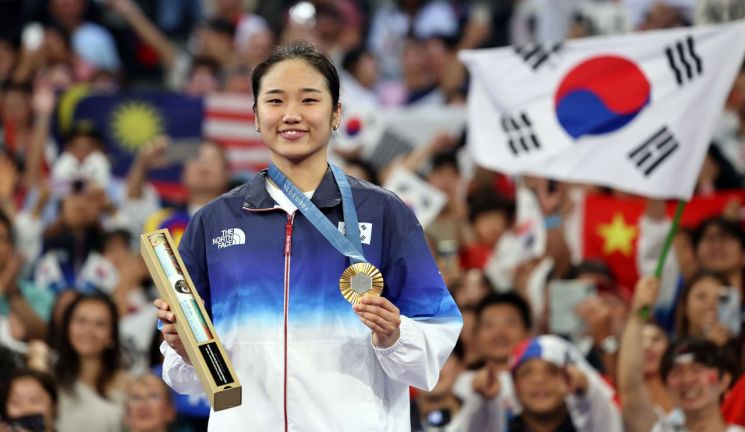 On the 5th (local time), at the Porte de la Chapelle Arena in Paris, France, An Se-young of Korea, who defeated China's He Bingjiao in the women's singles badminton final of the 2024 Paris Olympics, is standing on the podium with a gold medal around her neck. [Image source=Yonhap News]
Earlier, An Se-young pointed out in a recent media interview that improvements are needed in the regulations regarding personal sponsorships for national badminton players and salaries and signing bonuses for corporate team players. An Se-young said, "I believe that even without advertisements, it is possible to receive sufficient economic rewards through badminton," and added, "I hope restrictions on sponsorships and contracts are lifted and more opportunities are provided."
In response, the federation is confirmed to be reviewing the relaxation of the salary cap and signing bonus limits for rookie players. Regarding salary increase rates, options under consideration include raising the percentage and introducing exceptions. The exception clause is expected to exempt players within their third year from the increase limit if they achieve good results in international competitions such as the World Championships.
© The Asia Business Daily(www.asiae.co.kr). All rights reserved.
![Clutching a Stolen Dior Bag, Saying "I Hate Being Poor but Real"... The Grotesque Con of a "Human Knockoff" [Slate]](https://cwcontent.asiae.co.kr/asiaresize/183/2026021902243444107_1771435474.jpg)
















