SAF Market Opens with Stricter Carbon Emission Regulations
Production Facilities Enabled by Petroleum Business Act Revision
Refining Industry Calls for Government Support Such as Tax Credits
S-OIL is considering establishing sustainable aviation fuel (SAF) production facilities domestically.
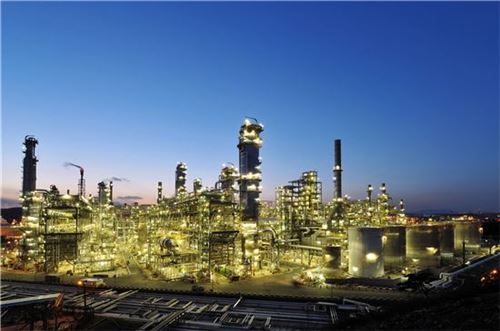 A panoramic view of the 2nd Aromatic Complex, a petrochemical facility of S-OIL.
 [Photo by Asia Economy DB]
According to industry sources on the 13th, S-OIL is reviewing the establishment of dedicated SAF production facilities in Korea after the Shahin project concludes in 2026. The Shahin project is a petrochemical production facility construction project that S-OIL is carrying out in the Onsan National Industrial Complex in Ulsan, representing the largest scale in the history of Korea's petrochemical industry with an investment of 9 trillion won.
In a recent earnings conference call, S-OIL stated, "With the strengthening of carbon emission regulations, SAF will become a new opportunity for revenue generation," adding, "We are actively considering the construction of a dedicated plant for SAF production."
SAF is an eco-friendly fuel produced from bio-based raw materials such as waste cooking oil, and it is attracting attention as the most effective method for carbon reduction in the aviation industry, with a greenhouse gas reduction effect 40-82% higher than conventional aviation fuel. According to market research firm Mordor Intelligence, the SAF market size is expected to expand from 1 trillion won in 2021 to approximately 30 trillion won by 2027.
S-OIL's active consideration of SAF investment is largely influenced by the revision of the Petroleum and Petroleum Alternative Fuel Business Act (Petroleum Business Act). This law recently relaxed regulations that allowed only petroleum raw materials for product production, enabling the use of biofuels and renewable synthetic fuels. Especially as major countries such as those in Europe have strengthened SAF mandates, Korea has also come under their influence. The EU has mandated that from 2025, aircraft departing from its 27 member countries must blend at least 2% SAF, with the blending ratio expected to rise to 70% by 2050. The United States aims to replace 100% of aviation fuel with SAF by 2050, and Japan has set a goal to replace 10% of aviation fuel demand with SAF by 2030. Singapore also regulated that from 2026, all aircraft departing from Singapore must blend SAF.
The four domestic refiners, including S-OIL, plan to invest about 6 trillion won in the SAF sector by 2030. Currently, there are no dedicated SAF production facilities in Korea.
The domestic refining industry emphasizes the need for active government support to secure a leading position in the SAF market. An industry official said, "In the United States, tax credits are provided for SAF produced and sold domestically," adding, "For Korean companies to be competitive in the global market, appropriate support is also necessary here."
© The Asia Business Daily(www.asiae.co.kr). All rights reserved.
![Clutching a Stolen Dior Bag, Saying "I Hate Being Poor but Real"... The Grotesque Con of a "Human Knockoff" [Slate]](https://cwcontent.asiae.co.kr/asiaresize/183/2026021902243444107_1771435474.jpg)














