"One Should Fully Enjoy Economic Rewards from Badminton Alone"
Se-young An (22), the gold medalist in women's singles badminton at the 2024 Paris Olympics, has emphasized the need for 'fair economic compensation' for athletes.
On the 11th, 'Yonhap News' released an interview with An Se-young. In the interview, An said, "I believe that even without advertisements, athletes can receive sufficient economic compensation solely through badminton," and requested, "I hope sponsorships and contractual matters are not restricted and are made more accessible."
Previously, after winning the gold medal at the Hangzhou Asian Games in October last year, An reportedly declined offers for advertisements and broadcasting to focus on the Paris Olympics schedule the following year.
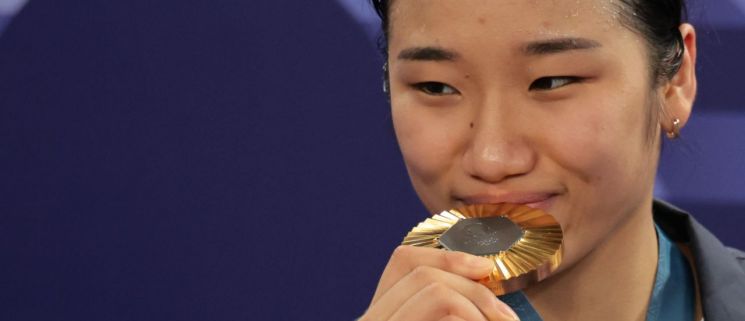 On the 5th (local time), at the 2024 Paris Olympic women's singles badminton final held at Porte de la Chapelle Arena in Paris, France, Korean player An Se-young, who defeated China's He Bingjiao to win the championship, is kissing the gold medal.
 [Image source=Yonhap News]
Instead, An emphasized the need to relax regulations related to individual sponsorship contracts for athletes who must focus on rigorous training schedules. Currently, the Korea Badminton Association's guidelines for national team individual sponsorship contracts limit sponsorship placement to "one item designated on the right collar (neck)." Additionally, individual sponsorship contracts with companies in the same industry as badminton equipment manufacturers and the association's sponsors are reportedly restricted.
Furthermore, there is a regulation stating that "during the period of individual sponsorship contracts, if participating in comprehensive sporting events organized and dispatched by the Korean Sport & Olympic Committee, such as the Olympics and Asian Games, athletes must comply with the promotional regulations of the Korean Sport & Olympic Committee." In other words, once an athlete becomes a national representative, opportunities for personal sponsorship decrease, and sponsorships from the association or the Korean Sport & Olympic Committee are prioritized.
An Se-young also pointed out issues with the contract bonuses and salary caps for professional badminton players. Currently, the first-year salary for players joining after graduating from high school cannot exceed 50 million KRW, salary increases cannot exceed 7% compared to the previous year until the third year, and contract bonuses cannot exceed 100 million KRW.
Because of this, there has been widespread speculation that players like An Se-young, who achieve outstanding results in international competitions, may not receive contract bonuses or salaries proportional to their skills. Regarding this, An expressed, "(Relaxing the salary cap) is not discrimination but can serve as motivation for players," adding, "If all players are treated the same, it might actually be reverse discrimination."
Meanwhile, a badminton official responded to An Se-young's claims to 'Yonhap News,' saying, "If the salary cap for the first three years is not set, there could be excessive inflation, making it difficult for professional teams to maintain their rosters," and explained, "Since this system is designed to protect the market itself, it may not be satisfactory for exceptional players like An Se-young, who appear once in decades."
© The Asia Business Daily(www.asiae.co.kr). All rights reserved.
![Clutching a Stolen Dior Bag, Saying "I Hate Being Poor but Real"... The Grotesque Con of a "Human Knockoff" [Slate]](https://cwcontent.asiae.co.kr/asiaresize/183/2026021902243444107_1771435474.jpg)















