There has been a call for an urgent shift to a recovery rehabilitation and primary care-centered medical system in preparation for a super-aged society (where the population aged 65 and over accounts for more than 20% of the total population).
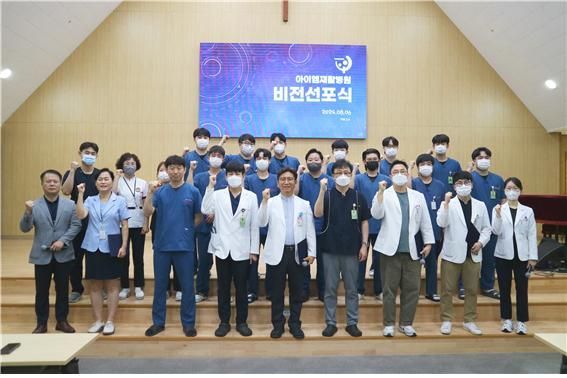 Director Woo Bong-sik of IM Rehabilitation Hospital (center) and hospital executives held the 'Research Leading Hospital' vision declaration ceremony on the 7th floor Abraham Hall of IM Rehabilitation Hospital in Cheongju, Chungbuk, on the 6th. [Image source=IM Rehabilitation Hospital]
Woo Bong-sik, director of IM Rehabilitation Hospital and former head of the Korea Medical Association's Medical Policy Research Institute, held the "Vision Declaration Ceremony for Leading Research Hospitals in the Field of Recovery Rehabilitation" on the 6th, stating, "Recovery rehabilitation medical care will play an important role in protecting the health and medical care of the elderly in South Korea as it enters a super-aged society in 2025."
He also emphasized the need to refer to the case of Japan, which is already experiencing a super-aged society. He explained, "Japan introduced the recovery rehabilitation system in 2000 and, to address the rising medical costs due to the increase in elderly people aged 75 and over, classifies hospital beds by function into 'highly acute, acute, recovery, and chronic' phases, converting costly acute care beds into recovery care beds."
He further argued that a recovery rehabilitation system and community care centered on primary care are more suitable for a super-aged society than policies to increase medical school quotas, which place a heavy burden on health insurance finances. Director Woo said, "South Korea should focus on building a community care system centered on recovery rehabilitation and primary care rather than increasing medical school quotas, which would heavily strain health insurance finances. While South Korea completely separates medical care and long-term care, Japan links medical care and kaigo (long-term care) and makes desperate efforts to use costs efficiently."
He added, "South Korea must also avoid a health insurance financial crisis caused by indiscriminate expansion of coverage."
IM Rehabilitation Hospital is a second-term recovery rehabilitation medical institution designated by the Ministry of Health and Welfare. Director Woo previously served as president of the Rehabilitation Hospital Association in 2020 and led the introduction of the recovery rehabilitation medical institution system in South Korea.
© The Asia Business Daily(www.asiae.co.kr). All rights reserved.
![Clutching a Stolen Dior Bag, Saying "I Hate Being Poor but Real"... The Grotesque Con of a "Human Knockoff" [Slate]](https://cwcontent.asiae.co.kr/asiaresize/183/2026021902243444107_1771435474.jpg)















