“File a Lawsuit for Transmission Line Compensation” Notices Sent
Land Location Identified via Satellite Maps,
Names and Addresses Obtained from Land Registry
Potential Violation of Attorney Advertising Regulations
Mr. A was startled by mail that recently arrived at his home. Letters had been sent to his two sons from law offices and law firms. He said his heart sank with worry, fearing that something might have happened to his sons. When he opened the envelopes, he found legal notices from attorneys and law firms urging, “Receive compensation for land under transmission lines through our firm.” The notices explained that since high-voltage transmission lines run over land owned by Mr. A’s sons, they could receive compensation by filing a lawsuit against Korea Electric Power Corporation, and requested that the case be entrusted to their respective law firms.
“Land under transmission lines” refers to land where the owner’s right to use or profit from the property is restricted due to high-voltage transmission lines passing overhead. If Korea Electric Power Corporation installs transmission lines without the consent or approval of the landowner, it must compensate the owner for any resulting property losses.
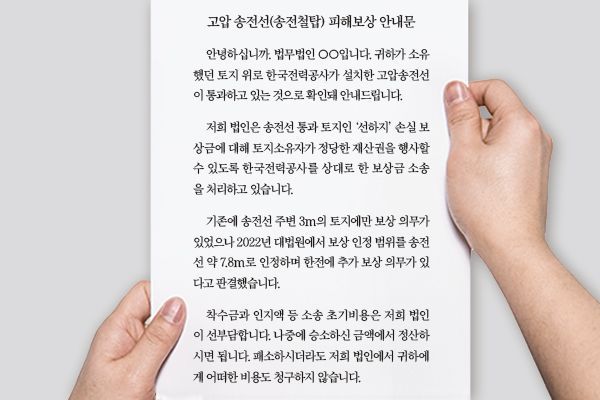 ※ This image is a reconstruction based on the contents of notices received by Mr. A from multiple law firms via mail. [Image source=Law Times]
Mr. A expressed his discomfort, saying, “I was very displeased about how they found out our names and addresses,” and added, “When I suddenly received mail from a lawyer, my heart raced and I was filled with anxiety.” He said that just this year, he had received legal notices from a total of six law firms or legal offices. Mr. A has filed a complaint with the Korean Bar Association (KBA) regarding these mailings.
How did the law firms and legal offices that sent mail to Mr. A’s residence obtain his address? It was found that they used satellite maps to identify land crossed by high-voltage transmission lines, then obtained certified copies of the land registry to access the names and addresses of the landowners, Mr. A’s sons. A representative from one of the law firms explained, “Many people who have already received compensation for land under transmission lines are unaware that additional compensation may now be available, so we sent notices by mail to inform them of legal remedies through litigation.”
Within the legal community, there are concerns that sending such notices by mail may violate the “Regulations on Attorney Advertising” and the “Code of Ethics,” potentially leading to disciplinary action against attorneys, and that such practices should be avoided.
According to Article 4 of the “Regulations on Attorney Advertising,” attorneys are prohibited from advertising to solicit cases by contacting parties or persons likely to be involved in a specific case-without their consent-through visits, phone calls, mail, email, text messages, or fax. However, this is permitted if approval is obtained from the local bar association.
A representative from the KBA stated, “Whether sending legal notices by mail after arbitrarily obtaining home addresses from land registry documents constitutes a violation of advertising regulations is a matter that requires an authoritative interpretation by the KBA’s Legislative Committee,” expressing a reserved position.
There is also a possibility that this practice violates the “Code of Ethics for Attorneys,” which is one of the KBA’s bylaws. The current Attorney-at-Law Act stipulates that violations of the bylaws of the local bar association or the KBA may be grounds for disciplinary action.
Article 19 of the Code of Ethics for Attorneys, which regulates relationships between attorneys and prospective clients, states that attorneys and their staff must not contact prospective clients or incite litigation in ways that are contrary to honor and dignity for the purpose of soliciting cases.
Jung Hyungkeun (67, Judicial Research and Training Institute Class 24), attorney at Hanmi Law Firm and former dean of Kyung Hee University Law School, said, “It is necessary to rigorously determine whether this constitutes a violation of the attorney advertising regulations and the code of ethics.” He added, “It is difficult to consider it appropriate for an attorney to proactively approach prospective clients and encourage them to exercise their property rights by filing lawsuits,” and further commented, “There are concerns that such practices could undermine the dignity of the legal profession and disrupt the proper order for case retention.”
Hong Yoonji, Park Suyeon Legal News Reporters
※This article is based on content supplied by Law Times.
© The Asia Business Daily(www.asiae.co.kr). All rights reserved.
![Clutching a Stolen Dior Bag, Saying "I Hate Being Poor but Real"... The Grotesque Con of a "Human Knockoff" [Slate]](https://cwcontent.asiae.co.kr/asiaresize/183/2026021902243444107_1771435474.jpg)















