Incheon City is set to begin land subdivision surveying work to delineate the boundary between 'Seo-gu' and the newly established 'Geomdan-gu' ahead of the administrative system reorganization scheduled for 2026.
On the 12th, the city announced that it has commissioned the Korea Land and Geospatial Informatix Corporation (LX) to conduct land subdivision surveying to adjust the boundaries of legal and administrative districts closely related to residents' daily lives.
The survey targets 19 parcels of state-owned river land within the Gyeongin Ara Waterway, spanning Oryu, Geomam, and Sicheon-dong in Seo-gu. Initially, 105 parcels were located across the boundary section, all of which needed to be subdivided. However, after consultation with Seo-gu, the number of parcels subject to land subdivision surveying was reduced to 19 through a pre-subdivision consolidation process.
Once the surveying work, scheduled to be completed by November, is finished, the city plans to organize the cadastral records through Seo-gu and assign new lot numbers to the subdivided parcels. Currently, Seo-gu consists of 21 legal dongs and 23 administrative dongs. In the future, Incheon will establish a basic plan and revise ordinances to adjust the legal and administrative dongs of Seo-gu and the newly established Geomdan-gu.
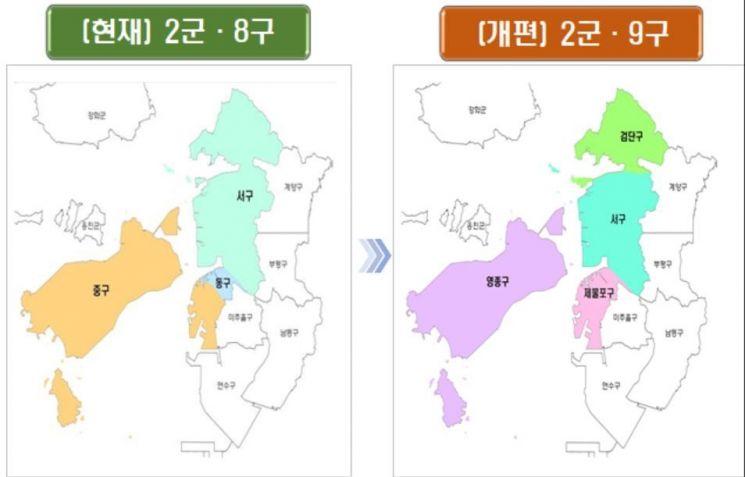 Incheon Administrative System Reorganized into 2 Districts and 9 Gu from July 2026 [Provided by Incheon City]
Incheon City is preparing for an administrative system reorganization that will establish Geomdan-gu and Yeongjong-gu in July 2026, marking the start of the 9th popularly elected term. Seo-gu, with a population of 600,000, will separate the Geomdan area to create 'Geomdan-gu' (population 210,000), while the remaining Seo-gu area (390,000) will remain as is.
Additionally, the existing Jung-gu (155,000) and Dong-gu (60,000) of Incheon will be reorganized into 'Yeongjong-gu' (110,000), centered on Yeongjong Island, and 'Jemulpo-gu' (100,000), covering the inland areas of Jung-gu and Dong-gu. With this change, Incheon's administrative system will expand from the 2 counties and 8 districts maintained since 1995 to 2 counties and 9 districts, adding one autonomous district.
Since its launch as a metropolitan city system in 1995 with a registered population of 2.35 million, Incheon's registered population exceeded 3 million as of January this year, bringing significant changes in administrative conditions due to population growth.
In particular, Seo-gu and Jung-gu face considerable resident inconvenience and reduced administrative efficiency due to geographic and living area separation within the regions. Additionally, changes in the urban environment caused by new town development have made it difficult to establish strategies for smooth administrative service provision and balanced urban development.
An Incheon city official stated, "The administrative system reorganization is a choice for Incheon's future," adding, "We will closely cooperate with the relevant autonomous districts to ensure a successful reorganization."
© The Asia Business Daily(www.asiae.co.kr). All rights reserved.
![Clutching a Stolen Dior Bag, Saying "I Hate Being Poor but Real"... The Grotesque Con of a "Human Knockoff" [Slate]](https://cwcontent.asiae.co.kr/asiaresize/183/2026021902243444107_1771435474.jpg)















