As the "Employment Permit System," introduced to alleviate the manpower shortage in domestic industries, marks its 20th anniversary, the government has emphasized the need for a comprehensive overhaul of foreign workforce policies.
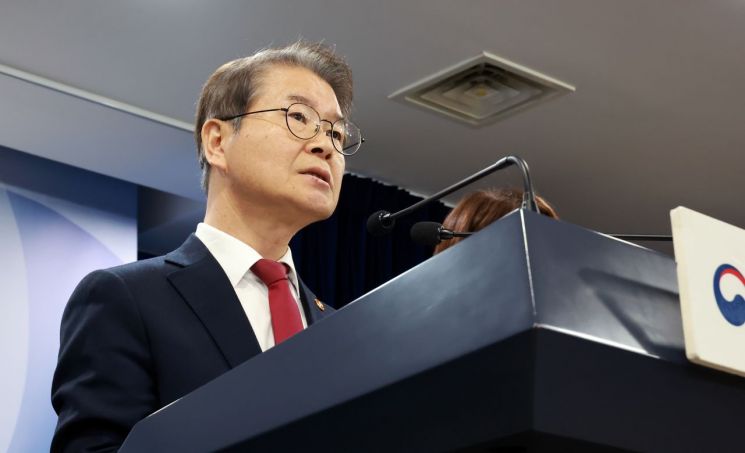
On the 12th, Lee Jeong-sik, Minister of Employment and Labor, stated at the Employment Permit System 20th Anniversary Conference and Policy Seminar held at Lotte Hotel World, "For the Employment Permit System to function as a sustainable foreign workforce policy and system, a comprehensive and groundbreaking reform of foreign workforce policies is necessary."
The Employment Permit System is a government-approved system that allows workplaces unable to hire domestic workers for non-professional jobs to employ foreign workers, first implemented in August 2004.
Minister Lee evaluated, "Over the past 20 years, the Employment Permit System has greatly contributed to resolving manpower shortages in our industrial sites and has been recognized internationally as a successful migrant labor policy," adding, "Going forward, the Ministry of Employment and Labor's foreign workforce policy must be more inclusive, flexible, and systematic."
Specifically, he emphasized, "Instead of being operated in a segmented manner by ministries and visa types, unified and systematic services and management must be implemented," and "The sectors and occupations where foreign workers can be active should be further expanded, and related systems should be made more flexible and operated so that necessary personnel can be deployed timely and appropriately."
Minister Lee also added, "Outstanding personnel should be encouraged to settle and obtain permanent residency, and be assigned roles and responsibilities befitting members of our labor market and citizens."
At the subsequent seminar, the Ministry of Employment and Labor explained that with the intensification of low birth rates and aging, industrial structure transformation, diversification of manpower demand, and increasing demand for long-term utilization of skilled workers, a fundamental overhaul of the entire process of utilizing foreign workers is necessary.
Professor Seol Dong-hoon of Jeonbuk National University suggested a data-driven foreign workforce policy that enables demand trend forecasting by establishing a continuous monitoring system and proposed a "developmental policy" to secure skilled technical personnel.
Dr. Lee Gyu-yong of the Korea Labor Institute stated that considering the demand in industrial sites, the supply method of foreign workers should be made flexible, policy governance should be organized to enable close linkage and cooperation among ministries, and foreign workforce support strategies should be established at the regional level.
© The Asia Business Daily(www.asiae.co.kr). All rights reserved.
![Clutching a Stolen Dior Bag, Saying "I Hate Being Poor but Real"... The Grotesque Con of a "Human Knockoff" [Slate]](https://cwcontent.asiae.co.kr/asiaresize/183/2026021902243444107_1771435474.jpg)















