Traffic Chaos Among Urban Residents During the Great East Japan Earthquake
On the 8th (local time), a magnitude 7.1 earthquake struck Hinatanaka, Miyazaki Prefecture in southern Kyushu, Japan, raising concerns about the so-called 'Nankai megaquake.' If such an earthquake were to occur, it is suggested that 4.2 million residents of major Japanese cities might be unable to return home on the same day.
On the 11th, the Japanese economic media outlet Nihon Keizai Shimbun (Nikkei) cited the government's 2019 report titled 'Nankai Trough Megaquake Damage Analysis.' According to Nikkei's investigation, if a megaquake were to strike at noon on a weekday, public transportation would halt, causing major chaos for citizens trying to return home.
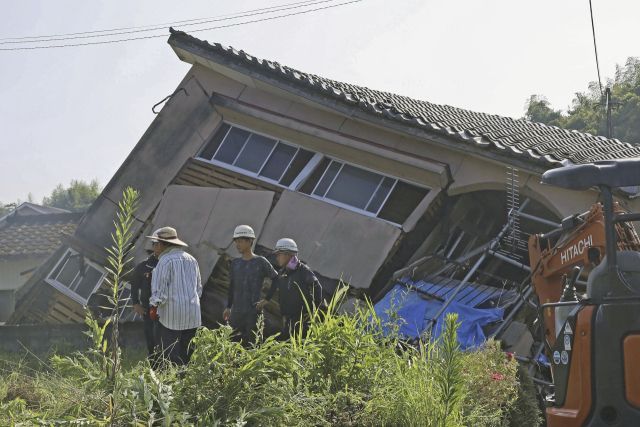 A house in Kagoshima Prefecture collapsed due to a strong earthquake that occurred on the 8th (local time) off the coast of Miyazaki Prefecture, Kyushu. [Image source=AP Yonhap News]
In the Shukyo region, which includes three prefectures such as the Kinki region on Honshu Island and Aichi Prefecture, approximately 6.6 million and 4.1 million people respectively are expected to be affected. The population estimated to be completely unable to return home on the day is up to 3 million in the Kinki area and up to 1.2 million in the Shukyo area. In total, 4.2 million people would be temporarily stranded outdoors.
This is not the first time that a megaquake has caused transportation paralysis in Japan. During the 2011 Great East Japan Earthquake, about 5.15 million people in the metropolitan area reportedly had difficulty returning home. At that time, Tokyo railway companies temporarily suspended train operations to ensure safety, which led to a significant increase in the use of general public transportation and caused severe bottlenecks for buses and taxis on the roads.
Learning from the Great East Japan Earthquake, the Japanese government has also prepared countermeasures. They issued guidelines to companies advising citizens to refrain from returning home for up to three days after an earthquake. While companies keep employees at the workplace, local governments cooperate with related agencies to restore various infrastructures as quickly as possible.
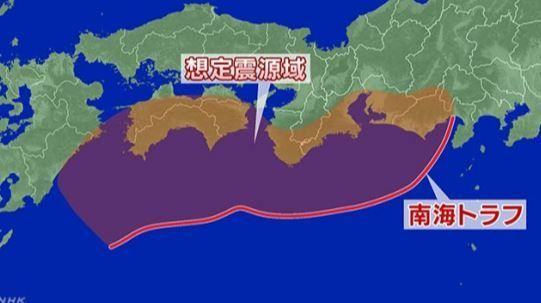 The red area indicates the impact zone of the Nankai Trough megathrust earthquake.
 [Image source=NHK broadcast capture]
Meanwhile, the Japan Meteorological Agency issued a temporary information bulletin on the Nankai Trough earthquake immediately after the quake on the 8th. They requested vigilance for earthquakes around magnitude 6 within the next week.
Japanese Prime Minister Fumio Kishida also stated, "The government is swiftly establishing a state of alert for the Nankai Trough earthquake," and urged citizens, "Please carefully check the information announced by the government, reconfirm your earthquake preparedness, and be ready to evacuate immediately if an earthquake occurs."
In some areas within the earthquake's impact zone, there have been reports of temporary shortages of bottled water and instant food, indicating signs of panic buying. Survival tips such as "store tap water in buckets in preparation for emergencies" have been shared on online communities and social networking services (SNS).
© The Asia Business Daily(www.asiae.co.kr). All rights reserved.
![Clutching a Stolen Dior Bag, Saying "I Hate Being Poor but Real"... The Grotesque Con of a "Human Knockoff" [Slate]](https://cwcontent.asiae.co.kr/asiaresize/183/2026021902243444107_1771435474.jpg)
















