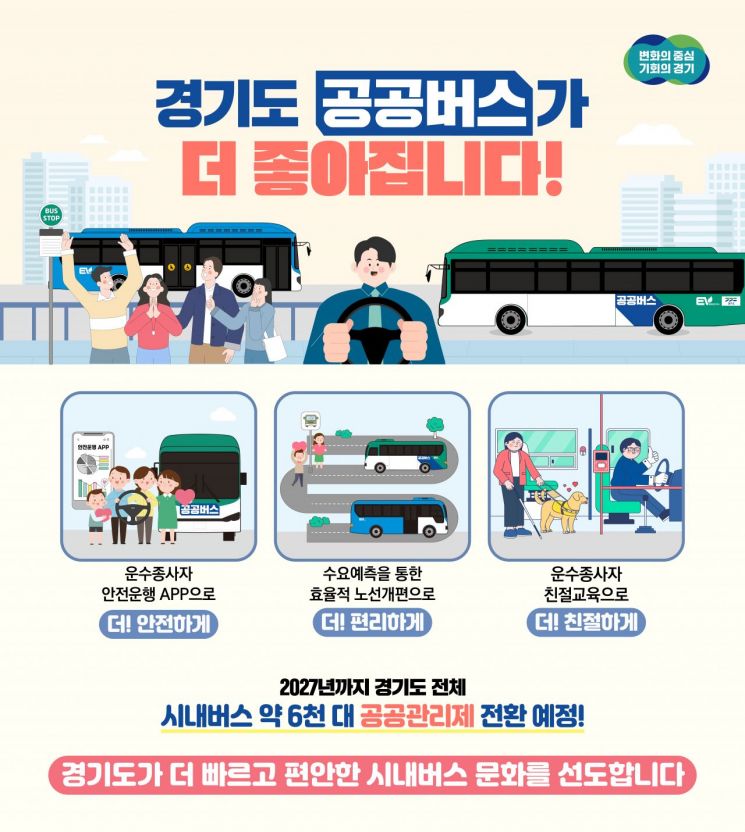
Gyeonggi Province has established a ‘Comprehensive Management Plan for Public Management of City Buses’ to provide residents with more comfortable bus usage, including the introduction of a safety driving app for transportation workers and regular route revisions using big data.
First, to create safer bus conditions, Gyeonggi Province will develop a ‘Bus Safety Driving Application’ for transportation workers that measures risky driving behaviors and provides feedback.
This app can record drivers’ driving habits in detail, enabling systematic management of driving habits and incentives for outstanding transportation workers, which is expected to reduce safety accidents and lower insurance costs.
Additionally, a ‘Service Safety Rating Disclosure System’ will be introduced to systematically evaluate bus safety management status by route and publicly disclose the evaluation grades and scores to residents. Through this, the province plans to establish safe driving habits among drivers and significantly strengthen safety management and supervision to reduce accidents.
Furthermore, to promote ‘friendly buses,’ the province will strengthen crackdowns on routes with frequent city bus complaints, mandate friendliness training for transportation workers, and provide incentives to excellent companies and workers through a Friendly Driver Certification System. In particular, it will actively work to eradicate the four major city bus complaints: non-stop service, unfriendliness, reckless driving, and complaints about dispatch intervals.
As a measure for faster and more convenient bus operation, Gyeonggi Province will regularize systematic route revisions by analyzing transportation card big data (such as passenger demand by route and stop) according to changing transportation conditions like the opening of GTX and railway extensions. It will focus on managing compliance rates with dispatch intervals by route to improve the punctuality and reliability of bus operations.
Moreover, to ensure a pleasant and clean bus experience, joint cleanliness inspections by the province and Gyeonggi Transportation Corporation will be conducted, disinfection of major odor-causing facilities such as bus air conditioning systems will be strengthened, and the expansion of eco-friendly buses and improvements to bus infrastructure will be promoted.
Gyeonggi Province has entered the procedure to revise related guidelines so that this comprehensive management plan can be introduced in the field as early as next year.
Nam Sang-eun, Director of the Gyeonggi Province Transportation Bureau, emphasized, "The public management system for city buses is a core transportation policy of the province that complements the shortcomings of the existing quasi-public operation system, minimizing financial burdens while improving bus service quality. Along with the implementation of the public management system for city buses, we will apply this comprehensive management plan for safer, friendlier, more convenient, and more pleasant buses to provide bus services that satisfy all residents."
Meanwhile, Gyeonggi Province plans to convert 1,200 city buses this year and expand to 6,000 city buses under public management by 2027.
The public management system for city buses focuses on strengthening public management of city buses. It is divided into the ‘public support type,’ which renews financial support agreements every three years through route-level service evaluations, and the ‘route bidding type,’ where the public owns the routes and selects transportation operators through open competition to operate for a certain period. Gyeonggi Province is the first in the nation to introduce this quasi-public operation system for city buses.
© The Asia Business Daily(www.asiae.co.kr). All rights reserved.
![Clutching a Stolen Dior Bag, Saying "I Hate Being Poor but Real"... The Grotesque Con of a "Human Knockoff" [Slate]](https://cwcontent.asiae.co.kr/asiaresize/183/2026021902243444107_1771435474.jpg)















