Operating profit 2 trillion KRW in Q3 last year → 1.2 trillion KRW in Q2 this year
Excluding subsidiaries, turned to a 100 billion KRW deficit
Cumulative deficit of 40.5 trillion KRW since 2021
The Korea Electric Power Corporation's (KEPCO) profit, which began in the third quarter of last year, continued for four consecutive quarters through the second quarter of this year. However, operating profit, which was around 2 trillion won, decreased to 1.2 trillion won, and on a separate basis excluding subsidiaries, a loss was recorded again in the second quarter of this year. Although a cumulative deficit of around 40 trillion won remains, the future outlook is not optimistic. This is due to the ongoing Middle East conflict and growing concerns over rising energy prices caused by high exchange rates.
According to KEPCO on the 11th, consolidated sales for the first half of this year amounted to 43.7664 trillion won, operating expenses were 41.2168 trillion won, and operating profit was 2.5496 trillion won.
A KEPCO official stated, "Operating profit increased by 10.9996 trillion won compared to the same period last year," adding, "Sales increased by 2.5499 trillion won due to tariff adjustments, while operating expenses decreased by 8.4497 trillion won due to reductions in fuel costs and power purchase costs."

Based on consolidated financial statements including subsidiaries such as power generation companies, KEPCO recorded operating profits for four consecutive quarters in 2023 due to three tariff hikes and stabilization of fuel prices. With four consecutive quarters of profit, the cumulative deficit has decreased to the 40 trillion won range. KEPCO recorded losses for nine consecutive quarters from the second quarter of 2021 to the second quarter of 2023, causing the cumulative deficit to soar to 47.5 trillion won. However, since turning a profit from the third quarter of last year, this amount has decreased to the 40 trillion won range. Nevertheless, the quarterly operating profit has declined from 2 trillion won in the third quarter of last year to 1.09 trillion won in the fourth quarter, 1.3 trillion won in the first quarter of this year, and 1.2 trillion won in the second quarter, slowing the pace of deficit reduction.
In particular, on a separate financial statement basis excluding subsidiaries, KEPCO recorded an operating loss of 100 billion won in the second quarter of this year, turning to a loss after three quarters. A KEPCO official explained, "The second quarter (April to June) is an off-season when electricity sales revenue decreases, dropping from 22.4 trillion won in the first quarter to 19.8 trillion won, a decrease of 2.6 trillion won. However, the reduction in power purchase costs from power generation subsidiaries was only 1.4 trillion won, resulting in a loss on a separate basis."
KEPCO's debt increased by 93.3736 trillion won from 108.8833 trillion won in 2014 to 202.4502 trillion won last year. This was due to debts ballooning by 13.3217 trillion won and 47.0077 trillion won in 2021 and 2022, respectively. The debt growth rates were 10.1% in 2021 and 32.2% in 2022, with debts incurred over these two years accounting for 29.8% of the total debt.
The increase in debt is attributed to KEPCO's inability to raise electricity prices in line with rising fuel costs necessary for power generation. In fact, the electricity tariff cost recovery rate (sales divided by cost) was 101.3% in 2020 but dropped to 85.9% in 2021 and 64.2% in 2022.
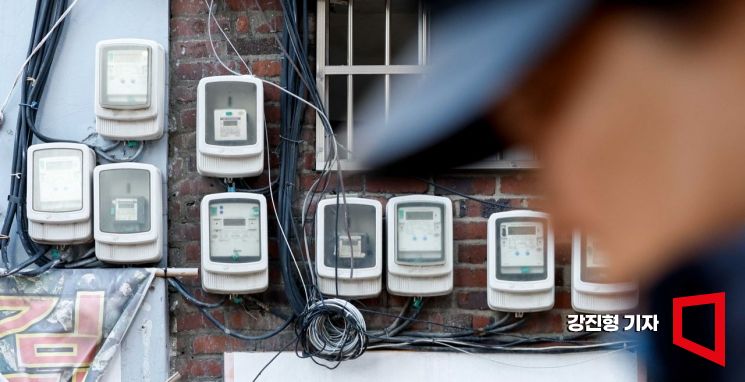 As Korea Electric Power Corporation prepares to actively discuss electricity rate hikes to resolve its deficit, an electricity meter is installed in a commercial building in Seoul on the 7th. Photo by Jinhyung Kang aymsdream@
The Yoon Suk-yeol administration judged that electricity rates needed to be raised by 51.6 won per kilowatt-hour (kWh) in 2023 to normalize KEPCO's management, but in reality, rates were only increased by 13.1 won and 8 won per kWh in January and May, respectively, totaling 21.1 won. In the fourth quarter, considering the burden of rising household prices, only industrial electricity rates were raised by 10.6 won per kWh. Since then, electricity rates have remained frozen.
KEPCO is concerned that the management environment will remain challenging due to expected increases in fuel and power purchase costs caused by the ongoing Middle East conflict and high exchange rates leading to rising energy prices. A KEPCO official said, "KEPCO is reducing power purchase costs through the introduction of customer participation load shedding programs and extension of fuel tax reduction periods, and is steadily implementing financial soundness plans such as austerity management. We will thoroughly and swiftly carry out the self-help efforts promised to the public and consult with the government on various measures to reduce the cumulative deficit through cost reductions in electricity tariffs, including lowering power purchase costs."
© The Asia Business Daily(www.asiae.co.kr). All rights reserved.
![Clutching a Stolen Dior Bag, Saying "I Hate Being Poor but Real"... The Grotesque Con of a "Human Knockoff" [Slate]](https://cwcontent.asiae.co.kr/asiaresize/183/2026021902243444107_1771435474.jpg)
















