Metropolitan Area Apartment Sales Up 0.03%·Jeonse Up 0.02%
‘8.8 Supply Plan’ Announced
210,000 Additional Units in Metropolitan Area
Focus on Normalizing Non-Apartment Market
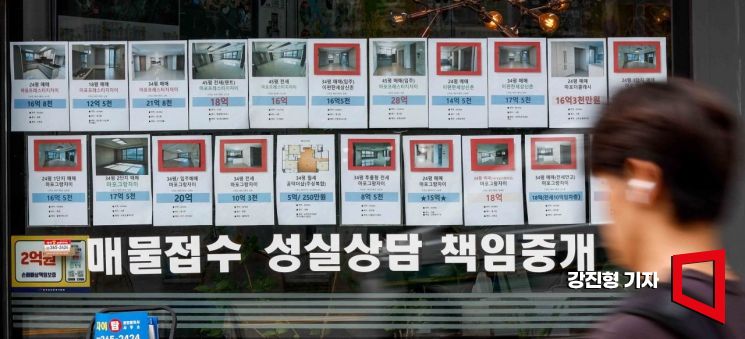
Despite the ongoing heatwave, the apartment sale price fluctuation rate in Seoul recorded 0.04%, showing an increased rise compared to the previous week (0.03%).
According to the 'Second Week of August Metropolitan Area Apartment Market Status' announced by Real Estate R114 on the 11th, the main apartment sale price fluctuation rates in new towns and Gyeonggi·Incheon rose by 0.03% and 0.02%, respectively, increasing by 0.01 to 0.02 percentage points from the previous week.
As many sellers and buyers are expected to postpone transactions and closely monitor market trends until the end of the summer vacation season, the sale prices are likely to continue their upward trend, with seller asking prices expected to be maintained without adjustment.
The jeonse (long-term lease) market showed a somewhat quiet atmosphere as tenant inquiries decreased. In Seoul, the number of areas with stable jeonse prices increased from 10 last week to 17, and the jeonse price fluctuation rate dropped by 0.04 percentage points compared to the previous week, indicating a temporary pause.
Seoul apartment sale prices rose by 0.04% for the second consecutive week, with both reconstruction and general apartments increasing by 0.04%. New towns rose by 0.03%, and Gyeonggi·Incheon continued their upward trend for the third week, adjusting up by 0.02%.
In Seoul, large complexes in the Gangnam area and planned redevelopment sites in the southwest led the rise. By individual areas, the increases were in the order of Gangnam (0.10%), Mapo (0.07%), Gwanak (0.07%), Yangcheon (0.05%), Seocho (0.05%), Dongjak (0.05%), Dongdaemun (0.05%), and Yeongdeungpo (0.04%). Among the 25 districts, Nowon was the only one to fall by -0.01%.
In new towns, the rise was mainly centered on second-phase new towns such as Gwanggyo (0.18%) and Dongtan (0.08%). In Gyeonggi·Incheon, areas such as Hwaseong (0.07%), Anyang (0.06%), Incheon (0.05%), Ansan (0.02%), and Suwon (0.01%) increased, but Icheon fell by 0.07% as Hyundai Hometown in Jeungil-dong dropped by about 5 million KRW.
In the jeonse market, Seoul's increase narrowed to 0.01% from 0.05% the previous week. New towns rose by 0.01%, and Gyeonggi·Incheon increased by 0.02%.
Most areas in Seoul showed a slight rise (0.01?0.02%), with notable increases in some northeastern and southwestern areas such as Gwanak (0.11%), Seongdong (0.06%), and Nowon (0.05%). In new towns, individual areas such as Sanbon (0.09%), Gwanggyo (0.04%), and Gimpo Hangang (0.01%) rose, while Jungdong was the only area to fall by 0.02%.
In Gyeonggi and Incheon, Hwaseong (0.08%), Incheon (0.07%), Osan (0.06%), Ansan (0.04%), Suwon (0.03%), and Goyang (0.03%) increased. Conversely, Icheon fell by 0.01% as Geopyeong Apartment in Bubal-eup dropped by about 2.5 million KRW.
A Real Estate R114 official stated, "On the 8th, the Ministry of Land, Infrastructure and Transport announced the 'Housing Supply Expansion Plan for National Housing Stability.' The government presented supply plans including new housing site discovery through greenbelt release in Seoul and nearby areas, simplification of redevelopment procedures, deregulation, and normalization of non-apartment supply through new purchase rental housing."
He added, "In a situation where house price increases are expanding mainly in the metropolitan area, presenting a supply expansion blueprint rather than suppressing demand is positive as it aims to offset concerns about the shortage of new apartment supply."
He also said, "Especially in the short term, activating supply in the non-apartment market, where securing volume is possible, is expected to disperse demand concentrated on apartments. It is also expected to have the effect of gently guiding the steep upward trend in house price increases centered on Seoul and the metropolitan area through the utilization of existing housing and expansion of new supply."
© The Asia Business Daily(www.asiae.co.kr). All rights reserved.
![Clutching a Stolen Dior Bag, Saying "I Hate Being Poor but Real"... The Grotesque Con of a "Human Knockoff" [Slate]](https://cwcontent.asiae.co.kr/asiaresize/183/2026021902243444107_1771435474.jpg)















