Slight Reduction in Net Inflow Scale Due to Public Semiconductor Export Restrictions
As expectations for the global semiconductor industry continue, foreigners have been net buyers of Korean stocks for nine consecutive months.
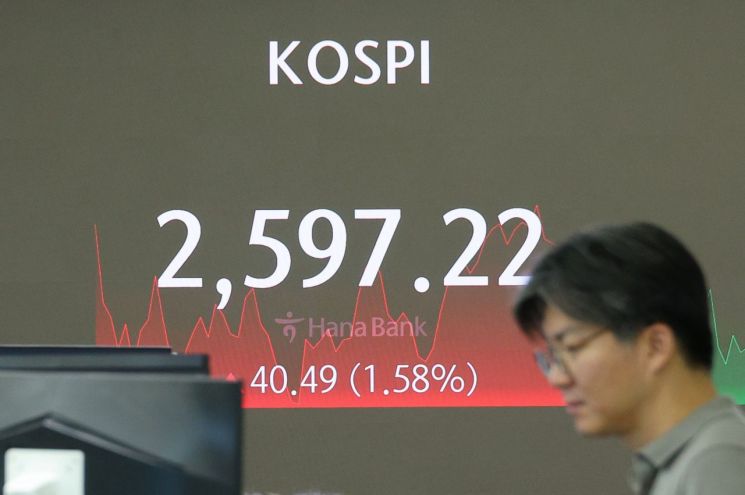
According to the 'International Finance and Foreign Exchange Market Trends after July 2024' released by the Bank of Korea on the 9th, the net inflow of foreign investment funds into domestic stocks last month amounted to $1.86 billion (approximately 3 trillion KRW). Compared to the previous month's $2.09 billion, the net inflow size slightly decreased. Foreigners have been net buyers of Korean stocks for nine consecutive months since November last year.
The Bank of Korea analyzed that the reason for the reduced net inflow was that although inflows were driven by expectations for the global semiconductor industry, external uncertainties increased due to U.S. semiconductor export restrictions on China in late July, along with continued profit-taking sales.
Last month, the net inflow of foreign investment funds into bonds was $380 million (approximately 522.6 billion KRW), maintaining a similar level to the previous month ($370 million). The Bank of Korea explained that despite some investors' profit-taking sales due to falling market interest rates, demand for medium- to long-term bond investments continued, resulting in a slight net inflow.
The total net inflow of foreign securities investment funds, combining stocks and bonds, was $2.24 billion (approximately 3 trillion KRW), maintaining a level similar to the previous month ($2.45 billion). Foreign securities investment funds have continued net inflows for nine consecutive months since November last year. The average monthly net inflow from November last year to last month reached $3.56 billion.
The credit default swap (CDS) premium for Korean government bonds (based on the 5-year Foreign Exchange Stabilization Fund bonds) averaged 36 basis points (1 bp = 0.01 percentage points) last month, remaining steady compared to the previous month. The Bank of Korea evaluated that the CDS premium for foreign exchange stabilization bonds has generally shown a stable trend.
The volatility of the won-dollar exchange rate slightly decreased. Last month, the won-dollar exchange rate volatility was 0.24%, slightly down from 0.26% in the previous month. The average daily fluctuation also narrowed to 3.3% from 3.5% in the previous month.
The Bank of Korea analyzed that last month, the won-dollar exchange rate initially declined due to the dovish stance of the U.S. Federal Open Market Committee (FOMC), but then stabilized as concerns over U.S. economic slowdown and Middle East instability worsened investor sentiment, reversing the decline. As of the end of last month, the won-dollar exchange rate was 1,376.5 KRW, steady compared to 1,376.8 KRW on the 7th.
Meanwhile, the average daily foreign exchange transaction volume in the domestic interbank market last month was $33.81 billion (approximately 46 trillion KRW), an increase of $1.15 billion compared to the previous month ($32.66 billion). The main factor was a $2.2 billion increase in spot foreign exchange transactions.
© The Asia Business Daily(www.asiae.co.kr). All rights reserved.
![Clutching a Stolen Dior Bag, Saying "I Hate Being Poor but Real"... The Grotesque Con of a "Human Knockoff" [Slate]](https://cwcontent.asiae.co.kr/asiaresize/183/2026021902243444107_1771435474.jpg)















