In Bangladesh, which has been thrown into turmoil by anti-government protests and the resignation of the prime minister, a caretaker government led by Nobel laureate Muhammad Yunus has been launched. It comes just three days after former Prime Minister Sheikh Hasina, who had been in power for a long time, was forced to resign by student protesters and fled abroad.
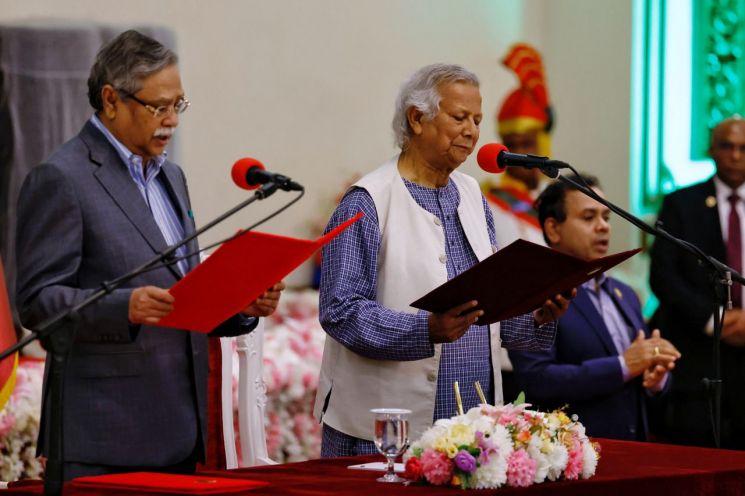
According to AFP and other sources on the 8th (local time), Yunus attended the inauguration ceremony of the caretaker government held at the presidential palace in the capital Dhaka the previous evening and took the oath of office, pledging to "uphold, defend, and protect the constitution."
Accordingly, Yunus, who is 84 years old this year, will take on the important role of chief advisor of the caretaker government, equivalent to the prime minister, to manage the political chaos and fairly oversee the upcoming general election. According to the constitution, the next general election must be held within 90 days from June 6, when the parliament was dissolved. Bangladesh, a parliamentary system, does not grant executive power to the president.
Along with Yunus, 16 other cabinet advisors, including those in ministerial roles, also attended the inauguration ceremony and took the oath of office. Among the advisors were two top leaders of the student groups who recently led the anti-government protests, as well as the well-known human rights activist Adilur Rahman Khan, who was sentenced to prison during Sheikh Hasina’s administration.
Yunus, who returned to the country just before the inauguration, expressed condolences to the victims of the protests aiming to protect democracy during a brief press conference at Dhaka airport, stating, "Bangladesh has created a new day of victory. We have gained a second independence." He also appealed to the public, saying, "Maintaining law and order is our first priority," and "Without restoring law and order, we cannot move forward even a single step."
Yunus emphasized, "What I want to say to the people is, if you trust me, please ensure that there are no attacks on anyone, anywhere," adding, "Everyone is our brother. Our mission is to protect them," and "All of Bangladesh is one big family."
Earlier, anti-government protests led mainly by university students spread after the Dhaka High Court decided to reinstate the public office quota system for children of independence heroes in June. Former Prime Minister Hasina responded with forceful suppression, leading to the worst violence in Bangladesh’s history. The death toll is estimated to be at least 455. Even after Hasina’s resignation on the 5th, arson, looting, and violence have continued in various places. Local reports also indicated that more than 200 prisoners escaped from prisons amid the chaos.
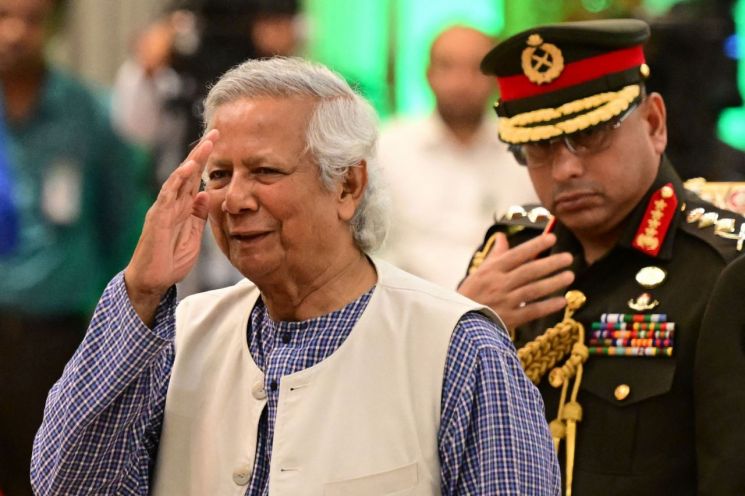
Yunus was appointed as the head of the caretaker government immediately after Hasina’s resignation, recommended by the student leadership who led the protests. As a poverty alleviation activist, he is known as the pioneer of so-called ‘microfinancing,’ providing unsecured small loans to the poor who had difficulty obtaining bank loans. For his efforts to help the poor, he was awarded the Nobel Peace Prize in 2006. However, in recent years, he spent a long time in court facing about 200 charges, including money laundering and bribery, filed against him and his colleagues. Locally, these charges were widely seen as politically motivated by the Hasina administration, which felt threatened by him.
Former Prime Minister Hasina, who resigned from her post, has fled to India. On the same day, her son Sajeeb Wazed Joy told Indian media in an interview, "My mother will return once democracy is restored in Bangladesh." Shortly after Yunus’s appointment as chief advisor, Indian Prime Minister Narendra Modi congratulated him via his X (formerly Twitter) account, mentioning the cooperative relationship between the two countries for peace, security, and development.
The United States, the European Union (EU), and others also expressed their readiness to cooperate with the caretaker government. Matthew Miller, spokesperson for the U.S. State Department, said that the U.S. hopes to "work together with Bangladesh for a democratic future."
© The Asia Business Daily(www.asiae.co.kr). All rights reserved.


















