Japanese Interest Rate Hike Triggers Yen Carry Trade Liquidation... Global Stock Markets Impacted
Yen Carry Trade Accumulates 690 Trillion... Recently 276 Trillion Liquidated
"This Is Just the Beginning of the End for Yen Carry Trade"
One of the backgrounds behind the "Black Monday on the 5th," which recorded the largest drop in the history of global stock markets, is the massive liquidation of yen carry trades caused by the Bank of Japan (BOJ)'s interest rate hike. Startled, the BOJ officially announced that "there will be no further rate hikes" and took steps to calm the market. However, some have pointed out that a second wave of liquidations may follow, raising concerns about lingering aftershocks.
According to major foreign media on the 7th (local time), the negative interest rate policy in Japan over the past three years has led to an explosive increase in "carry trades," a method of borrowing money from low-interest-rate countries to invest in assets of other countries with higher yields.
Investors raised funds in low-interest yen and invested in all profitable sectors, from emerging market currencies such as the Mexican peso to Taiwanese stocks, real estate, and U.S. technology stocks.
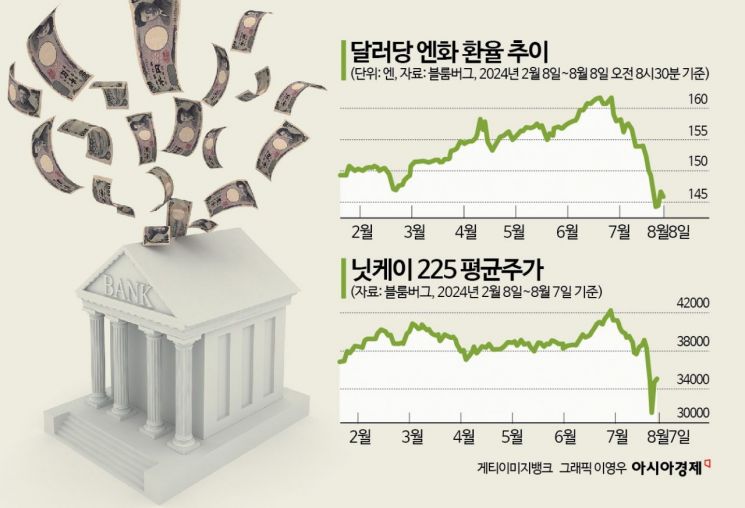
However, the BOJ implemented an additional rate hike on the 31st of last month, raising the policy rate from 0~0.1% to 0.25% after four months. Since then, the yen-dollar exchange rate, which was once weak at the 161-yen level per dollar earlier last month, has been moving around the 146-yen level. Due to the yen's appreciation, hedge funds and other investors had to unwind their yen carry trades.
As a result, on the 5th, the New York Stock Exchange saw the Dow Jones Industrial Average fall by 2.6%, the S&P 500 by 3%, and the Nasdaq Composite by 3.43%. The Nikkei 225, Japan's representative stock index, closed down 12.4% from the previous trading day, recording the largest drop in history, surpassing the Black Monday of October 1987. Although the New York stock market rebounded on the 6th, somewhat restoring investor sentiment, global unease remains. The Nikkei index started the trading day on the 8th down 2.2% from the previous day.
Analysts stated that all investors?from hedge funds, family offices, private capital to Japanese companies?engaged in yen carry trades, making it difficult to estimate the exact scale of the transactions. While hedge funds and short-term investors engaged in speculative bets by borrowing yen, the figures also include Japanese households and companies investing overseas with domestic funds.
James Malcolm, UBS Global Strategist, estimated that the cumulative size of the dollar-yen carry trade since 2011 is about $500 billion (approximately 690 trillion won), half of which expanded over the past two to three years. Malcolm said that $200 billion (about 276 trillion won) positions have been sold in recent weeks, which accounts for about three-quarters of the funds he predicted would ultimately be sold.
According to the Bank for International Settlements (BIS), yen borrowing overseas increased by $724 billion (approximately 998 trillion won) since the end of 2021. However, not all of this amount is yen carry trades. According to ING, overseas loans originating from Japan reached 157 trillion yen (about 1,483 trillion won) as of March 2024, a 21% increase compared to 2021.
According to Nihon Keizai Shimbun (Nikkei), on the previous day, BOJ Deputy Governor Shinichi Uchida stated, "We will not raise interest rates in an unstable financial capital market." This is seen as alleviating immediate concerns about a rate hike in September. However, the possibility of further rate hikes remains.
Some analysts and traders believe that most of the speculative investments using carry trades have been liquidated this time. Benjamin Shatil, JP Morgan Currency Strategist, said, "The reality of yen carry trades is that no one knows exactly how big it is or how much has been unwound now. But there is definitely a feeling that some of the most unstable yen short positions that financed speculative trades have been completely eliminated." However, he added, "There is still a long way to go," indicating the possibility of additional yen carry trade liquidations.
Osamu Takashima, currency analyst at Citibank, said, "The current adjustment is only the beginning of the end of the yen carry trade," predicting that the yen-dollar exchange rate will reach 129 yen in 2026 and 116 yen in 2027. If this happens, additional yen carry trade liquidations will follow.
© The Asia Business Daily(www.asiae.co.kr). All rights reserved.
![Clutching a Stolen Dior Bag, Saying "I Hate Being Poor but Real"... The Grotesque Con of a "Human Knockoff" [Slate]](https://cwcontent.asiae.co.kr/asiaresize/183/2026021902243444107_1771435474.jpg)











