Experts, "Slow Charger Charging Limit Function Needed
Battery Real-Name System Should Be Introduced for Consumer Choice"
BMS Enhancement to Send Warnings in Case of Vehicle Abnormalities
Battery Technology Development Needed to Delay Thermal Runaway
Government to Hold Electric Vehicle Battery Inter-Ministerial Meeting on 12th
As electric vehicle fire incidents continue to occur, the possibility of introducing a battery real-name system for vehicles is gaining traction. Following the so-called "chasm," which refers to a temporary stagnation in demand, the emergence of an "electric vehicle phobia" phenomenon could escalate into a major adverse factor, prompting authorities to focus all efforts on alleviating concerns.
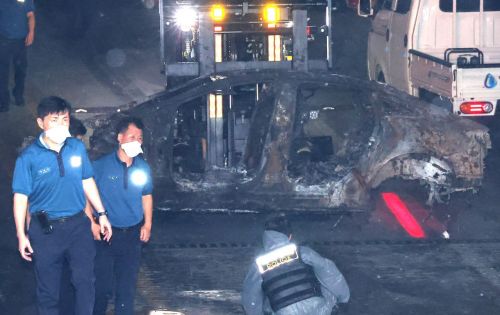 On the afternoon of the 5th, police who completed a joint inspection at the underground parking lot fire scene of an apartment in Cheongna-dong, Seo-gu, Incheon, are moving the electric vehicle where the fire occurred.
 [Image source=Yonhap News]
Government Formulating ‘Comprehensive Safety Measures for Electric Vehicle Fires’
According to related ministries on the 8th, the government will soon announce comprehensive safety measures for electric vehicle fires. A government official stated, "The Ministry of Environment is leading the effort, with the Ministry of Land, Infrastructure and Transport, Ministry of Trade, Industry and Energy, and the National Fire Agency jointly formulating safety measures related to electric vehicle fires."
The most likely measure is the introduction of a real-name system for electric vehicle batteries. Initially, it was reported that the accident vehicle was equipped with a nickel-cobalt-manganese (NCM) 811 battery manufactured by China's CATL, but it was later confirmed that the battery was actually from China's Parasys. Generally, Chinese NCM battery technology is considered to lag behind that of Korea. In particular, Parasys is ranked outside the top 10 among global battery companies and is a latecomer even within China.
Until now, automobile manufacturers have not officially disclosed which batteries are installed in electric vehicles. This has been criticized for limiting consumers' right to know and their choice. Just as the type of engine is an important consideration when purchasing an internal combustion engine vehicle, the battery can be a very important criterion in electric vehicles as well.
Professor Lee Hogun of Daeduk University pointed out, "Following this accident, manufacturers need to specify what type of battery is installed on the battery registration certificate." In addition, the battery industry is calling for the introduction of a separate battery registration system. Kim Seungtae, Policy Support Director of the Korea Battery Industry Association, said, "We need to implement a battery separate registration system that can separate the ownership of the vehicle and the battery, creating an environment where various business models can emerge."
Besides this, the government is expected to include contents such as electric vehicle charging facility safety, battery safety standards, fire safety facilities in multi-family housing, and battery technology research and development (R&D). In particular, there are calls for improvements to electric vehicle charging systems in multi-family housing such as apartments. Electric vehicles are vulnerable to fire when the battery is overcharged. In the case of fast chargers, they are equipped with devices that communicate with the vehicle during charging and cut off charging when the battery reaches 80-90% or more. Hyundai Motor Company also slows down the charging speed when charging exceeds 80% to prevent overcharging.
However, most slow chargers installed in residential facilities such as apartments lack such devices, so current continues to flow as long as the vehicle is connected to the charger. Professor Lee Hogun of Daeduk University explained, "Charging below 80% can prevent battery fires caused by dendrites (crystals formed by lithium accumulating on the anode) by more than 99%."
The government currently provides an additional subsidy of 400,000 KRW per slow charger equipped with overcharge prevention devices. However, the 310,000 slow chargers previously distributed are lacking such devices. Professor Kim Pilsoo of Daelim University pointed out, "Measures are needed to prevent overcharging even for existing slow chargers." A Ministry of Environment official said, "We are reviewing ways to improve subsidies to strengthen the safety of electric vehicle chargers."
‘Electric Vehicle Battery Safety Certification System’ to be Introduced in February Next Year
The Ministry of Land, Infrastructure and Transport plans to introduce an ‘Electric Vehicle Battery Safety Certification System’ in February next year. Manufacturers will have to obtain certification from the Minister of Land, Infrastructure and Transport confirming that the electric vehicle battery meets safety standards before manufacturing and selling.
Technologies to prevent electric vehicle fires also need to be enhanced. A representative example is the Battery Management System (BMS) installed in vehicles. BMS refers to a device that measures and manages battery current, voltage, temperature, etc., through sensors. It also automatically cuts off electricity when the battery is overcharged. Experts advise improving the BMS functions to develop a system that can send warning messages to the vehicle owner or fire authorities if abnormal signs are detected even when the vehicle is turned off.
There are also calls for battery manufacturers to proactively develop thermal runaway delay technology. Thermal runaway delay refers to slowing the time it takes for a fire to spread from one battery cell to others after an explosion occurs in a specific battery cell. Currently, the automotive industry applies a 5-minute delay time from thermal runaway to heat transfer according to the UN-GTR (Global Technology Regulation) recommendation established in 2018. The UN-GTR is expected to require a strengthened delay time of 15 to 30 minutes in the upcoming second-phase recommendation. Accordingly, domestic electric vehicle and battery companies urgently need to adopt technologies that can delay thermal runaway in electric vehicles.
Although electric vehicle fires also occur overseas, the risk is particularly heightened in Korea due to the prevalence of underground parking lots in residential areas. Accordingly, some argue that electric vehicle chargers or parking lots should be separately installed above ground, but immediate implementation seems difficult. A Ministry of Environment official emphasized, "The charger itself is not a direct cause of fire."
© The Asia Business Daily(www.asiae.co.kr). All rights reserved.
![Clutching a Stolen Dior Bag, Saying "I Hate Being Poor but Real"... The Grotesque Con of a "Human Knockoff" [Slate]](https://cwcontent.asiae.co.kr/asiaresize/183/2026021902243444107_1771435474.jpg)
















