Kim Sang-hoon "Will Collaborate on Bills Suitable for Consensus"
Jin Sung-jun "Hopes for Swift Passage of Common Legislation"
Heatwave Measures and Nursing Act Bills Gain Momentum
250,000 Won Support Fund and Financial Investment Tax Still Controversial
As the 22nd National Assembly continues its extreme confrontation due to political strife, the policy chiefs of the ruling and opposition parties met for the first time in 70 days since the opening of the session to begin discussions on livelihood legislation. This came as a consensus formed that the processing of economic and livelihood bills, which had been delayed due to the intense confrontation between the parties, could no longer be postponed. In political circles, there are also voices hoping that by discussing bills with fewer disagreements between the parties first, the tense situation in the National Assembly will thaw.
Kim Sang-hoon, the Policy Chief of the People Power Party, visited Jin Sung-jun, the Policy Chief of the Democratic Party of Korea, at the National Assembly at 10:30 a.m. that day. This meeting took place amid a situation where, since the start of the 22nd National Assembly, special investigations, impeachments, filibusters, and committee disruptions have been repeated for over two months, causing the processing of livelihood bills to come to a standstill.
Chairman Kim said, "If there are bills that both parties can accept and agree to process, I will support handling them in the National Assembly," adding, "There is a growing expectation that the National Assembly should take a more active role in caring for the people and their livelihoods. I will work closely with Chairman Jin going forward." Chairman Jin responded, "There are about 80 common pledges made by both parties during the last general election. Looking at the 31 bills adopted as party policies by the People Power Party to be prioritized in the 22nd National Assembly, there are quite a few bills with few disagreements," and added, "I hope that this meeting will serve as a starting point for the leadership of both parties to regularly meet through their policy chiefs and swiftly advance common legislation."
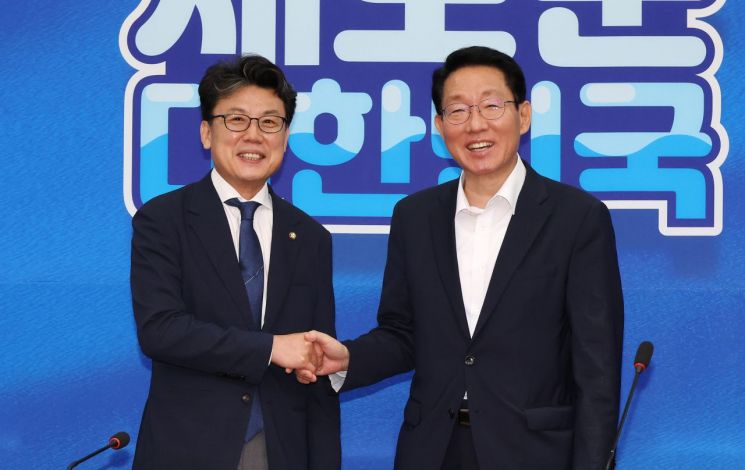
Due to the ongoing heatwave, urgent measures to reduce and support electricity bills for vulnerable groups during the hot season are being considered as a priority. Additionally, there is a possibility of discussions on bills with fewer disagreements, such as the Nursing Act, the Special Act on Jeonse Fraud, the Special Act on High-Level Radioactive Waste Management, the Civil Code Amendment (Gu Hara Act), and the Tax Incentives Limitation Act Amendment (K-Chips Act). Chairman Kim stated, "I believe we can discuss the Act on Industrial Cluster Activation and Factory Establishment and the Act on Promotion of Win-Win Cooperation among Large, Medium, and Small Enterprises together," and mentioned, "We can also sufficiently discuss extending parental leave periods for dual-income couples, improving care services, balanced regional economic development, and revitalizing the supply of rental housing." Furthermore, follow-up measures and prevention plans regarding the unpaid settlement funds incident involving TMON and WEMAKEPRICE (TMEP) are also expected to be discussed.
In particular, the Nursing Act amendment, which includes institutionalizing the scope of work for Physician Assistant (PA) nurses, and the Gu Hara Act are expected to gain momentum soon as there are almost no disagreements between the parties. After the meeting with Chairman Kim, Chairman Jin explained to reporters regarding the Nursing Act, "We confirmed that there are no major disagreements between the parties, so we agreed to coordinate the minor issues and expedite the process." Chairman Kim also mentioned, "Regarding the PA nurse system, we will coordinate through consultations between Chairman Jin and the working-level staff." Regarding the Gu Hara Act, Chairman Jin said, "It was not stalled due to opposition but because of the situation in the 21st National Assembly. The Legislation and Judiciary Committee could not be properly convened at that time, so despite no disagreements between the parties, it was not processed. We will review it further at the working level."
There is growing anticipation in political circles that discussions on livelihood bills will intensify starting with this meeting. A first-term lawmaker said, "For the past 70 days, livelihood bills have not been processed due to prolonged political strife, leading to a sense of helplessness, so it is fortunate that the policy chiefs of both parties are now meeting to discuss livelihood legislation," adding, "I hope this meeting will create an atmosphere of cooperation on livelihood legislation and that politics will provide a sense of efficacy to the people."
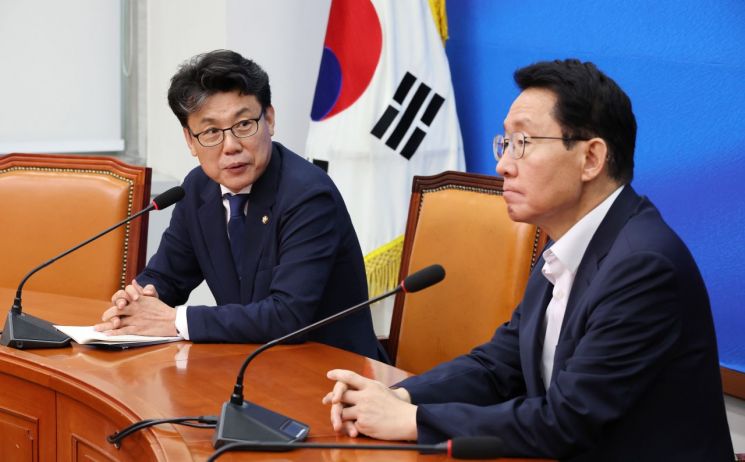
Meanwhile, no consensus was reached on the Special Measures Act for Livelihood Recovery Support Payments (the 250,000 won support law), which President Yoon Suk-yeol is likely to veto, and the repeal of the Financial Investment Income Tax (Capital Gains Tax) law, which the opposition party opposes. After the meeting of the policy chiefs, Chairman Kim responded to a reporter's question asking, "You mentioned that internal consultations are needed regarding the 250,000 won law. Does this mean there is room for changing opposition?" by saying, "It is unlikely that there will be a fundamental change in position, but I will consult with the floor leader about the meeting results," and explained, "There was a 56 trillion won tax revenue shortfall last year, so overall, the fiscal situation is not easy to accommodate."
Regarding the Capital Gains Tax, Chairman Jin said, "Chairman Kim asked us to clarify our position, and we plan to do so. I conveyed that even if partial supplements are made to address public concerns, the implementation should proceed as scheduled," adding, "When asked if discussions on the Capital Gains Tax will take place within the party after the next Democratic Party leader is elected, I said, 'Of course, they will.'"
© The Asia Business Daily(www.asiae.co.kr). All rights reserved.
![Clutching a Stolen Dior Bag, Saying "I Hate Being Poor but Real"... The Grotesque Con of a "Human Knockoff" [Slate]](https://cwcontent.asiae.co.kr/asiaresize/183/2026021902243444107_1771435474.jpg)
















