Securities Market Q3 Dollar-Yen Exchange Rate Outlook
Downgrade from 150 Yen to 140 Yen Range
Some Confident Views on Limited Further Rise
 [Image source=Yonhap News]
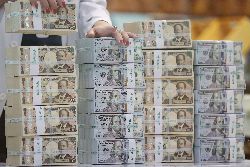
Amid the strong Japanese yen being cited as one of the factors behind the "Black Monday," securities firms have lowered their third-quarter yen-dollar exchange rate forecasts from the previous 150 yen to the low 140s. As the Japanese government moves to curb the yen's depreciation and concerns about a U.S. economic recession coincide, short-term volatility expansion has become inevitable.
According to Woori Bank on the 7th, the yen-dollar exchange rate recorded 144.18 yen on the 6th. The exchange rate surged to a maximum of 161.65 yen in early July but steadily declined afterward, falling more than 10% in just over a month. The decline in the exchange rate means an appreciation of the yen's value.
The recent sharp rise in the yen's value stemmed from the Bank of Japan's (BOJ) early rate hike decision at the July Monetary Policy Meeting (MPM) and Governor Ueda's hawkish remarks. The BOJ left open the possibility of additional hikes within the year and stated that it does not view the hike limit as 0.50%. At the same time, the unwinding of yen carry trades in the global market is also believed to have accelerated the pace of yen appreciation. Yen carry trade involves investors borrowing funds in low-interest-rate currencies like the Japanese yen and reinvesting them in assets offering higher returns. Another cause was the dollar weakening after the July U.S. employment report released on the 2nd (local time) showed a deterioration. This fueled expectations that the U.S. Federal Reserve (Fed) would implement rate cuts.
Investor anxiety in the stock market has also increased. If the yen appreciates, the possibility of unwinding yen carry trades, which benefited from the "super yen depreciation" boom, also grows. The Korea Exchange cited concerns over yen carry trade capital outflows as one of the reasons for triggering circuit breakers in the KOSPI and KOSDAQ markets on the 5th. Circuit breakers are measures that temporarily halt market trading for 20 minutes to reduce volatility. On the 5th, the KOSPI index recorded a decline in the 8% range, and the KOSDAQ index fell by about 11%. The Japanese Nikkei 225 index even recorded a drop of around 12%.
In the securities industry, the yen's strength, which recently exceeded expectations, led to revisions in the dollar-yen exchange rate forecasts. Korea Investment & Securities lowered its third-quarter forecast from 155 yen in July to 147 yen on the 6th. Moon Da-woon, a researcher at Korea Investment & Securities, said, "We are lowering the baseline due to recent dollar weakness and rapid unwinding of yen short positions." Eugene Investment & Securities, which had initially expected the yen-dollar exchange rate to be around 150 yen within the year earlier this month, also revised its forecast to between 140 and 145 yen. Lee Jung-hoon, a researcher at Eugene Investment & Securities, explained, "It was beyond expectations. However, we believe that since a lot of the yen appreciation has already occurred, the pace will calm down somewhat."
The market has reached a consensus that volatility within the financial market has increased. Kwon Ah-min, a researcher at NH Investment & Securities, said, "It is a situation where significant U.S. economic and interest rate-related volatility has expanded, making it difficult to view this solely as an issue unique to the yen due to BOJ policy normalization." He added, "For the time being, the possibility of yen carry trade unwinding linked with increased U.S. Treasury yield volatility is highly likely to stimulate further declines in the yen-dollar exchange rate."
However, some voices expressed confidence that the additional appreciation would be limited. Park Sang-hyun, chief economist at Hi Investment & Securities, said, "The Japanese government and BOJ have so far succeeded in resolving the excessive concentration caused by the super yen depreciation phenomenon." He pointed out, "A sharp additional appreciation of the yen at the current level is likely to have an adverse effect on the Japanese economy and stock market, so the Japanese government will face significant pressure ahead of the Liberal Democratic Party election in September." He also emphasized the need to note that a considerable portion of the yen depreciation positions, which had been excessively concentrated due to the recent yen weakness, has been cleared.
Meanwhile, in the market, the yuan's value rose amid expectations that China would benefit from the yen carry trade unwinding caused by the yen's strength. Min Kyung-won, an economist at Woori Bank, explained, "The yuan showed a concurrent strengthening linked to the sharp rise in the yen," adding, "The outlook that overseas capital will flow into China due to yen carry trade unwinding and U.S. rate cuts remains valid."
© The Asia Business Daily(www.asiae.co.kr). All rights reserved.
![Clutching a Stolen Dior Bag, Saying "I Hate Being Poor but Real"... The Grotesque Con of a "Human Knockoff" [Slate]](https://cwcontent.asiae.co.kr/asiaresize/183/2026021902243444107_1771435474.jpg)















