Mayor Lee Jangwoo Announces Customized Care Support Plan
Mandatory Parenting Time for Parents with Young Children... New 'Infertility Companion Leave' for Male Public Officials
Expanded Overtime Pay and Vacation Points for Substitute Workers
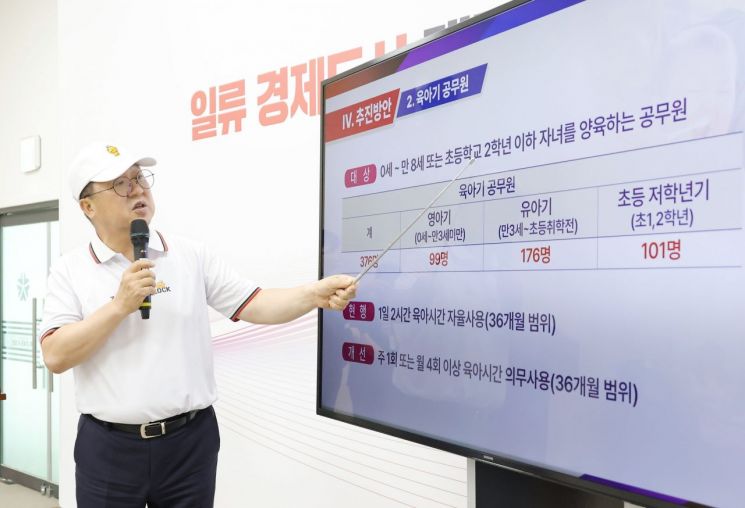 Lee Jangwoo, mayor of Daejeon, is briefing the customized care support operation plan on the 6th. / Daejeon City
Starting this August, Daejeon City public officials will be required to work from home once a week and take mandatory childcare time, divided into pregnancy, childcare, and childhood periods.
On the afternoon of the 6th, Daejeon Mayor Lee Jangwoo announced this customized care support operation plan during a city administration briefing.
Accordingly, pregnant public officials will be required to work from home once a week. Maternity protection time, which can be used for two hours a day, must also be mandatorily used without concern for colleagues or supervisors.
Public officials with children from newborns to second grade in elementary school will also be required to use some childcare time, mandating at least once a week or four times a month for childcare purposes.
Public officials with children from third to sixth grade in elementary school can use one hour of childcare time within a limit of 36 months. The city has determined that there is currently no childcare support system for officials with children in this age group, resulting in care gaps. To address this and help employees balance work and family, the city plans to revise the 'Daejeon City Local Public Officials Service Ordinance' to secure childcare and care time for employees.
Special leave for pregnancy and infertility will also be introduced. Through the revision of the service ordinance, the city will supplement the existing female-centered infertility support system by creating 'infertility companion leave' for male public officials so they can accompany their spouses during infertility treatments, granting the same number of leave days as female officials.
Additionally, a special leave of up to five days will be established for male public officials so they can actively participate in care and parenting from their spouse's pregnancy, allowing them to accompany their pregnant spouse to regular checkups and other appointments.
Compensation will also be provided to employees who cover the duties of those on maternity protection or childcare time. The monthly cap for overtime pay for such substitute employees will be increased from 48 hours to 57 hours.
In particular, for employees working at civil service counters such as the Communication Civil Affairs Division or the Vehicle Registration Office, if they use maternity protection or childcare time, the substitute's time will be accumulated like mileage and awarded up to 300,000 won in vacation points every six months.
Mayor Lee Jangwoo emphasized, "Responding to the population issue is a matter of national fate for Korea," and added, "Low birth rates are now the most critical issue facing our country, and Daejeon City is making every effort to address the population crisis with the determination to respond to a national disaster."
He continued, "We will first implement childbirth and childcare support systems within the public sector to minimize care gaps, and then improve and expand these measures to the private sector as well."
Meanwhile, in a survey conducted by Daejeon City from June 24 to July 5 among all employees to prepare for the customized care support work system, the most needed policies for work-family balance were mandatory use of childcare or maternity protection time (31.6%) and a four-day workweek with one day of telecommuting or leave (29.3%).
On the other hand, 38.6% of employees responded that they were not able to freely use childcare or maternity protection time, and the biggest obstacle to introducing a four-day workweek was increased workload for colleagues (62.9%).
© The Asia Business Daily(www.asiae.co.kr). All rights reserved.
![Clutching a Stolen Dior Bag, Saying "I Hate Being Poor but Real"... The Grotesque Con of a "Human Knockoff" [Slate]](https://cwcontent.asiae.co.kr/asiaresize/183/2026021902243444107_1771435474.jpg)
















